

420
E. A. Koblova et al.
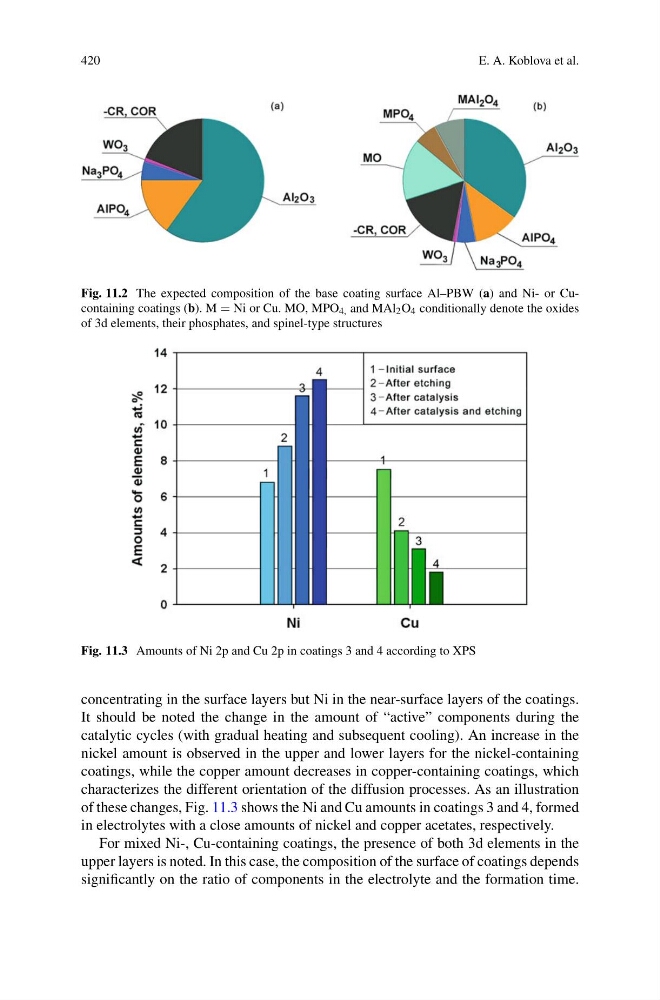
Fig. 11.2 The expected composition of the base coating surface Al–PBW (a) and Ni- or Cucontaining coatings (b). M = Ni or Cu. MO, MPO 4, and MAl 2 O 4 conditionally denote the oxides
of 3d elements, their phosphates, and spinel-type structures
Fig. 11.3 Amounts of Ni 2p and Cu 2p in coatings 3 and 4 according to XPS
concentrating in the surface layers but Ni in the near-surface layers of the coatings.
It should be noted the change in the amount of “active” components during the
catalytic cycles (with gradual heating and subsequent cooling). An increase in the
nickel amount is observed in the upper and lower layers for the nickel-containing
coatings, while the copper amount decreases in copper-containing coatings, which
characterizes the different orientation of the diffusion processes. As an illustration
of these changes, Fig. 11.3 shows the Ni and Cu amounts in coatings 3 and 4, formed
in electrolytes with a close amounts of nickel and copper acetates, respectively.
For mixed Ni-, Cu-containing coatings, the presence of both 3d elements in the
upper layers is noted. In this case, the composition of the surface of coatings depends
significantly on the ratio of components in the electrolyte and the formation time.
E. A. Koblova et al.
Fig. 11.2 The expected composition of the base coating surface Al–PBW (a) and Ni- or Cucontaining coatings (b). M = Ni or Cu. MO, MPO 4, and MAl 2 O 4 conditionally denote the oxides
of 3d elements, their phosphates, and spinel-type structures
Fig. 11.3 Amounts of Ni 2p and Cu 2p in coatings 3 and 4 according to XPS
concentrating in the surface layers but Ni in the near-surface layers of the coatings.
It should be noted the change in the amount of “active” components during the
catalytic cycles (with gradual heating and subsequent cooling). An increase in the
nickel amount is observed in the upper and lower layers for the nickel-containing
coatings, while the copper amount decreases in copper-containing coatings, which
characterizes the different orientation of the diffusion processes. As an illustration
of these changes, Fig. 11.3 shows the Ni and Cu amounts in coatings 3 and 4, formed
in electrolytes with a close amounts of nickel and copper acetates, respectively.
For mixed Ni-, Cu-containing coatings, the presence of both 3d elements in the
upper layers is noted. In this case, the composition of the surface of coatings depends
significantly on the ratio of components in the electrolyte and the formation time.