

10 New Na + Superionic Conductor Narpsio Glass-Ceramics
385
al. on the family of N5-type materials by substituting Y with Er, Gd, or Sm [8].
However, their results were not completely satisfactory because of the relatively
lower conductivities of σ 300 < 2 × 10 −2 S/cm than the reported values of N5 [8].
This discrepancy may possibly have arisen from the occurrence of a less conductive
metastable phase during crystallization [9], as discussed below.
Contrary to the results of Banks et al., we obtained glass-ceramics where
σ 300 = 1 × 10 −1 S/cm and E a = 20 kJ/mol [10]; these compounds were based on
the phosphorus-containing N5-type materials discovered in the Na 2 O-Y 2 O 3 -P 2 O 5 -
SiO 2 system [10]. These N5-type materials, in addition to Na 3 YSi 3 O 9 (N3)-type
materials [11–13], were obtained with the composition formula originally derived
for N3-type solid solutions and expressed as follows [14]:
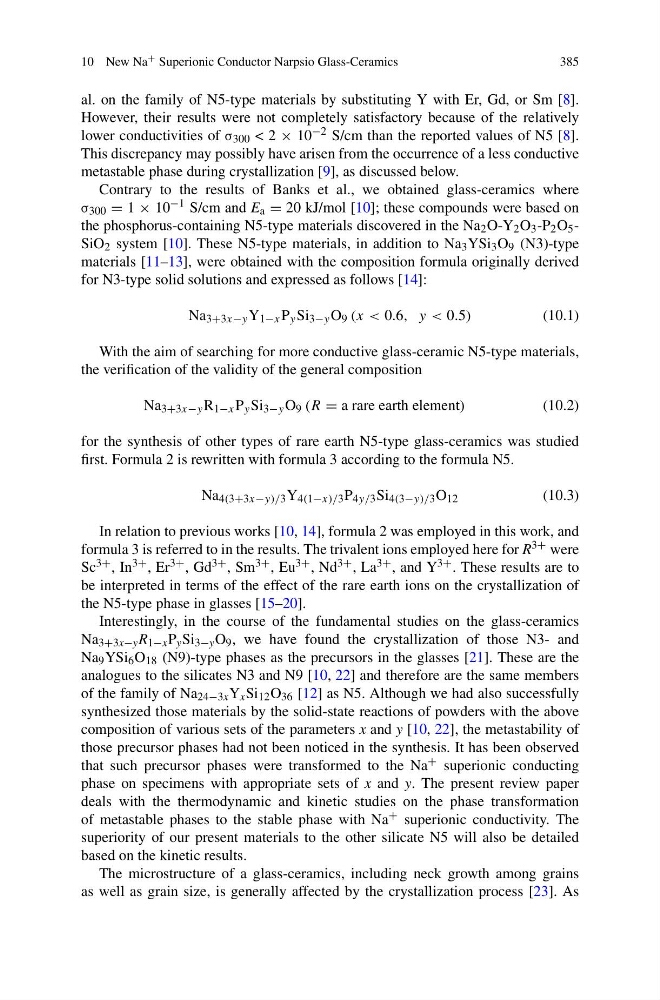
Na 3+3x−y Y 1−x P y Si 3−y O 9 (x < 0.6, y < 0.5)
(10.1)
With the aim of searching for more conductive glass-ceramic N5-type materials,
the verification of the validity of the general composition
Na 3+3x−y R 1−x P y Si 3−y O 9 (R = a rare earth element)
(10.2)
for the synthesis of other types of rare earth N5-type glass-ceramics was studied
first. Formula 2 is rewritten with formula 3 according to the formula N5.
Na 4(3+3x−y)/3 Y 4(1−x)/3 P 4y/3 Si 4(3−y)/3 O 12
(10.3)
In relation to previous works [10, 14], formula 2 was employed in this work, and
formula 3 is referred to in the results. The trivalent ions employed here for R 3+ were
Sc 3+ , In 3+ , Er 3+ , Gd 3+ , Sm 3+ , Eu 3+ , Nd 3+ , La 3+ , and Y 3+ . These results are to
be interpreted in terms of the effect of the rare earth ions on the crystallization of
the N5-type phase in glasses [15–20].
Interestingly, in the course of the fundamental studies on the glass-ceramics
Na 3+3x−y R 1−x P y Si 3−y O 9 , we have found the crystallization of those N3- and
Na 9 YSi 6 O 18 (N9)-type phases as the precursors in the glasses [21]. These are the
analogues to the silicates N3 and N9 [10, 22] and therefore are the same members
of the family of Na 24−3x Y x Si 12 O 36 [12] as N5. Although we had also successfully
synthesized those materials by the solid-state reactions of powders with the above
composition of various sets of the parameters x and y [10, 22], the metastability of
those precursor phases had not been noticed in the synthesis. It has been observed
that such precursor phases were transformed to the Na + superionic conducting
phase on specimens with appropriate sets of x and y. The present review paper
deals with the thermodynamic and kinetic studies on the phase transformation
of metastable phases to the stable phase with Na + superionic conductivity. The
superiority of our present materials to the other silicate N5 will also be detailed
based on the kinetic results.
The microstructure of a glass-ceramics, including neck growth among grains
as well as grain size, is generally affected by the crystallization process [23]. As
385
al. on the family of N5-type materials by substituting Y with Er, Gd, or Sm [8].
However, their results were not completely satisfactory because of the relatively
lower conductivities of σ 300 < 2 × 10 −2 S/cm than the reported values of N5 [8].
This discrepancy may possibly have arisen from the occurrence of a less conductive
metastable phase during crystallization [9], as discussed below.
Contrary to the results of Banks et al., we obtained glass-ceramics where
σ 300 = 1 × 10 −1 S/cm and E a = 20 kJ/mol [10]; these compounds were based on
the phosphorus-containing N5-type materials discovered in the Na 2 O-Y 2 O 3 -P 2 O 5 -
SiO 2 system [10]. These N5-type materials, in addition to Na 3 YSi 3 O 9 (N3)-type
materials [11–13], were obtained with the composition formula originally derived
for N3-type solid solutions and expressed as follows [14]:
Na 3+3x−y Y 1−x P y Si 3−y O 9 (x < 0.6, y < 0.5)
(10.1)
With the aim of searching for more conductive glass-ceramic N5-type materials,
the verification of the validity of the general composition
Na 3+3x−y R 1−x P y Si 3−y O 9 (R = a rare earth element)
(10.2)
for the synthesis of other types of rare earth N5-type glass-ceramics was studied
first. Formula 2 is rewritten with formula 3 according to the formula N5.
Na 4(3+3x−y)/3 Y 4(1−x)/3 P 4y/3 Si 4(3−y)/3 O 12
(10.3)
In relation to previous works [10, 14], formula 2 was employed in this work, and
formula 3 is referred to in the results. The trivalent ions employed here for R 3+ were
Sc 3+ , In 3+ , Er 3+ , Gd 3+ , Sm 3+ , Eu 3+ , Nd 3+ , La 3+ , and Y 3+ . These results are to
be interpreted in terms of the effect of the rare earth ions on the crystallization of
the N5-type phase in glasses [15–20].
Interestingly, in the course of the fundamental studies on the glass-ceramics
Na 3+3x−y R 1−x P y Si 3−y O 9 , we have found the crystallization of those N3- and
Na 9 YSi 6 O 18 (N9)-type phases as the precursors in the glasses [21]. These are the
analogues to the silicates N3 and N9 [10, 22] and therefore are the same members
of the family of Na 24−3x Y x Si 12 O 36 [12] as N5. Although we had also successfully
synthesized those materials by the solid-state reactions of powders with the above
composition of various sets of the parameters x and y [10, 22], the metastability of
those precursor phases had not been noticed in the synthesis. It has been observed
that such precursor phases were transformed to the Na + superionic conducting
phase on specimens with appropriate sets of x and y. The present review paper
deals with the thermodynamic and kinetic studies on the phase transformation
of metastable phases to the stable phase with Na + superionic conductivity. The
superiority of our present materials to the other silicate N5 will also be detailed
based on the kinetic results.
The microstructure of a glass-ceramics, including neck growth among grains
as well as grain size, is generally affected by the crystallization process [23]. As