

384
T. Okura and K. Yamashita
discussed in the context of the ionic conductivity of these N5-type glass-ceramics. In
addition, results on the improvement in superconductivity by Na + ion implantation
and control of the structure by bias crystallization of glasses in an electric field are
presented.
Keywords Superionic conductor · Glass-ceramics · Crystallization ·
Microstructure · Ion implantation · Bias crystallization
10.1 Introduction
The use of glass-making processing is favorablefor the fabrication of Na + conducting electrolyte tubes, which has been the key to the technological development of
1 MW Na/S secondary battery plants. However, the processing technique cannot
be applied to well-known β- and β-aluminas (e.g., NaAl 11 O 17 and NaAl 5 O 8 ) and
Nasicons (Na 1+x Zr 2 P 3−x Si x O 12 ) because their high inclusion of Al 2 O 3 or ZrO 2
brings about the inhomogeneous melting or crystallization of glasses. Alternatively,
Nasicon-like glass-ceramics were synthesized using a composition with lower
content of ZrO 2 (mNa 2 O·xZrO 2 ·yP 2 O 5 ·(100−m−x−y)SiO 2 [m = 20, 30 mol %]).
However, the conductivities (σ) attained were, at most, as high as σ 300 = 2 × 10 −2
S/cm at 300 ◦ C with the activation energies (E a ) of ca. 30 kJ/mol [1]. These
low conductivities were attributed to the crystallization of the poorly conductive
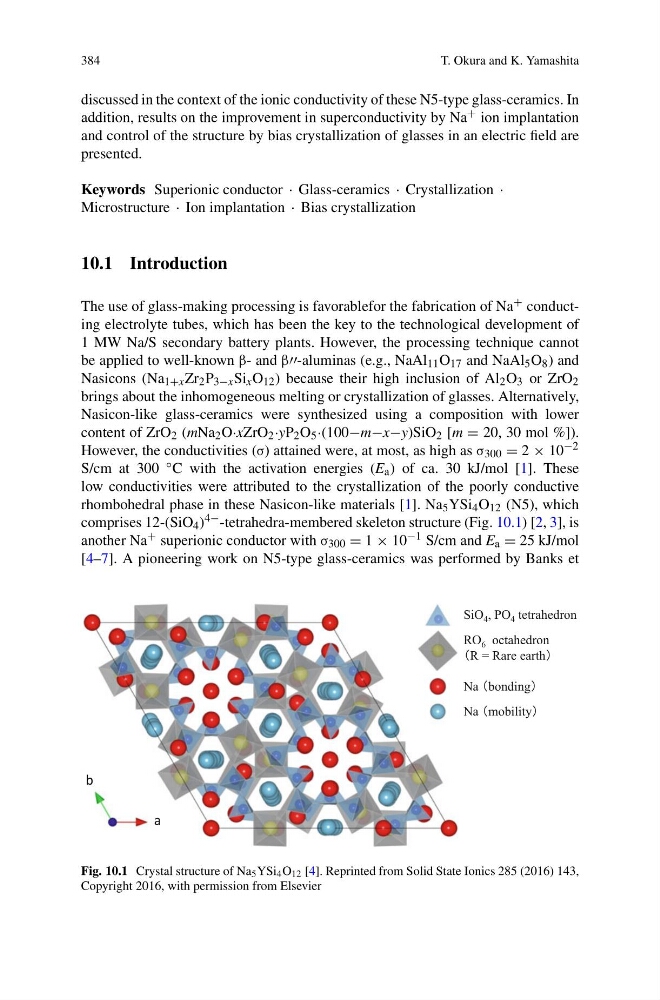
rhombohedral phase in these Nasicon-like materials [1]. Na 5 YSi 4 O 12 (N5), which
comprises 12-(SiO 4 ) 4− -tetrahedra-membered skeleton structure (Fig. 10.1) [2, 3], is
another Na + superionic conductor with σ 300 = 1 × 10 −1 S/cm and E a = 25 kJ/mol
[4–7]. A pioneering work on N5-type glass-ceramics was performed by Banks et
a
b
RO 6 octahedron
䠄R = Rare earth䠅
Na 䠄bonding䠅
Na 䠄mobility䠅
SiO 4 , PO 4 tetrahedron
Fig. 10.1 Crystal structure of Na 5 YSi 4 O 12 [4]. Reprinted from Solid State Ionics 285 (2016) 143,
Copyright 2016, with permission from Elsevier
T. Okura and K. Yamashita
discussed in the context of the ionic conductivity of these N5-type glass-ceramics. In
addition, results on the improvement in superconductivity by Na + ion implantation
and control of the structure by bias crystallization of glasses in an electric field are
presented.
Keywords Superionic conductor · Glass-ceramics · Crystallization ·
Microstructure · Ion implantation · Bias crystallization
10.1 Introduction
The use of glass-making processing is favorablefor the fabrication of Na + conducting electrolyte tubes, which has been the key to the technological development of
1 MW Na/S secondary battery plants. However, the processing technique cannot
be applied to well-known β- and β-aluminas (e.g., NaAl 11 O 17 and NaAl 5 O 8 ) and
Nasicons (Na 1+x Zr 2 P 3−x Si x O 12 ) because their high inclusion of Al 2 O 3 or ZrO 2
brings about the inhomogeneous melting or crystallization of glasses. Alternatively,
Nasicon-like glass-ceramics were synthesized using a composition with lower
content of ZrO 2 (mNa 2 O·xZrO 2 ·yP 2 O 5 ·(100−m−x−y)SiO 2 [m = 20, 30 mol %]).
However, the conductivities (σ) attained were, at most, as high as σ 300 = 2 × 10 −2
S/cm at 300 ◦ C with the activation energies (E a ) of ca. 30 kJ/mol [1]. These
low conductivities were attributed to the crystallization of the poorly conductive
rhombohedral phase in these Nasicon-like materials [1]. Na 5 YSi 4 O 12 (N5), which
comprises 12-(SiO 4 ) 4− -tetrahedra-membered skeleton structure (Fig. 10.1) [2, 3], is
another Na + superionic conductor with σ 300 = 1 × 10 −1 S/cm and E a = 25 kJ/mol
[4–7]. A pioneering work on N5-type glass-ceramics was performed by Banks et
a
b
RO 6 octahedron
䠄R = Rare earth䠅
Na 䠄bonding䠅
Na 䠄mobility䠅
SiO 4 , PO 4 tetrahedron
Fig. 10.1 Crystal structure of Na 5 YSi 4 O 12 [4]. Reprinted from Solid State Ionics 285 (2016) 143,
Copyright 2016, with permission from Elsevier