

362
Y. Kobayashi and H. Kobayashi
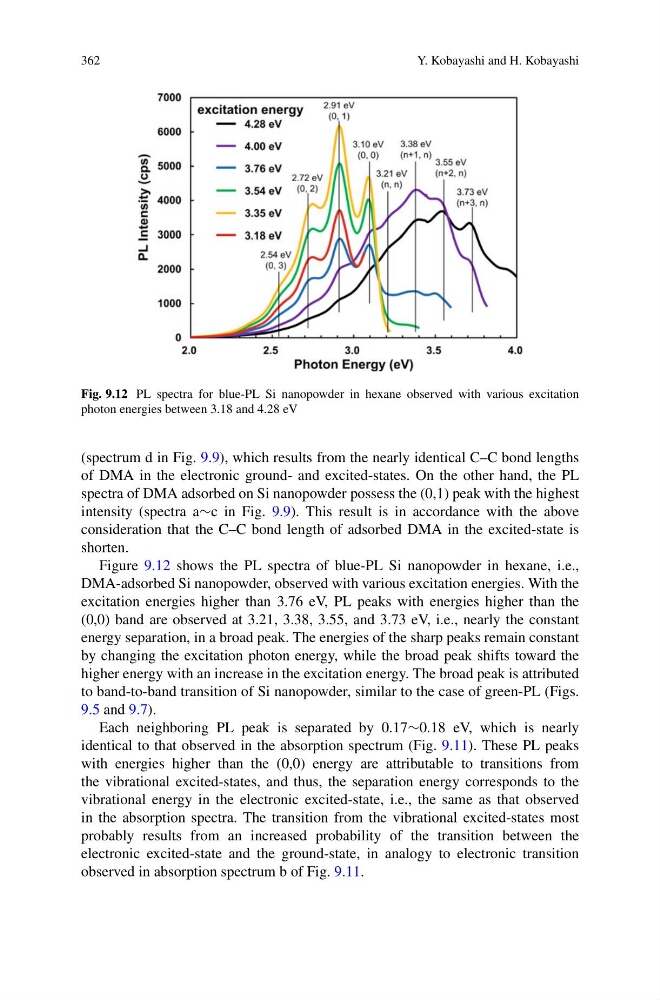
Fig. 9.12 PL spectra for blue-PL Si nanopowder in hexane observed with various excitation
photon energies between 3.18 and 4.28 eV
(spectrum d in Fig. 9.9), which results from the nearly identical C–C bond lengths
of DMA in the electronic ground- and excited-states. On the other hand, the PL
spectra of DMA adsorbed on Si nanopowder possess the (0,1) peak with the highest
intensity (spectra a∼c in Fig. 9.9). This result is in accordance with the above
consideration that the C–C bond length of adsorbed DMA in the excited-state is
shorten.
Figure 9.12 shows the PL spectra of blue-PL Si nanopowder in hexane, i.e.,
DMA-adsorbed Si nanopowder, observed with various excitation energies. With the
excitation energies higher than 3.76 eV, PL peaks with energies higher than the
(0,0) band are observed at 3.21, 3.38, 3.55, and 3.73 eV, i.e., nearly the constant
energy separation, in a broad peak. The energies of the sharp peaks remain constant
by changing the excitation photon energy, while the broad peak shifts toward the
higher energy with an increase in the excitation energy. The broad peak is attributed
to band-to-band transition of Si nanopowder, similar to the case of green-PL (Figs.
9.5 and 9.7).
Each neighboring PL peak is separated by 0.17∼0.18 eV, which is nearly
identical to that observed in the absorption spectrum (Fig. 9.11). These PL peaks
with energies higher than the (0,0) energy are attributable to transitions from
the vibrational excited-states, and thus, the separation energy corresponds to the
vibrational energy in the electronic excited-state, i.e., the same as that observed
in the absorption spectra. The transition from the vibrational excited-states most
probably results from an increased probability of the transition between the
electronic excited-state and the ground-state, in analogy to electronic transition
observed in absorption spectrum b of Fig. 9.11.
Y. Kobayashi and H. Kobayashi
Fig. 9.12 PL spectra for blue-PL Si nanopowder in hexane observed with various excitation
photon energies between 3.18 and 4.28 eV
(spectrum d in Fig. 9.9), which results from the nearly identical C–C bond lengths
of DMA in the electronic ground- and excited-states. On the other hand, the PL
spectra of DMA adsorbed on Si nanopowder possess the (0,1) peak with the highest
intensity (spectra a∼c in Fig. 9.9). This result is in accordance with the above
consideration that the C–C bond length of adsorbed DMA in the excited-state is
shorten.
Figure 9.12 shows the PL spectra of blue-PL Si nanopowder in hexane, i.e.,
DMA-adsorbed Si nanopowder, observed with various excitation energies. With the
excitation energies higher than 3.76 eV, PL peaks with energies higher than the
(0,0) band are observed at 3.21, 3.38, 3.55, and 3.73 eV, i.e., nearly the constant
energy separation, in a broad peak. The energies of the sharp peaks remain constant
by changing the excitation photon energy, while the broad peak shifts toward the
higher energy with an increase in the excitation energy. The broad peak is attributed
to band-to-band transition of Si nanopowder, similar to the case of green-PL (Figs.
9.5 and 9.7).
Each neighboring PL peak is separated by 0.17∼0.18 eV, which is nearly
identical to that observed in the absorption spectrum (Fig. 9.11). These PL peaks
with energies higher than the (0,0) energy are attributable to transitions from
the vibrational excited-states, and thus, the separation energy corresponds to the
vibrational energy in the electronic excited-state, i.e., the same as that observed
in the absorption spectra. The transition from the vibrational excited-states most
probably results from an increased probability of the transition between the
electronic excited-state and the ground-state, in analogy to electronic transition
observed in absorption spectrum b of Fig. 9.11.