

8 Electronic Properties of Transition Metal-Benzene Sandwich Clusters
331
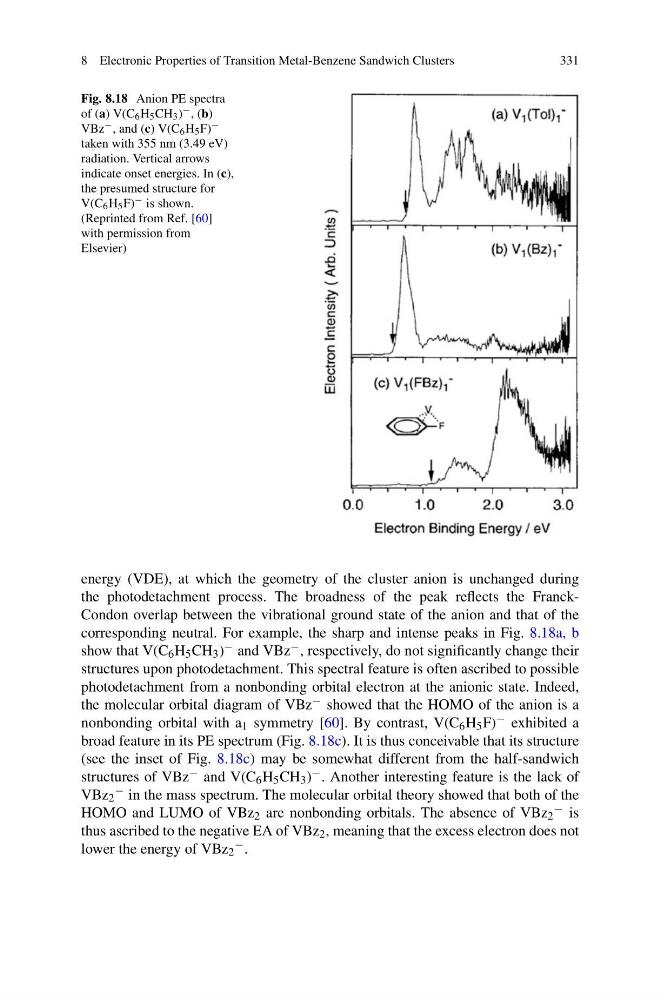
Fig. 8.18 Anion PE spectra
of (a) V(C 6 H 5 CH 3 ) − , (b)
VBz − , and (c) V(C 6 H 5 F) −
taken with 355 nm (3.49 eV)
radiation. Vertical arrows
indicate onset energies. In (c),
the presumed structure for
V(C 6 H 5 F) − is shown.
(Reprinted from Ref. [60]
with permission from
Elsevier)
energy (VDE), at which the geometry of the cluster anion is unchanged during
the photodetachment process. The broadness of the peak reflects the FranckCondon overlap between the vibrational ground state of the anion and that of the
corresponding neutral. For example, the sharp and intense peaks in Fig. 8.18a, b
show that V(C 6 H 5 CH 3 ) − and VBz − , respectively, do not significantly change their
structures upon photodetachment. This spectral feature is often ascribed to possible
photodetachment from a nonbonding orbital electron at the anionic state. Indeed,
the molecular orbital diagram of VBz − showed that the HOMO of the anion is a
nonbonding orbital with a 1 symmetry [60]. By contrast, V(C 6 H 5 F) − exhibited a
broad feature in its PE spectrum (Fig. 8.18c). It is thus conceivable that its structure
(see the inset of Fig. 8.18c) may be somewhat different from the half-sandwich
structures of VBz − and V(C 6 H 5 CH 3 ) − . Another interesting feature is the lack of
VBz 2
− in the mass spectrum. The molecular orbital theory showed that both of the
HOMO and LUMO of VBz 2 are nonbonding orbitals. The absence of VBz 2
− is
thus ascribed to the negative EA of VBz 2 , meaning that the excess electron does not
lower the energy of VBz 2
− .
331
Fig. 8.18 Anion PE spectra
of (a) V(C 6 H 5 CH 3 ) − , (b)
VBz − , and (c) V(C 6 H 5 F) −
taken with 355 nm (3.49 eV)
radiation. Vertical arrows
indicate onset energies. In (c),
the presumed structure for
V(C 6 H 5 F) − is shown.
(Reprinted from Ref. [60]
with permission from
Elsevier)
energy (VDE), at which the geometry of the cluster anion is unchanged during
the photodetachment process. The broadness of the peak reflects the FranckCondon overlap between the vibrational ground state of the anion and that of the
corresponding neutral. For example, the sharp and intense peaks in Fig. 8.18a, b
show that V(C 6 H 5 CH 3 ) − and VBz − , respectively, do not significantly change their
structures upon photodetachment. This spectral feature is often ascribed to possible
photodetachment from a nonbonding orbital electron at the anionic state. Indeed,
the molecular orbital diagram of VBz − showed that the HOMO of the anion is a
nonbonding orbital with a 1 symmetry [60]. By contrast, V(C 6 H 5 F) − exhibited a
broad feature in its PE spectrum (Fig. 8.18c). It is thus conceivable that its structure
(see the inset of Fig. 8.18c) may be somewhat different from the half-sandwich
structures of VBz − and V(C 6 H 5 CH 3 ) − . Another interesting feature is the lack of
VBz 2
− in the mass spectrum. The molecular orbital theory showed that both of the
HOMO and LUMO of VBz 2 are nonbonding orbitals. The absence of VBz 2
− is
thus ascribed to the negative EA of VBz 2 , meaning that the excess electron does not
lower the energy of VBz 2
− .