

7 Computational and Experimental Analysis of Carbon Functional Nanomaterials
301
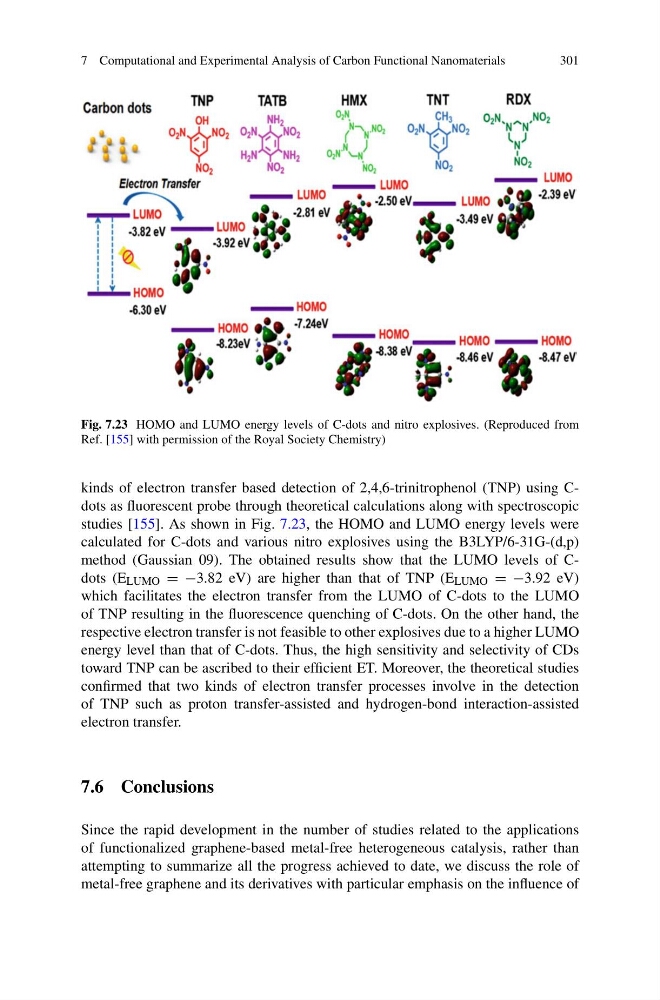
Fig. 7.23 HOMO and LUMO energy levels of C-dots and nitro explosives. (Reproduced from
Ref. [155] with permission of the Royal Society Chemistry)
kinds of electron transfer based detection of 2,4,6-trinitrophenol (TNP) using Cdots as fluorescent probe through theoretical calculations along with spectroscopic
studies [155]. As shown in Fig. 7.23, the HOMO and LUMO energy levels were
calculated for C-dots and various nitro explosives using the B3LYP/6-31G-(d,p)
method (Gaussian 09). The obtained results show that the LUMO levels of Cdots (E LUMO = −3.82 eV) are higher than that of TNP (E LUMO = −3.92 eV)
which facilitates the electron transfer from the LUMO of C-dots to the LUMO
of TNP resulting in the fluorescence quenching of C-dots. On the other hand, the
respective electron transfer is not feasible to other explosives due to a higher LUMO
energy level than that of C-dots. Thus, the high sensitivity and selectivity of CDs
toward TNP can be ascribed to their efficient ET. Moreover, the theoretical studies
confirmed that two kinds of electron transfer processes involve in the detection
of TNP such as proton transfer-assisted and hydrogen-bond interaction-assisted
electron transfer.
7.6 Conclusions
Since the rapid development in the number of studies related to the applications
of functionalized graphene-based metal-free heterogeneous catalysis, rather than
attempting to summarize all the progress achieved to date, we discuss the role of
metal-free graphene and its derivatives with particular emphasis on the influence of
301
Fig. 7.23 HOMO and LUMO energy levels of C-dots and nitro explosives. (Reproduced from
Ref. [155] with permission of the Royal Society Chemistry)
kinds of electron transfer based detection of 2,4,6-trinitrophenol (TNP) using Cdots as fluorescent probe through theoretical calculations along with spectroscopic
studies [155]. As shown in Fig. 7.23, the HOMO and LUMO energy levels were
calculated for C-dots and various nitro explosives using the B3LYP/6-31G-(d,p)
method (Gaussian 09). The obtained results show that the LUMO levels of Cdots (E LUMO = −3.82 eV) are higher than that of TNP (E LUMO = −3.92 eV)
which facilitates the electron transfer from the LUMO of C-dots to the LUMO
of TNP resulting in the fluorescence quenching of C-dots. On the other hand, the
respective electron transfer is not feasible to other explosives due to a higher LUMO
energy level than that of C-dots. Thus, the high sensitivity and selectivity of CDs
toward TNP can be ascribed to their efficient ET. Moreover, the theoretical studies
confirmed that two kinds of electron transfer processes involve in the detection
of TNP such as proton transfer-assisted and hydrogen-bond interaction-assisted
electron transfer.
7.6 Conclusions
Since the rapid development in the number of studies related to the applications
of functionalized graphene-based metal-free heterogeneous catalysis, rather than
attempting to summarize all the progress achieved to date, we discuss the role of
metal-free graphene and its derivatives with particular emphasis on the influence of