

300
P. Veerakumar et al.
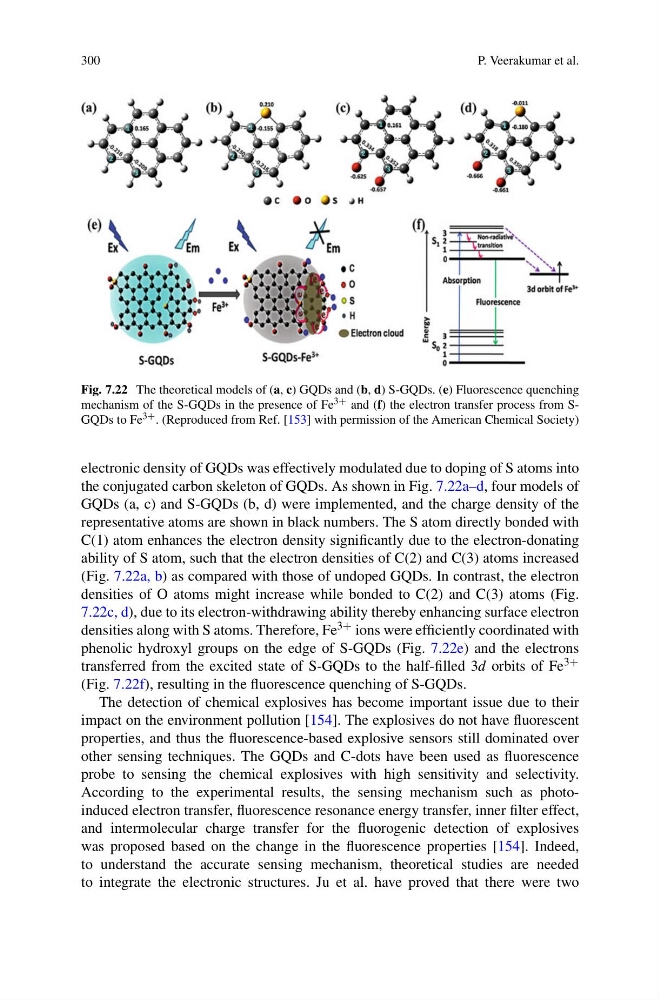
Fig. 7.22 The theoretical models of (a, c) GQDs and (b, d) S-GQDs. (e) Fluorescence quenching
mechanism of the S-GQDs in the presence of Fe 3+ and (f) the electron transfer process from SGQDs to Fe 3+ . (Reproduced from Ref. [153] with permission of the American Chemical Society)
electronic density of GQDs was effectively modulated due to doping of S atoms into
the conjugated carbon skeleton of GQDs. As shown in Fig. 7.22a–d, four models of
GQDs (a, c) and S-GQDs (b, d) were implemented, and the charge density of the
representative atoms are shown in black numbers. The S atom directly bonded with
C(1) atom enhances the electron density significantly due to the electron-donating
ability of S atom, such that the electron densities of C(2) and C(3) atoms increased
(Fig. 7.22a, b) as compared with those of undoped GQDs. In contrast, the electron
densities of O atoms might increase while bonded to C(2) and C(3) atoms (Fig.
7.22c, d), due to its electron-withdrawing ability thereby enhancing surface electron
densities along with S atoms. Therefore, Fe 3+ ions were efficiently coordinated with
phenolic hydroxyl groups on the edge of S-GQDs (Fig. 7.22e) and the electrons
transferred from the excited state of S-GQDs to the half-filled 3d orbits of Fe 3+
(Fig. 7.22f), resulting in the fluorescence quenching of S-GQDs.
The detection of chemical explosives has become important issue due to their
impact on the environment pollution [154]. The explosives do not have fluorescent
properties, and thus the fluorescence-based explosive sensors still dominated over
other sensing techniques. The GQDs and C-dots have been used as fluorescence
probe to sensing the chemical explosives with high sensitivity and selectivity.
According to the experimental results, the sensing mechanism such as photoinduced electron transfer, fluorescence resonance energy transfer, inner filter effect,
and intermolecular charge transfer for the fluorogenic detection of explosives
was proposed based on the change in the fluorescence properties [154]. Indeed,
to understand the accurate sensing mechanism, theoretical studies are needed
to integrate the electronic structures. Ju et al. have proved that there were two
P. Veerakumar et al.
Fig. 7.22 The theoretical models of (a, c) GQDs and (b, d) S-GQDs. (e) Fluorescence quenching
mechanism of the S-GQDs in the presence of Fe 3+ and (f) the electron transfer process from SGQDs to Fe 3+ . (Reproduced from Ref. [153] with permission of the American Chemical Society)
electronic density of GQDs was effectively modulated due to doping of S atoms into
the conjugated carbon skeleton of GQDs. As shown in Fig. 7.22a–d, four models of
GQDs (a, c) and S-GQDs (b, d) were implemented, and the charge density of the
representative atoms are shown in black numbers. The S atom directly bonded with
C(1) atom enhances the electron density significantly due to the electron-donating
ability of S atom, such that the electron densities of C(2) and C(3) atoms increased
(Fig. 7.22a, b) as compared with those of undoped GQDs. In contrast, the electron
densities of O atoms might increase while bonded to C(2) and C(3) atoms (Fig.
7.22c, d), due to its electron-withdrawing ability thereby enhancing surface electron
densities along with S atoms. Therefore, Fe 3+ ions were efficiently coordinated with
phenolic hydroxyl groups on the edge of S-GQDs (Fig. 7.22e) and the electrons
transferred from the excited state of S-GQDs to the half-filled 3d orbits of Fe 3+
(Fig. 7.22f), resulting in the fluorescence quenching of S-GQDs.
The detection of chemical explosives has become important issue due to their
impact on the environment pollution [154]. The explosives do not have fluorescent
properties, and thus the fluorescence-based explosive sensors still dominated over
other sensing techniques. The GQDs and C-dots have been used as fluorescence
probe to sensing the chemical explosives with high sensitivity and selectivity.
According to the experimental results, the sensing mechanism such as photoinduced electron transfer, fluorescence resonance energy transfer, inner filter effect,
and intermolecular charge transfer for the fluorogenic detection of explosives
was proposed based on the change in the fluorescence properties [154]. Indeed,
to understand the accurate sensing mechanism, theoretical studies are needed
to integrate the electronic structures. Ju et al. have proved that there were two