

298
P. Veerakumar et al.
and 6-31+G(d) basis set. The DFT calculations suggested that the existence of
graphitic nitrogen into the carbon core resulted in red-shifted absorption with
respect to undoped system which is due to the transition into the second excited
singlet state (S 0 → S 2 ). Moreover, the differences between the HOMO and LUMO
band gap, as shown in Fig. 7.20b, clearly indicate narrowing of the HOMO-LUMO
gap in the nitrogen-doped systems and also create mid gap states within the original
gap of the undoped system. Consequently, the red-shift fluorescence (above 600 nm)
was observed for nitrogen-doped systems (Fig. 7.20c), and the red shift extent
gradually increases as increasing amount of graphitic nitrogen in carbon core.
Xu et al. reported the Zn-doped C-dots with a high fluorescence quantum yield
(32.3%). The ab initio studies were investigated to understand the involvement
of molecular orbitals in the fluorescence process [148]. They have employed two
well-established DFT-based ab initio methods including the plane-wave projectoraugmented wave method as implemented in the Vienna ab initio simulation package
(VASP) and the orthogonalized linear combination of atomic orbital (OLCAO)
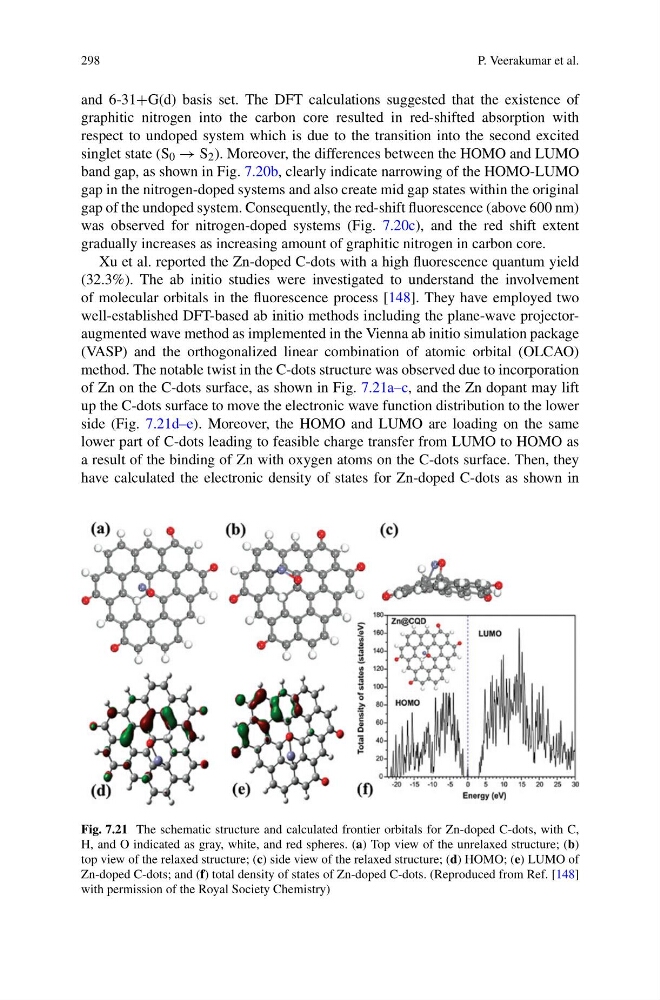
method. The notable twist in the C-dots structure was observed due to incorporation
of Zn on the C-dots surface, as shown in Fig. 7.21a–c, and the Zn dopant may lift
up the C-dots surface to move the electronic wave function distribution to the lower
side (Fig. 7.21d–e). Moreover, the HOMO and LUMO are loading on the same
lower part of C-dots leading to feasible charge transfer from LUMO to HOMO as
a result of the binding of Zn with oxygen atoms on the C-dots surface. Then, they
have calculated the electronic density of states for Zn-doped C-dots as shown in
Fig. 7.21 The schematic structure and calculated frontier orbitals for Zn-doped C-dots, with C,
H, and O indicated as gray, white, and red spheres. (a) Top view of the unrelaxed structure; (b)
top view of the relaxed structure; (c) side view of the relaxed structure; (d) HOMO; (e) LUMO of
Zn-doped C-dots; and (f) total density of states of Zn-doped C-dots. (Reproduced from Ref. [148]
with permission of the Royal Society Chemistry)
P. Veerakumar et al.
and 6-31+G(d) basis set. The DFT calculations suggested that the existence of
graphitic nitrogen into the carbon core resulted in red-shifted absorption with
respect to undoped system which is due to the transition into the second excited
singlet state (S 0 → S 2 ). Moreover, the differences between the HOMO and LUMO
band gap, as shown in Fig. 7.20b, clearly indicate narrowing of the HOMO-LUMO
gap in the nitrogen-doped systems and also create mid gap states within the original
gap of the undoped system. Consequently, the red-shift fluorescence (above 600 nm)
was observed for nitrogen-doped systems (Fig. 7.20c), and the red shift extent
gradually increases as increasing amount of graphitic nitrogen in carbon core.
Xu et al. reported the Zn-doped C-dots with a high fluorescence quantum yield
(32.3%). The ab initio studies were investigated to understand the involvement
of molecular orbitals in the fluorescence process [148]. They have employed two
well-established DFT-based ab initio methods including the plane-wave projectoraugmented wave method as implemented in the Vienna ab initio simulation package
(VASP) and the orthogonalized linear combination of atomic orbital (OLCAO)
method. The notable twist in the C-dots structure was observed due to incorporation
of Zn on the C-dots surface, as shown in Fig. 7.21a–c, and the Zn dopant may lift
up the C-dots surface to move the electronic wave function distribution to the lower
side (Fig. 7.21d–e). Moreover, the HOMO and LUMO are loading on the same
lower part of C-dots leading to feasible charge transfer from LUMO to HOMO as
a result of the binding of Zn with oxygen atoms on the C-dots surface. Then, they
have calculated the electronic density of states for Zn-doped C-dots as shown in
Fig. 7.21 The schematic structure and calculated frontier orbitals for Zn-doped C-dots, with C,
H, and O indicated as gray, white, and red spheres. (a) Top view of the unrelaxed structure; (b)
top view of the relaxed structure; (c) side view of the relaxed structure; (d) HOMO; (e) LUMO of
Zn-doped C-dots; and (f) total density of states of Zn-doped C-dots. (Reproduced from Ref. [148]
with permission of the Royal Society Chemistry)