

7 Computational and Experimental Analysis of Carbon Functional Nanomaterials
297
significant contribution of electrostatic interactions of the surface carboxyl groups
greatly influences the role of C-dots acting as surface emissive traps. Similarly, the
fluorescence of para-substituted anilines functionalized C-dots was controlled to
emit at longer wavelength with very narrow spectral width by creating a new energy
levels [146].
Different from surface functionalization, the metal/element doping is another
important factor to influence the fluorescence properties of C-dots. For instance,
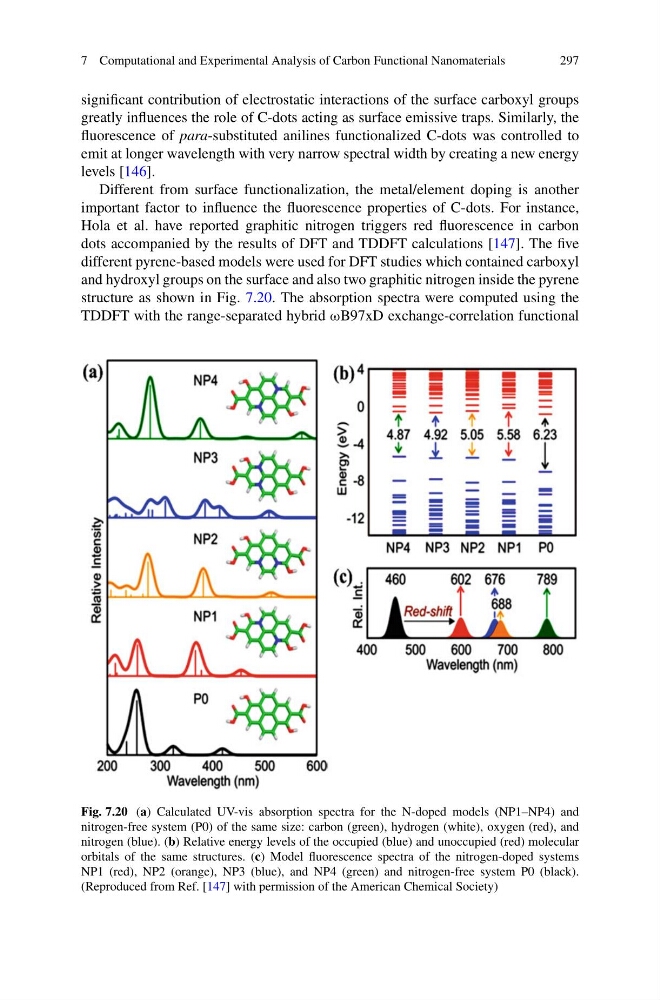
Hola et al. have reported graphitic nitrogen triggers red fluorescence in carbon
dots accompanied by the results of DFT and TDDFT calculations [147]. The five
different pyrene-based models were used for DFT studies which contained carboxyl
and hydroxyl groups on the surface and also two graphitic nitrogen inside the pyrene
structure as shown in Fig. 7.20. The absorption spectra were computed using the
TDDFT with the range-separated hybrid ωB97xD exchange-correlation functional
Fig. 7.20 (a) Calculated UV-vis absorption spectra for the N-doped models (NP1–NP4) and
nitrogen-free system (P0) of the same size: carbon (green), hydrogen (white), oxygen (red), and
nitrogen (blue). (b) Relative energy levels of the occupied (blue) and unoccupied (red) molecular
orbitals of the same structures. (c) Model fluorescence spectra of the nitrogen-doped systems
NP1 (red), NP2 (orange), NP3 (blue), and NP4 (green) and nitrogen-free system P0 (black).
(Reproduced from Ref. [147] with permission of the American Chemical Society)
297
significant contribution of electrostatic interactions of the surface carboxyl groups
greatly influences the role of C-dots acting as surface emissive traps. Similarly, the
fluorescence of para-substituted anilines functionalized C-dots was controlled to
emit at longer wavelength with very narrow spectral width by creating a new energy
levels [146].
Different from surface functionalization, the metal/element doping is another
important factor to influence the fluorescence properties of C-dots. For instance,
Hola et al. have reported graphitic nitrogen triggers red fluorescence in carbon
dots accompanied by the results of DFT and TDDFT calculations [147]. The five
different pyrene-based models were used for DFT studies which contained carboxyl
and hydroxyl groups on the surface and also two graphitic nitrogen inside the pyrene
structure as shown in Fig. 7.20. The absorption spectra were computed using the
TDDFT with the range-separated hybrid ωB97xD exchange-correlation functional
Fig. 7.20 (a) Calculated UV-vis absorption spectra for the N-doped models (NP1–NP4) and
nitrogen-free system (P0) of the same size: carbon (green), hydrogen (white), oxygen (red), and
nitrogen (blue). (b) Relative energy levels of the occupied (blue) and unoccupied (red) molecular
orbitals of the same structures. (c) Model fluorescence spectra of the nitrogen-doped systems
NP1 (red), NP2 (orange), NP3 (blue), and NP4 (green) and nitrogen-free system P0 (black).
(Reproduced from Ref. [147] with permission of the American Chemical Society)