

284
P. Veerakumar et al.
7.3.7 Reduction of Nitro Compounds
Nitroaromatic compounds (NACs) are widely utilized as pesticides, explosives, and
synthesis intermediates, [85, 86] causing environmental pollution. The electronwithdrawing effect of the nitro groups and the stability of the benzene ring lead
to the recalcitrance of the NACs through either chemical reduction [87] or oxidative
degradation [88]. Pal et al. found that 4-nitrophenol (Nip) may be reduced to 4aminophenol (Amp) by sodium borohydride (NaBH 4 ) in the presence of N-doped
graphene (NG), in which the N-doping greatly enhanced catalytic activity [89]. The
activity was related to the surface area of the catalysts. Recently, Kong group [90]
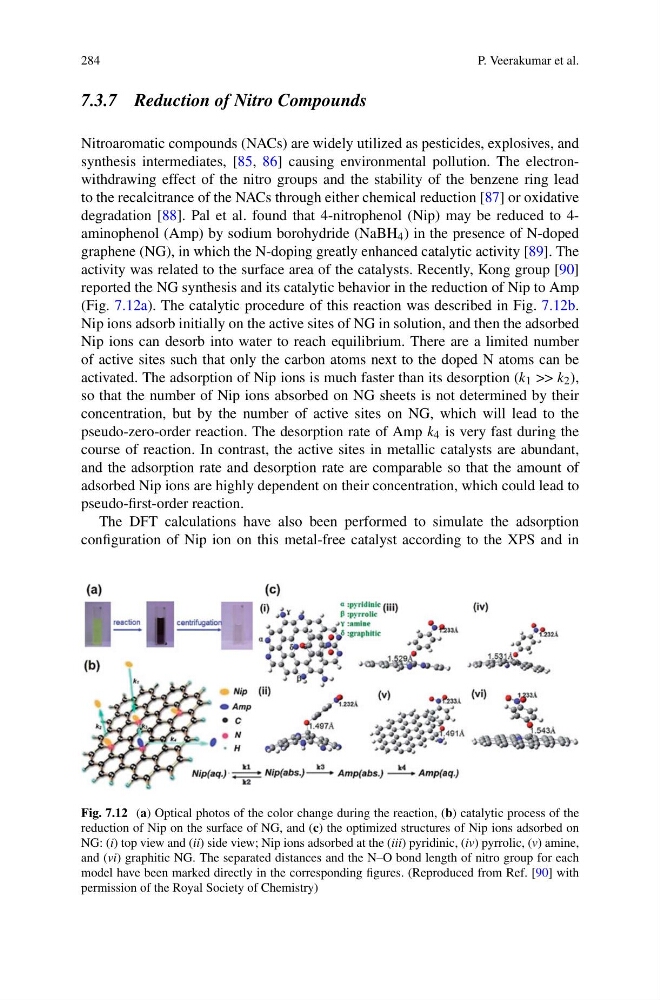
reported the NG synthesis and its catalytic behavior in the reduction of Nip to Amp
(Fig. 7.12a). The catalytic procedure of this reaction was described in Fig. 7.12b.
Nip ions adsorb initially on the active sites of NG in solution, and then the adsorbed
Nip ions can desorb into water to reach equilibrium. There are a limited number
of active sites such that only the carbon atoms next to the doped N atoms can be
activated. The adsorption of Nip ions is much faster than its desorption (k 1 >> k 2 ),
so that the number of Nip ions absorbed on NG sheets is not determined by their
concentration, but by the number of active sites on NG, which will lead to the
pseudo-zero-order reaction. The desorption rate of Amp k 4 is very fast during the
course of reaction. In contrast, the active sites in metallic catalysts are abundant,
and the adsorption rate and desorption rate are comparable so that the amount of
adsorbed Nip ions are highly dependent on their concentration, which could lead to
pseudo-first-order reaction.
The DFT calculations have also been performed to simulate the adsorption
configuration of Nip ion on this metal-free catalyst according to the XPS and in
Fig. 7.12 (a) Optical photos of the color change during the reaction, (b) catalytic process of the
reduction of Nip on the surface of NG, and (c) the optimized structures of Nip ions adsorbed on
NG: (i) top view and (ii) side view; Nip ions adsorbed at the (iii) pyridinic, (iv) pyrrolic, (v) amine,
and (vi) graphitic NG. The separated distances and the N–O bond length of nitro group for each
model have been marked directly in the corresponding figures. (Reproduced from Ref. [90] with
permission of the Royal Society of Chemistry)
P. Veerakumar et al.
7.3.7 Reduction of Nitro Compounds
Nitroaromatic compounds (NACs) are widely utilized as pesticides, explosives, and
synthesis intermediates, [85, 86] causing environmental pollution. The electronwithdrawing effect of the nitro groups and the stability of the benzene ring lead
to the recalcitrance of the NACs through either chemical reduction [87] or oxidative
degradation [88]. Pal et al. found that 4-nitrophenol (Nip) may be reduced to 4aminophenol (Amp) by sodium borohydride (NaBH 4 ) in the presence of N-doped
graphene (NG), in which the N-doping greatly enhanced catalytic activity [89]. The
activity was related to the surface area of the catalysts. Recently, Kong group [90]
reported the NG synthesis and its catalytic behavior in the reduction of Nip to Amp
(Fig. 7.12a). The catalytic procedure of this reaction was described in Fig. 7.12b.
Nip ions adsorb initially on the active sites of NG in solution, and then the adsorbed
Nip ions can desorb into water to reach equilibrium. There are a limited number
of active sites such that only the carbon atoms next to the doped N atoms can be
activated. The adsorption of Nip ions is much faster than its desorption (k 1 >> k 2 ),
so that the number of Nip ions absorbed on NG sheets is not determined by their
concentration, but by the number of active sites on NG, which will lead to the
pseudo-zero-order reaction. The desorption rate of Amp k 4 is very fast during the
course of reaction. In contrast, the active sites in metallic catalysts are abundant,
and the adsorption rate and desorption rate are comparable so that the amount of
adsorbed Nip ions are highly dependent on their concentration, which could lead to
pseudo-first-order reaction.
The DFT calculations have also been performed to simulate the adsorption
configuration of Nip ion on this metal-free catalyst according to the XPS and in
Fig. 7.12 (a) Optical photos of the color change during the reaction, (b) catalytic process of the
reduction of Nip on the surface of NG, and (c) the optimized structures of Nip ions adsorbed on
NG: (i) top view and (ii) side view; Nip ions adsorbed at the (iii) pyridinic, (iv) pyrrolic, (v) amine,
and (vi) graphitic NG. The separated distances and the N–O bond length of nitro group for each
model have been marked directly in the corresponding figures. (Reproduced from Ref. [90] with
permission of the Royal Society of Chemistry)