

7 Computational and Experimental Analysis of Carbon Functional Nanomaterials
273
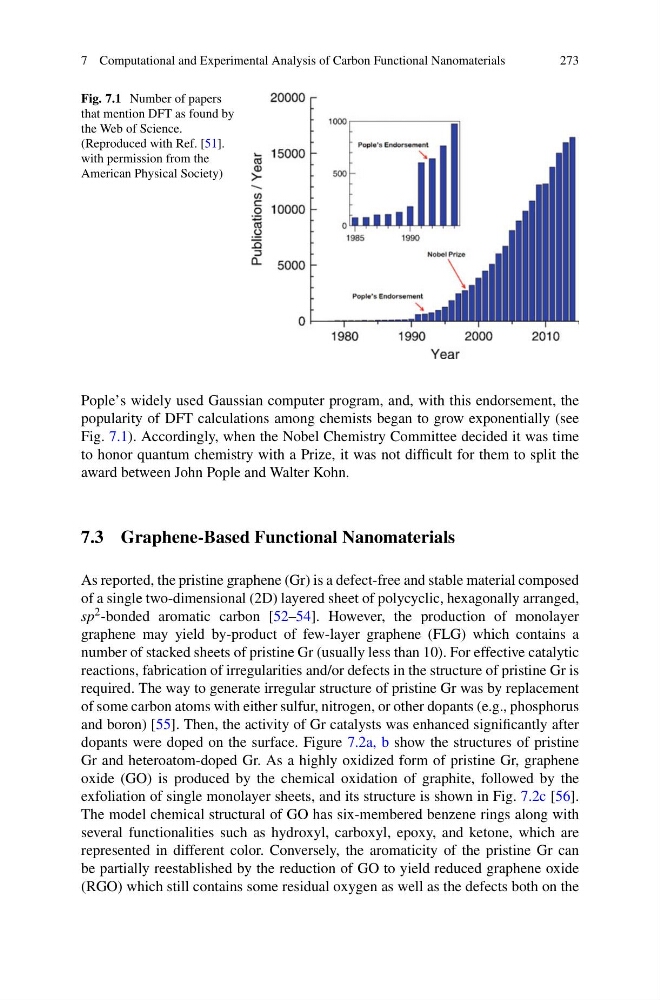
Fig. 7.1 Number of papers
that mention DFT as found by
the Web of Science.
(Reproduced with Ref. [51].
with permission from the
American Physical Society)
Pople’s widely used Gaussian computer program, and, with this endorsement, the
popularity of DFT calculations among chemists began to grow exponentially (see
Fig. 7.1). Accordingly, when the Nobel Chemistry Committee decided it was time
to honor quantum chemistry with a Prize, it was not difficult for them to split the
award between John Pople and Walter Kohn.
7.3 Graphene-Based Functional Nanomaterials
As reported, the pristine graphene (Gr) is a defect-free and stable material composed
of a single two-dimensional (2D) layered sheet of polycyclic, hexagonally arranged,
sp 2 -bonded aromatic carbon [52–54]. However, the production of monolayer
graphene may yield by-product of few-layer graphene (FLG) which contains a
number of stacked sheets of pristine Gr (usually less than 10). For effective catalytic
reactions, fabrication of irregularities and/or defects in the structure of pristine Gr is
required. The way to generate irregular structure of pristine Gr was by replacement
of some carbon atoms with either sulfur, nitrogen, or other dopants (e.g., phosphorus
and boron) [55]. Then, the activity of Gr catalysts was enhanced significantly after
dopants were doped on the surface. Figure 7.2a, b show the structures of pristine
Gr and heteroatom-doped Gr. As a highly oxidized form of pristine Gr, graphene
oxide (GO) is produced by the chemical oxidation of graphite, followed by the
exfoliation of single monolayer sheets, and its structure is shown in Fig. 7.2c [56].
The model chemical structural of GO has six-membered benzene rings along with
several functionalities such as hydroxyl, carboxyl, epoxy, and ketone, which are
represented in different color. Conversely, the aromaticity of the pristine Gr can
be partially reestablished by the reduction of GO to yield reduced graphene oxide
(RGO) which still contains some residual oxygen as well as the defects both on the
273
Fig. 7.1 Number of papers
that mention DFT as found by
the Web of Science.
(Reproduced with Ref. [51].
with permission from the
American Physical Society)
Pople’s widely used Gaussian computer program, and, with this endorsement, the
popularity of DFT calculations among chemists began to grow exponentially (see
Fig. 7.1). Accordingly, when the Nobel Chemistry Committee decided it was time
to honor quantum chemistry with a Prize, it was not difficult for them to split the
award between John Pople and Walter Kohn.
7.3 Graphene-Based Functional Nanomaterials
As reported, the pristine graphene (Gr) is a defect-free and stable material composed
of a single two-dimensional (2D) layered sheet of polycyclic, hexagonally arranged,
sp 2 -bonded aromatic carbon [52–54]. However, the production of monolayer
graphene may yield by-product of few-layer graphene (FLG) which contains a
number of stacked sheets of pristine Gr (usually less than 10). For effective catalytic
reactions, fabrication of irregularities and/or defects in the structure of pristine Gr is
required. The way to generate irregular structure of pristine Gr was by replacement
of some carbon atoms with either sulfur, nitrogen, or other dopants (e.g., phosphorus
and boron) [55]. Then, the activity of Gr catalysts was enhanced significantly after
dopants were doped on the surface. Figure 7.2a, b show the structures of pristine
Gr and heteroatom-doped Gr. As a highly oxidized form of pristine Gr, graphene
oxide (GO) is produced by the chemical oxidation of graphite, followed by the
exfoliation of single monolayer sheets, and its structure is shown in Fig. 7.2c [56].
The model chemical structural of GO has six-membered benzene rings along with
several functionalities such as hydroxyl, carboxyl, epoxy, and ketone, which are
represented in different color. Conversely, the aromaticity of the pristine Gr can
be partially reestablished by the reduction of GO to yield reduced graphene oxide
(RGO) which still contains some residual oxygen as well as the defects both on the