

246
A. V. Pomogaeva and A. Y. Timoshkin
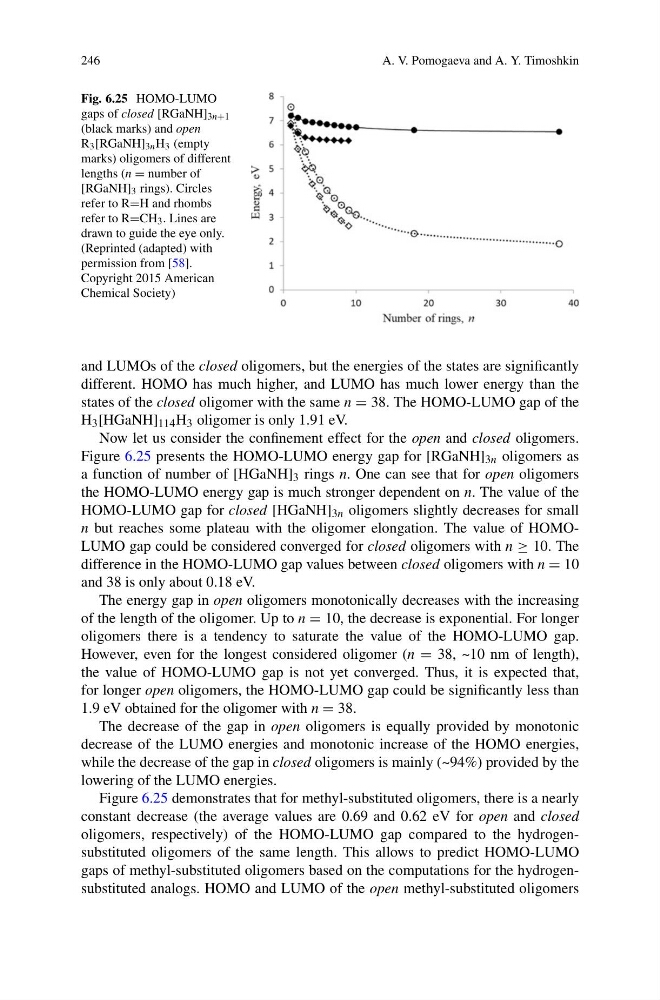
Fig. 6.25 HOMO-LUMO
gaps of closed [RGaNH] 3n+1
(black marks) and open
R 3 [RGaNH] 3n H 3 (empty
marks) oligomers of different
lengths (n = number of
[RGaNH] 3 rings). Circles
refer to R=H and rhombs
refer to R=CH 3 . Lines are
drawn to guide the eye only.
(Reprinted (adapted) with
permission from [58].
Copyright 2015 American
Chemical Society)
and LUMOs of the closed oligomers, but the energies of the states are significantly
different. HOMO has much higher, and LUMO has much lower energy than the
states of the closed oligomer with the same n = 38. The HOMO-LUMO gap of the
H 3 [HGaNH] 114 H 3 oligomer is only 1.91 eV.
Now let us consider the confinement effect for the open and closed oligomers.
Figure 6.25 presents the HOMO-LUMO energy gap for [RGaNH] 3n oligomers as
a function of number of [HGaNH] 3 rings n. One can see that for open oligomers
the HOMO-LUMO energy gap is much stronger dependent on n. The value of the
HOMO-LUMO gap for closed [HGaNH] 3n oligomers slightly decreases for small
n but reaches some plateau with the oligomer elongation. The value of HOMOLUMO gap could be considered converged for closed oligomers with n ≥ 10. The
difference in the HOMO-LUMO gap values between closed oligomers with n = 10
and 38 is only about 0.18 eV.
The energy gap in open oligomers monotonically decreases with the increasing
of the length of the oligomer. Up to n = 10, the decrease is exponential. For longer
oligomers there is a tendency to saturate the value of the HOMO-LUMO gap.
However, even for the longest considered oligomer (n = 38, ~10 nm of length),
the value of HOMO-LUMO gap is not yet converged. Thus, it is expected that,
for longer open oligomers, the HOMO-LUMO gap could be significantly less than
1.9 eV obtained for the oligomer with n = 38.
The decrease of the gap in open oligomers is equally provided by monotonic
decrease of the LUMO energies and monotonic increase of the HOMO energies,
while the decrease of the gap in closed oligomers is mainly (~94%) provided by the
lowering of the LUMO energies.
Figure 6.25 demonstrates that for methyl-substituted oligomers, there is a nearly
constant decrease (the average values are 0.69 and 0.62 eV for open and closed
oligomers, respectively) of the HOMO-LUMO gap compared to the hydrogensubstituted oligomers of the same length. This allows to predict HOMO-LUMO
gaps of methyl-substituted oligomers based on the computations for the hydrogensubstituted analogs. HOMO and LUMO of the open methyl-substituted oligomers
A. V. Pomogaeva and A. Y. Timoshkin
Fig. 6.25 HOMO-LUMO
gaps of closed [RGaNH] 3n+1
(black marks) and open
R 3 [RGaNH] 3n H 3 (empty
marks) oligomers of different
lengths (n = number of
[RGaNH] 3 rings). Circles
refer to R=H and rhombs
refer to R=CH 3 . Lines are
drawn to guide the eye only.
(Reprinted (adapted) with
permission from [58].
Copyright 2015 American
Chemical Society)
and LUMOs of the closed oligomers, but the energies of the states are significantly
different. HOMO has much higher, and LUMO has much lower energy than the
states of the closed oligomer with the same n = 38. The HOMO-LUMO gap of the
H 3 [HGaNH] 114 H 3 oligomer is only 1.91 eV.
Now let us consider the confinement effect for the open and closed oligomers.
Figure 6.25 presents the HOMO-LUMO energy gap for [RGaNH] 3n oligomers as
a function of number of [HGaNH] 3 rings n. One can see that for open oligomers
the HOMO-LUMO energy gap is much stronger dependent on n. The value of the
HOMO-LUMO gap for closed [HGaNH] 3n oligomers slightly decreases for small
n but reaches some plateau with the oligomer elongation. The value of HOMOLUMO gap could be considered converged for closed oligomers with n ≥ 10. The
difference in the HOMO-LUMO gap values between closed oligomers with n = 10
and 38 is only about 0.18 eV.
The energy gap in open oligomers monotonically decreases with the increasing
of the length of the oligomer. Up to n = 10, the decrease is exponential. For longer
oligomers there is a tendency to saturate the value of the HOMO-LUMO gap.
However, even for the longest considered oligomer (n = 38, ~10 nm of length),
the value of HOMO-LUMO gap is not yet converged. Thus, it is expected that,
for longer open oligomers, the HOMO-LUMO gap could be significantly less than
1.9 eV obtained for the oligomer with n = 38.
The decrease of the gap in open oligomers is equally provided by monotonic
decrease of the LUMO energies and monotonic increase of the HOMO energies,
while the decrease of the gap in closed oligomers is mainly (~94%) provided by the
lowering of the LUMO energies.
Figure 6.25 demonstrates that for methyl-substituted oligomers, there is a nearly
constant decrease (the average values are 0.69 and 0.62 eV for open and closed
oligomers, respectively) of the HOMO-LUMO gap compared to the hydrogensubstituted oligomers of the same length. This allows to predict HOMO-LUMO
gaps of methyl-substituted oligomers based on the computations for the hydrogensubstituted analogs. HOMO and LUMO of the open methyl-substituted oligomers