

6 Group 13–15 Needle-Shaped Oligomers and Nanorods: Structures. . .
245
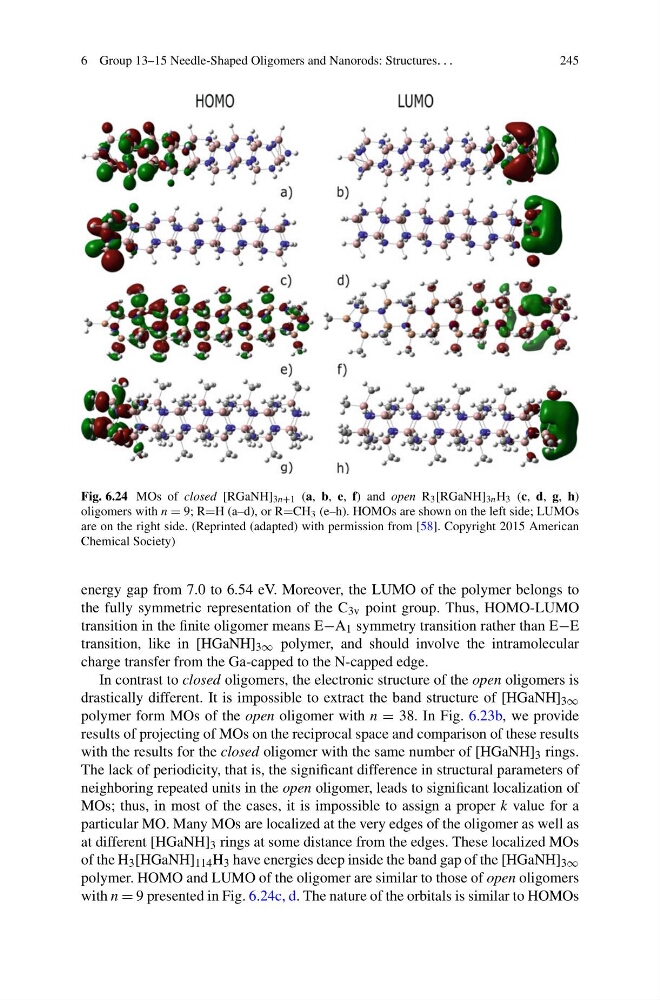
Fig. 6.24 MOs of closed [RGaNH] 3n+1 (a, b, e, f) and open R 3 [RGaNH] 3n H 3 (c, d, g, h)
oligomers with n = 9; R=H (a–d), or R=CH 3 (e–h). HOMOs are shown on the left side; LUMOs
are on the right side. (Reprinted (adapted) with permission from [58]. Copyright 2015 American
Chemical Society)
energy gap from 7.0 to 6.54 eV. Moreover, the LUMO of the polymer belongs to
the fully symmetric representation of the C 3v point group. Thus, HOMO-LUMO
transition in the finite oligomer means E−A 1 symmetry transition rather than E−E
transition, like in [HGaNH] 3∞ polymer, and should involve the intramolecular
charge transfer from the Ga-capped to the N-capped edge.
In contrast to closed oligomers, the electronic structure of the open oligomers is
drastically different. It is impossible to extract the band structure of [HGaNH] 3∞
polymer form MOs of the open oligomer with n = 38. In Fig. 6.23b, we provide
results of projecting of MOs on the reciprocal space and comparison of these results
with the results for the closed oligomer with the same number of [HGaNH] 3 rings.
The lack of periodicity, that is, the significant difference in structural parameters of
neighboring repeated units in the open oligomer, leads to significant localization of
MOs; thus, in most of the cases, it is impossible to assign a proper k value for a
particular MO. Many MOs are localized at the very edges of the oligomer as well as
at different [HGaNH] 3 rings at some distance from the edges. These localized MOs
of the H 3 [HGaNH] 114 H 3 have energies deep inside the band gap of the [HGaNH] 3∞
polymer. HOMO and LUMO of the oligomer are similar to those of open oligomers
with n = 9 presented in Fig. 6.24c, d. The nature of the orbitals is similar to HOMOs
245
Fig. 6.24 MOs of closed [RGaNH] 3n+1 (a, b, e, f) and open R 3 [RGaNH] 3n H 3 (c, d, g, h)
oligomers with n = 9; R=H (a–d), or R=CH 3 (e–h). HOMOs are shown on the left side; LUMOs
are on the right side. (Reprinted (adapted) with permission from [58]. Copyright 2015 American
Chemical Society)
energy gap from 7.0 to 6.54 eV. Moreover, the LUMO of the polymer belongs to
the fully symmetric representation of the C 3v point group. Thus, HOMO-LUMO
transition in the finite oligomer means E−A 1 symmetry transition rather than E−E
transition, like in [HGaNH] 3∞ polymer, and should involve the intramolecular
charge transfer from the Ga-capped to the N-capped edge.
In contrast to closed oligomers, the electronic structure of the open oligomers is
drastically different. It is impossible to extract the band structure of [HGaNH] 3∞
polymer form MOs of the open oligomer with n = 38. In Fig. 6.23b, we provide
results of projecting of MOs on the reciprocal space and comparison of these results
with the results for the closed oligomer with the same number of [HGaNH] 3 rings.
The lack of periodicity, that is, the significant difference in structural parameters of
neighboring repeated units in the open oligomer, leads to significant localization of
MOs; thus, in most of the cases, it is impossible to assign a proper k value for a
particular MO. Many MOs are localized at the very edges of the oligomer as well as
at different [HGaNH] 3 rings at some distance from the edges. These localized MOs
of the H 3 [HGaNH] 114 H 3 have energies deep inside the band gap of the [HGaNH] 3∞
polymer. HOMO and LUMO of the oligomer are similar to those of open oligomers
with n = 9 presented in Fig. 6.24c, d. The nature of the orbitals is similar to HOMOs