

240
A. V. Pomogaeva and A. Y. Timoshkin
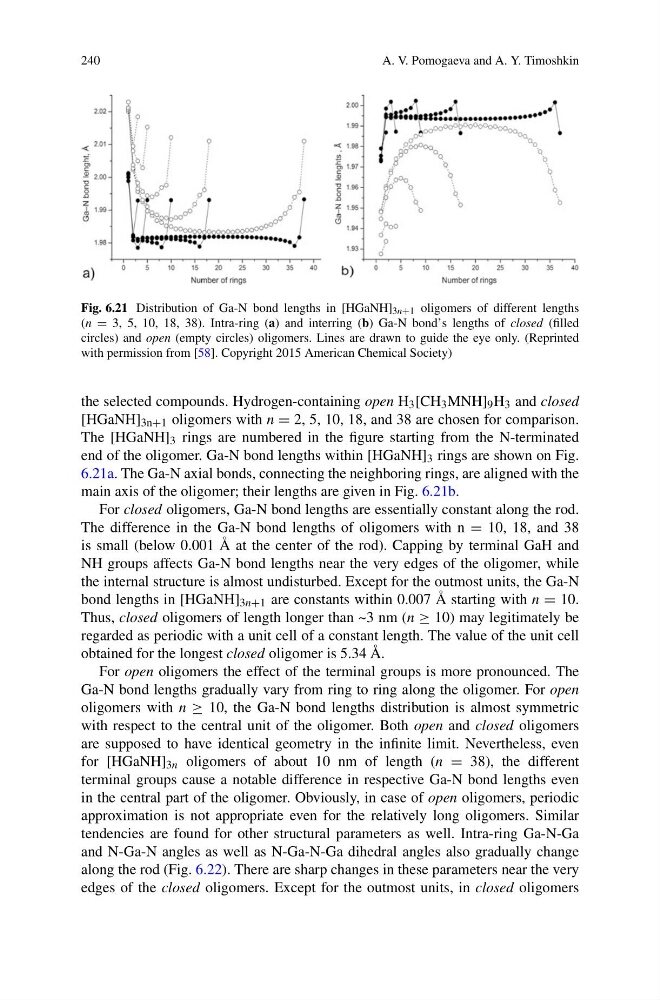
Fig. 6.21 Distribution of Ga-N bond lengths in [HGaNH] 3n+1 oligomers of different lengths
(n = 3, 5, 10, 18, 38). Intra-ring (a) and interring (b) Ga-N bond’s lengths of closed (filled
circles) and open (empty circles) oligomers. Lines are drawn to guide the eye only. (Reprinted
with permission from [58]. Copyright 2015 American Chemical Society)
the selected compounds. Hydrogen-containing open H 3 [CH 3 MNH] 9 H 3 and closed
[HGaNH] 3n+1 oligomers with n = 2, 5, 10, 18, and 38 are chosen for comparison.
The [HGaNH] 3 rings are numbered in the figure starting from the N-terminated
end of the oligomer. Ga-N bond lengths within [HGaNH] 3 rings are shown on Fig.
6.21a. The Ga-N axial bonds, connecting the neighboring rings, are aligned with the
main axis of the oligomer; their lengths are given in Fig. 6.21b.
For closed oligomers, Ga-N bond lengths are essentially constant along the rod.
The difference in the Ga-N bond lengths of oligomers with n = 10, 18, and 38
is small (below 0.001 Å at the center of the rod). Capping by terminal GaH and
NH groups affects Ga-N bond lengths near the very edges of the oligomer, while
the internal structure is almost undisturbed. Except for the outmost units, the Ga-N
bond lengths in [HGaNH] 3n+1 are constants within 0.007 Å starting with n = 10.
Thus, closed oligomers of length longer than ~3 nm (n ≥ 10) may legitimately be
regarded as periodic with a unit cell of a constant length. The value of the unit cell
obtained for the longest closed oligomer is 5.34 Å.
For open oligomers the effect of the terminal groups is more pronounced. The
Ga-N bond lengths gradually vary from ring to ring along the oligomer. For open
oligomers with n ≥ 10, the Ga-N bond lengths distribution is almost symmetric
with respect to the central unit of the oligomer. Both open and closed oligomers
are supposed to have identical geometry in the infinite limit. Nevertheless, even
for [HGaNH] 3n oligomers of about 10 nm of length (n = 38), the different
terminal groups cause a notable difference in respective Ga-N bond lengths even
in the central part of the oligomer. Obviously, in case of open oligomers, periodic
approximation is not appropriate even for the relatively long oligomers. Similar
tendencies are found for other structural parameters as well. Intra-ring Ga-N-Ga
and N-Ga-N angles as well as N-Ga-N-Ga dihedral angles also gradually change
along the rod (Fig. 6.22). There are sharp changes in these parameters near the very
edges of the closed oligomers. Except for the outmost units, in closed oligomers
A. V. Pomogaeva and A. Y. Timoshkin
Fig. 6.21 Distribution of Ga-N bond lengths in [HGaNH] 3n+1 oligomers of different lengths
(n = 3, 5, 10, 18, 38). Intra-ring (a) and interring (b) Ga-N bond’s lengths of closed (filled
circles) and open (empty circles) oligomers. Lines are drawn to guide the eye only. (Reprinted
with permission from [58]. Copyright 2015 American Chemical Society)
the selected compounds. Hydrogen-containing open H 3 [CH 3 MNH] 9 H 3 and closed
[HGaNH] 3n+1 oligomers with n = 2, 5, 10, 18, and 38 are chosen for comparison.
The [HGaNH] 3 rings are numbered in the figure starting from the N-terminated
end of the oligomer. Ga-N bond lengths within [HGaNH] 3 rings are shown on Fig.
6.21a. The Ga-N axial bonds, connecting the neighboring rings, are aligned with the
main axis of the oligomer; their lengths are given in Fig. 6.21b.
For closed oligomers, Ga-N bond lengths are essentially constant along the rod.
The difference in the Ga-N bond lengths of oligomers with n = 10, 18, and 38
is small (below 0.001 Å at the center of the rod). Capping by terminal GaH and
NH groups affects Ga-N bond lengths near the very edges of the oligomer, while
the internal structure is almost undisturbed. Except for the outmost units, the Ga-N
bond lengths in [HGaNH] 3n+1 are constants within 0.007 Å starting with n = 10.
Thus, closed oligomers of length longer than ~3 nm (n ≥ 10) may legitimately be
regarded as periodic with a unit cell of a constant length. The value of the unit cell
obtained for the longest closed oligomer is 5.34 Å.
For open oligomers the effect of the terminal groups is more pronounced. The
Ga-N bond lengths gradually vary from ring to ring along the oligomer. For open
oligomers with n ≥ 10, the Ga-N bond lengths distribution is almost symmetric
with respect to the central unit of the oligomer. Both open and closed oligomers
are supposed to have identical geometry in the infinite limit. Nevertheless, even
for [HGaNH] 3n oligomers of about 10 nm of length (n = 38), the different
terminal groups cause a notable difference in respective Ga-N bond lengths even
in the central part of the oligomer. Obviously, in case of open oligomers, periodic
approximation is not appropriate even for the relatively long oligomers. Similar
tendencies are found for other structural parameters as well. Intra-ring Ga-N-Ga
and N-Ga-N angles as well as N-Ga-N-Ga dihedral angles also gradually change
along the rod (Fig. 6.22). There are sharp changes in these parameters near the very
edges of the closed oligomers. Except for the outmost units, in closed oligomers