

6 Group 13–15 Needle-Shaped Oligomers and Nanorods: Structures. . .
239
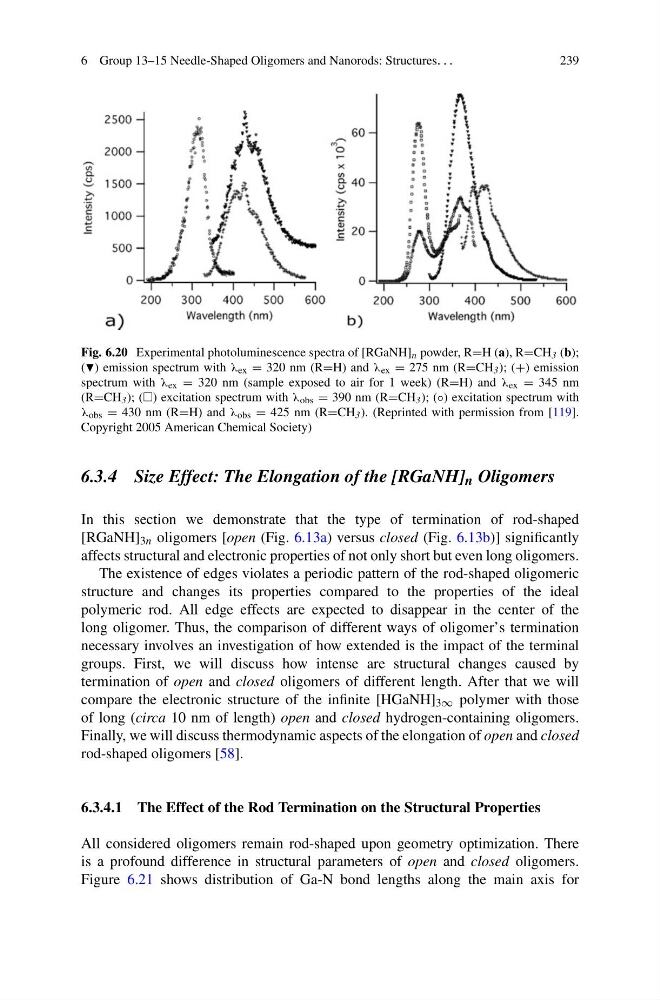
Fig. 6.20 Experimental photoluminescence spectra of [RGaNH] n powder, R=H (a), R=CH 3 (b);
() emission spectrum with λ ex = 320 nm (R=H) and λ ex = 275 nm (R=CH 3 ); (+) emission
spectrum with λ ex = 320 nm (sample exposed to air for 1 week) (R=H) and λ ex = 345 nm
(R=CH 3 ); () excitation spectrum with λ obs = 390 nm (R=CH 3 ); (◦) excitation spectrum with
λ obs = 430 nm (R=H) and λ obs = 425 nm (R=CH 3 ). (Reprinted with permission from [119].
Copyright 2005 American Chemical Society)
6.3.4 Size Effect: The Elongation of the [RGaNH] n Oligomers
In this section we demonstrate that the type of termination of rod-shaped
[RGaNH] 3n oligomers [open (Fig. 6.13a) versus closed (Fig. 6.13b)] significantly
affects structural and electronic properties of not only short but even long oligomers.
The existence of edges violates a periodic pattern of the rod-shaped oligomeric
structure and changes its properties compared to the properties of the ideal
polymeric rod. All edge effects are expected to disappear in the center of the
long oligomer. Thus, the comparison of different ways of oligomer’s termination
necessary involves an investigation of how extended is the impact of the terminal
groups. First, we will discuss how intense are structural changes caused by
termination of open and closed oligomers of different length. After that we will
compare the electronic structure of the infinite [HGaNH] 3∞ polymer with those
of long (circa 10 nm of length) open and closed hydrogen-containing oligomers.
Finally, we will discuss thermodynamic aspects of the elongation of open and closed
rod-shaped oligomers [58].
6.3.4.1 The Effect of the Rod Termination on the Structural Properties
All considered oligomers remain rod-shaped upon geometry optimization. There
is a profound difference in structural parameters of open and closed oligomers.
Figure 6.21 shows distribution of Ga-N bond lengths along the main axis for
239
Fig. 6.20 Experimental photoluminescence spectra of [RGaNH] n powder, R=H (a), R=CH 3 (b);
() emission spectrum with λ ex = 320 nm (R=H) and λ ex = 275 nm (R=CH 3 ); (+) emission
spectrum with λ ex = 320 nm (sample exposed to air for 1 week) (R=H) and λ ex = 345 nm
(R=CH 3 ); () excitation spectrum with λ obs = 390 nm (R=CH 3 ); (◦) excitation spectrum with
λ obs = 430 nm (R=H) and λ obs = 425 nm (R=CH 3 ). (Reprinted with permission from [119].
Copyright 2005 American Chemical Society)
6.3.4 Size Effect: The Elongation of the [RGaNH] n Oligomers
In this section we demonstrate that the type of termination of rod-shaped
[RGaNH] 3n oligomers [open (Fig. 6.13a) versus closed (Fig. 6.13b)] significantly
affects structural and electronic properties of not only short but even long oligomers.
The existence of edges violates a periodic pattern of the rod-shaped oligomeric
structure and changes its properties compared to the properties of the ideal
polymeric rod. All edge effects are expected to disappear in the center of the
long oligomer. Thus, the comparison of different ways of oligomer’s termination
necessary involves an investigation of how extended is the impact of the terminal
groups. First, we will discuss how intense are structural changes caused by
termination of open and closed oligomers of different length. After that we will
compare the electronic structure of the infinite [HGaNH] 3∞ polymer with those
of long (circa 10 nm of length) open and closed hydrogen-containing oligomers.
Finally, we will discuss thermodynamic aspects of the elongation of open and closed
rod-shaped oligomers [58].
6.3.4.1 The Effect of the Rod Termination on the Structural Properties
All considered oligomers remain rod-shaped upon geometry optimization. There
is a profound difference in structural parameters of open and closed oligomers.
Figure 6.21 shows distribution of Ga-N bond lengths along the main axis for