

6 Group 13–15 Needle-Shaped Oligomers and Nanorods: Structures. . .
229
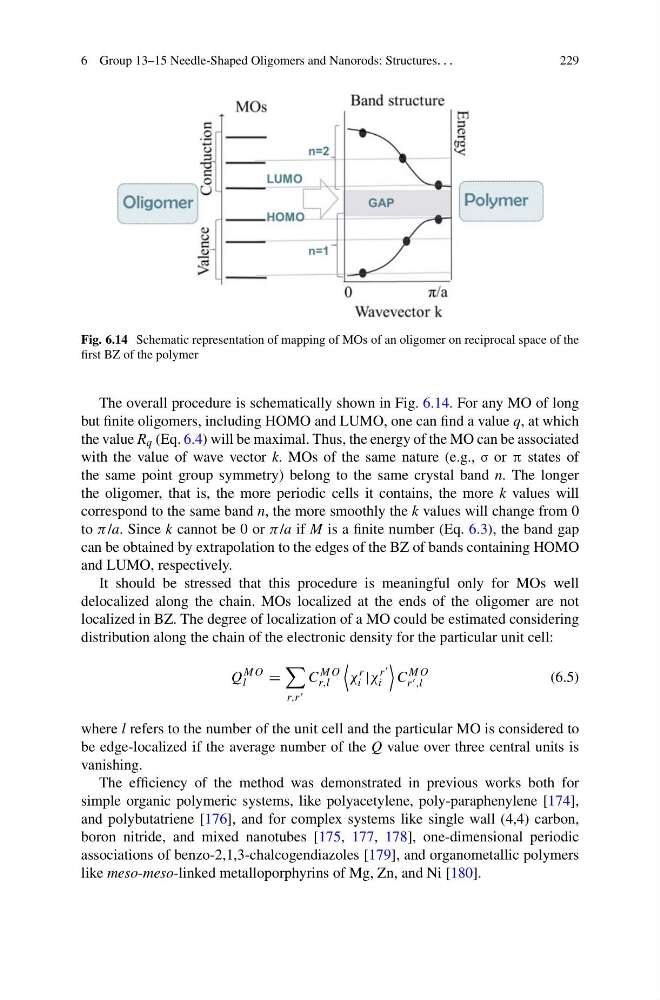
Fig. 6.14 Schematic representation of mapping of MOs of an oligomer on reciprocal space of the
first BZ of the polymer
The overall procedure is schematically shown in Fig. 6.14. For any MO of long
but finite oligomers, including HOMO and LUMO, one can find a value q, at which
the value R q (Eq. 6.4) will be maximal. Thus, the energy of the MO can be associated
with the value of wave vector k. MOs of the same nature (e.g., σ or π states of
the same point group symmetry) belong to the same crystal band n. The longer
the oligomer, that is, the more periodic cells it contains, the more k values will
correspond to the same band n, the more smoothly the k values will change from 0
to π /a. Since k cannot be 0 or π /a if M is a finite number (Eq. 6.3), the band gap
can be obtained by extrapolation to the edges of the BZ of bands containing HOMO
and LUMO, respectively.
It should be stressed that this procedure is meaningful only for MOs well
delocalized along the chain. MOs localized at the ends of the oligomer are not
localized in BZ. The degree of localization of a MO could be estimated considering
distribution along the chain of the electronic density for the particular unit cell:
Q
MO
l
=
r,r
C
MO
r,l
χ
r
i |χ
r
i
C
MO
r ,l
(6.5)
where l refers to the number of the unit cell and the particular MO is considered to
be edge-localized if the average number of the Q value over three central units is
vanishing.
The efficiency of the method was demonstrated in previous works both for
simple organic polymeric systems, like polyacetylene, poly-paraphenylene [174],
and polybutatriene [176], and for complex systems like single wall (4,4) carbon,
boron nitride, and mixed nanotubes [175, 177, 178], one-dimensional periodic
associations of benzo-2,1,3-chalcogendiazoles [179], and organometallic polymers
like meso-meso-linked metalloporphyrins of Mg, Zn, and Ni [180].
229
Fig. 6.14 Schematic representation of mapping of MOs of an oligomer on reciprocal space of the
first BZ of the polymer
The overall procedure is schematically shown in Fig. 6.14. For any MO of long
but finite oligomers, including HOMO and LUMO, one can find a value q, at which
the value R q (Eq. 6.4) will be maximal. Thus, the energy of the MO can be associated
with the value of wave vector k. MOs of the same nature (e.g., σ or π states of
the same point group symmetry) belong to the same crystal band n. The longer
the oligomer, that is, the more periodic cells it contains, the more k values will
correspond to the same band n, the more smoothly the k values will change from 0
to π /a. Since k cannot be 0 or π /a if M is a finite number (Eq. 6.3), the band gap
can be obtained by extrapolation to the edges of the BZ of bands containing HOMO
and LUMO, respectively.
It should be stressed that this procedure is meaningful only for MOs well
delocalized along the chain. MOs localized at the ends of the oligomer are not
localized in BZ. The degree of localization of a MO could be estimated considering
distribution along the chain of the electronic density for the particular unit cell:
Q
MO
l
=
r,r
C
MO
r,l
χ
r
i |χ
r
i
C
MO
r ,l
(6.5)
where l refers to the number of the unit cell and the particular MO is considered to
be edge-localized if the average number of the Q value over three central units is
vanishing.
The efficiency of the method was demonstrated in previous works both for
simple organic polymeric systems, like polyacetylene, poly-paraphenylene [174],
and polybutatriene [176], and for complex systems like single wall (4,4) carbon,
boron nitride, and mixed nanotubes [175, 177, 178], one-dimensional periodic
associations of benzo-2,1,3-chalcogendiazoles [179], and organometallic polymers
like meso-meso-linked metalloporphyrins of Mg, Zn, and Ni [180].