

228
A. V. Pomogaeva and A. Y. Timoshkin
decreases exponentially as a function of the ribbon length [173]. It is expected
that terminal effects should be profound in the case of 13−15 nanorods grown in
[0001] direction, where alternation of atoms of group 13 and 15 sublayers provides
polarization of the nanorods along the main axis and produces high interface charge
densities.
The good choice of simultaneous study of edge effects and periodic properties
of oligomer at the same level of theory is a method of extracting a band structure
from the conventional computations of long but finite size oligomer of more or
less regular structure [174, 175]. It is a method of mapping of MOs on reciprocal
space which allows building of the band structure of the polymer without applying
PBC during computations. The extracting of the [HGaNH] 3∞ polymer properties
from B3LYP/SVP computation of the finite GaX[HGaNH] 3n NY oligomers allows
a direct comparison of their electronic structures. It gives a unique ability to track
edge effects provided by different types of termination of the finite oligomers. All
details of the method one can find elsewhere [174, 175] and here we provide only
the core idea of it.
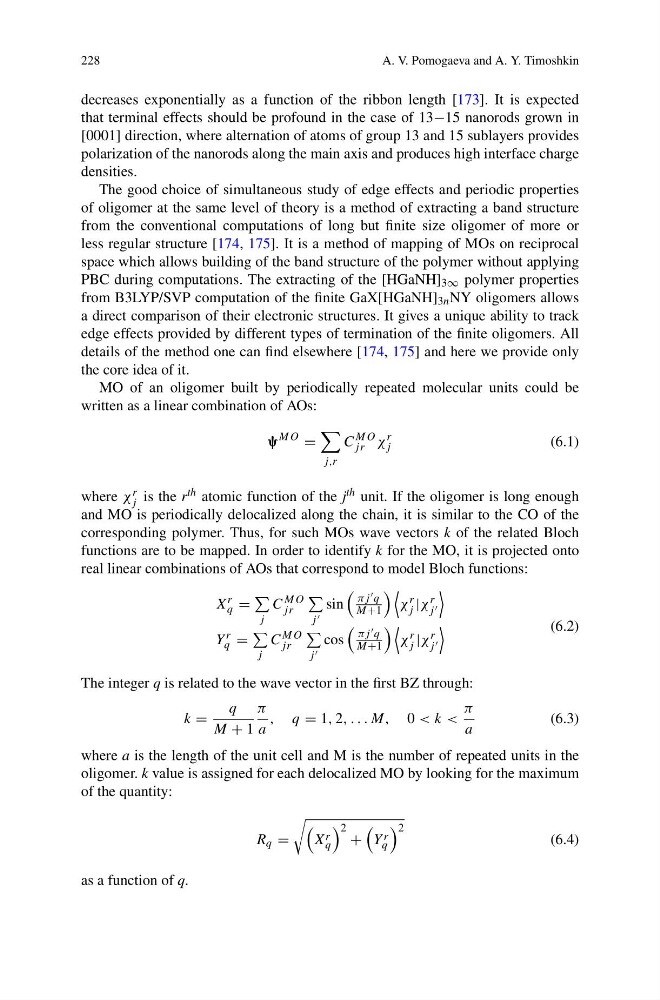
MO of an oligomer built by periodically repeated molecular units could be
written as a linear combination of AOs:
ψ
MO
=
j,r
C
MO
jr χ
r
j
(6.1)
where χ r
j is the r th atomic function of the j th unit. If the oligomer is long enough
and MO is periodically delocalized along the chain, it is similar to the CO of the
corresponding polymer. Thus, for such MOs wave vectors k of the related Bloch
functions are to be mapped. In order to identify k for the MO, it is projected onto
real linear combinations of AOs that correspond to model Bloch functions:
X r
q =
j
C MO
jr
j
sin
πj q
M+1
χ r
j |χ r
j
Y r
q =
j
C MO
jr
j
cos
πj q
M+1
χ r
j |χ r
j
(6.2)
The integer q is related to the wave vector in the first BZ through:
k =
q
M + 1
π
a
, q = 1, 2, . . . M, 0 < k <
π
a
(6.3)
where a is the length of the unit cell and M is the number of repeated units in the
oligomer. k value is assigned for each delocalized MO by looking for the maximum
of the quantity:
R q =
X r
q
2 +
Y r
q
2
(6.4)
as a function of q.
A. V. Pomogaeva and A. Y. Timoshkin
decreases exponentially as a function of the ribbon length [173]. It is expected
that terminal effects should be profound in the case of 13−15 nanorods grown in
[0001] direction, where alternation of atoms of group 13 and 15 sublayers provides
polarization of the nanorods along the main axis and produces high interface charge
densities.
The good choice of simultaneous study of edge effects and periodic properties
of oligomer at the same level of theory is a method of extracting a band structure
from the conventional computations of long but finite size oligomer of more or
less regular structure [174, 175]. It is a method of mapping of MOs on reciprocal
space which allows building of the band structure of the polymer without applying
PBC during computations. The extracting of the [HGaNH] 3∞ polymer properties
from B3LYP/SVP computation of the finite GaX[HGaNH] 3n NY oligomers allows
a direct comparison of their electronic structures. It gives a unique ability to track
edge effects provided by different types of termination of the finite oligomers. All
details of the method one can find elsewhere [174, 175] and here we provide only
the core idea of it.
MO of an oligomer built by periodically repeated molecular units could be
written as a linear combination of AOs:
ψ
MO
=
j,r
C
MO
jr χ
r
j
(6.1)
where χ r
j is the r th atomic function of the j th unit. If the oligomer is long enough
and MO is periodically delocalized along the chain, it is similar to the CO of the
corresponding polymer. Thus, for such MOs wave vectors k of the related Bloch
functions are to be mapped. In order to identify k for the MO, it is projected onto
real linear combinations of AOs that correspond to model Bloch functions:
X r
q =
j
C MO
jr
j
sin
πj q
M+1
χ r
j |χ r
j
Y r
q =
j
C MO
jr
j
cos
πj q
M+1
χ r
j |χ r
j
(6.2)
The integer q is related to the wave vector in the first BZ through:
k =
q
M + 1
π
a
, q = 1, 2, . . . M, 0 < k <
π
a
(6.3)
where a is the length of the unit cell and M is the number of repeated units in the
oligomer. k value is assigned for each delocalized MO by looking for the maximum
of the quantity:
R q =
X r
q
2 +
Y r
q
2
(6.4)
as a function of q.