

206
A. V. Pomogaeva and A. Y. Timoshkin
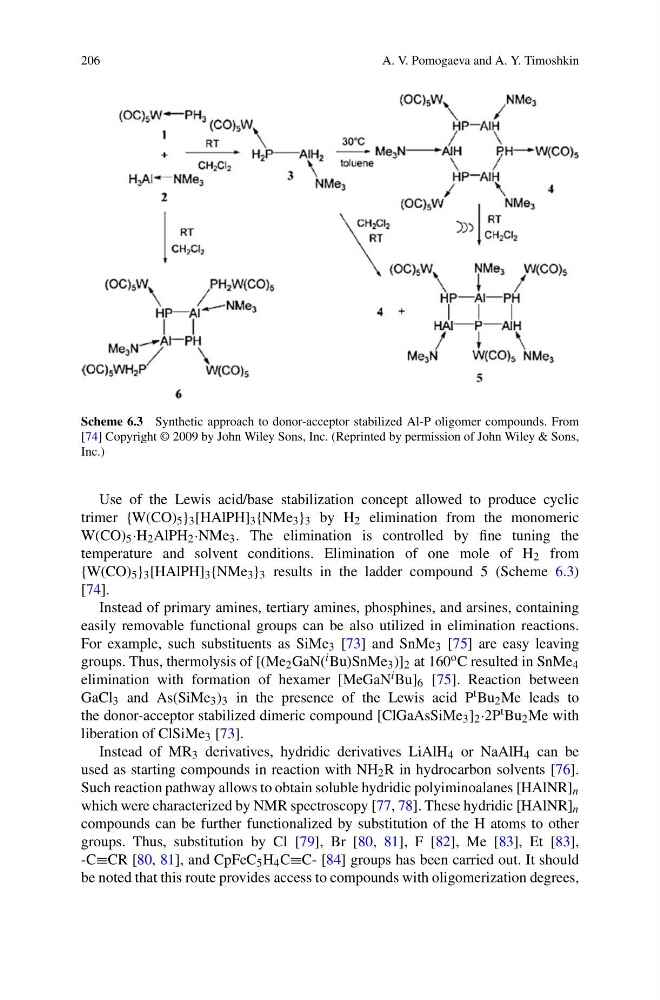
Scheme 6.3 Synthetic approach to donor-acceptor stabilized Al-P oligomer compounds. From
[74] Copyright © 2009 by John Wiley Sons, Inc. (Reprinted by permission of John Wiley & Sons,
Inc.)
Use of the Lewis acid/base stabilization concept allowed to produce cyclic
trimer {W(CO) 5 } 3 [HAlPH] 3 {NMe 3 } 3 by H 2 elimination from the monomeric
W(CO) 5 ·H 2 AlPH 2 ·NMe 3 . The elimination is controlled by fine tuning the
temperature and solvent conditions. Elimination of one mole of H 2 from
{W(CO) 5 } 3 [HAlPH] 3 {NMe 3 } 3 results in the ladder compound 5 (Scheme 6.3)
[74].
Instead of primary amines, tertiary amines, phosphines, and arsines, containing
easily removable functional groups can be also utilized in elimination reactions.
For example, such substituents as SiMe 3 [73] and SnMe 3 [75] are easy leaving
groups. Thus, thermolysis of [(Me 2 GaN( i Bu)SnMe 3 )] 2 at 160 o C resulted in SnMe 4
elimination with formation of hexamer [MeGaN i Bu] 6 [75]. Reaction between
GaCl 3 and As(SiMe 3 ) 3 in the presence of the Lewis acid P t Bu 2 Me leads to
the donor-acceptor stabilized dimeric compound [ClGaAsSiMe 3 ] 2 ·2P t Bu 2 Me with
liberation of ClSiMe 3 [73].
Instead of MR 3 derivatives, hydridic derivatives LiAlH 4 or NaAlH 4 can be
used as starting compounds in reaction with NH 2 R in hydrocarbon solvents [76].
Such reaction pathway allows to obtain soluble hydridic polyiminoalanes [HAlNR] n
which were characterized by NMR spectroscopy [77, 78]. These hydridic [HAlNR] n
compounds can be further functionalized by substitution of the H atoms to other
groups. Thus, substitution by Cl [79], Br [80, 81], F [82], Me [83], Et [83],
-C≡CR [80, 81], and CpFeC 5 H 4 C≡C- [84] groups has been carried out. It should
be noted that this route provides access to compounds with oligomerization degrees,
A. V. Pomogaeva and A. Y. Timoshkin
Scheme 6.3 Synthetic approach to donor-acceptor stabilized Al-P oligomer compounds. From
[74] Copyright © 2009 by John Wiley Sons, Inc. (Reprinted by permission of John Wiley & Sons,
Inc.)
Use of the Lewis acid/base stabilization concept allowed to produce cyclic
trimer {W(CO) 5 } 3 [HAlPH] 3 {NMe 3 } 3 by H 2 elimination from the monomeric
W(CO) 5 ·H 2 AlPH 2 ·NMe 3 . The elimination is controlled by fine tuning the
temperature and solvent conditions. Elimination of one mole of H 2 from
{W(CO) 5 } 3 [HAlPH] 3 {NMe 3 } 3 results in the ladder compound 5 (Scheme 6.3)
[74].
Instead of primary amines, tertiary amines, phosphines, and arsines, containing
easily removable functional groups can be also utilized in elimination reactions.
For example, such substituents as SiMe 3 [73] and SnMe 3 [75] are easy leaving
groups. Thus, thermolysis of [(Me 2 GaN( i Bu)SnMe 3 )] 2 at 160 o C resulted in SnMe 4
elimination with formation of hexamer [MeGaN i Bu] 6 [75]. Reaction between
GaCl 3 and As(SiMe 3 ) 3 in the presence of the Lewis acid P t Bu 2 Me leads to
the donor-acceptor stabilized dimeric compound [ClGaAsSiMe 3 ] 2 ·2P t Bu 2 Me with
liberation of ClSiMe 3 [73].
Instead of MR 3 derivatives, hydridic derivatives LiAlH 4 or NaAlH 4 can be
used as starting compounds in reaction with NH 2 R in hydrocarbon solvents [76].
Such reaction pathway allows to obtain soluble hydridic polyiminoalanes [HAlNR] n
which were characterized by NMR spectroscopy [77, 78]. These hydridic [HAlNR] n
compounds can be further functionalized by substitution of the H atoms to other
groups. Thus, substitution by Cl [79], Br [80, 81], F [82], Me [83], Et [83],
-C≡CR [80, 81], and CpFeC 5 H 4 C≡C- [84] groups has been carried out. It should
be noted that this route provides access to compounds with oligomerization degrees,