

178
S. Taioli
Drude-Lorentz Model
Within the DL model, the material response to an applied uniform external
electromagnetic field is approximated by considering the target screening electrons
as harmonic oscillators of frequency ω n =
E n
¯
h , where E n is the plasmon energy.
Charge oscillations are damped via a damping term n , which introduces frictionlike forces affecting the oscillatory harmonic motion.
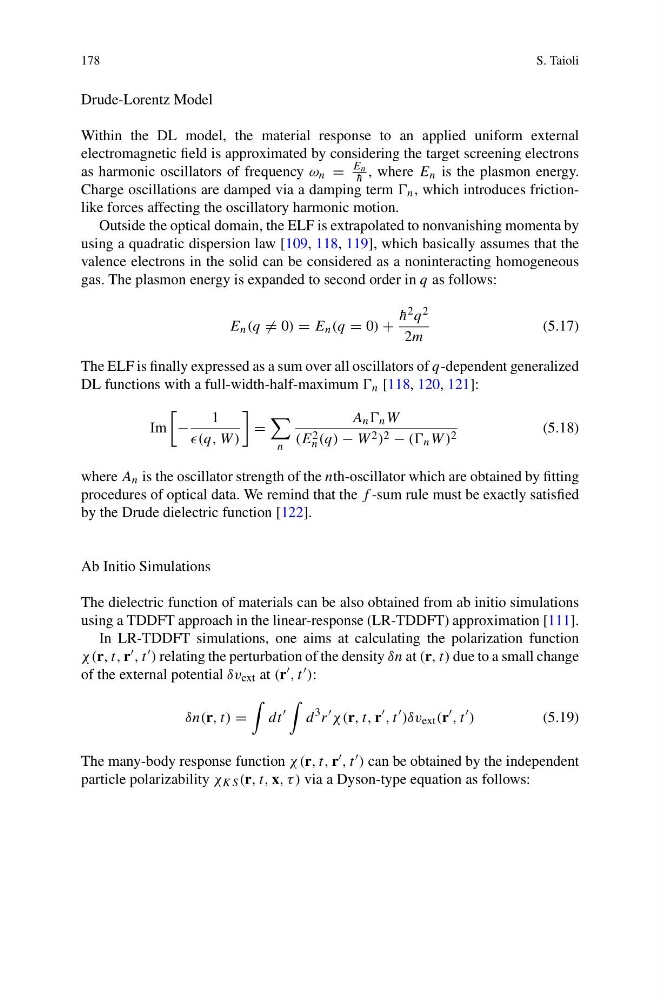
Outside the optical domain, the ELF is extrapolated to nonvanishing momenta by
using a quadratic dispersion law [109, 118, 119], which basically assumes that the
valence electrons in the solid can be considered as a noninteracting homogeneous
gas. The plasmon energy is expanded to second order in q as follows:
E n (q = 0) = E n (q = 0) +
¯
h 2 q 2
2m
(5.17)
The ELF is finally expressed as a sum over all oscillators of q-dependent generalized
DL functions with a full-width-half-maximum n [118, 120, 121]:
Im
−
1
W )
=
n
A n n W
(E 2
n (q) − W 2 ) 2 − (( n W ) 2
(5.18)
where A n is the oscillator strength of the nth-oscillator which are obtained by fitting
procedures of optical data. We remind that the f -sum rule must be exactly satisfied
by the Drude dielectric function [122].
Ab Initio Simulations
The dielectric function of materials can be also obtained from ab initio simulations
using a TDDFT approach in the linear-response (LR-TDDFT) approximation [111].
In LR-TDDFT simulations, one aims at calculating the polarization function
χ(r, t, r , t ) relating the perturbation of the density δn at (r, t) due to a small change
of the external potential δv ext at (r , t ):
δn(r, t) =
dt
d
3 r
χ(r, t, r
, t
)δv ext (r
, t
)
(5.19)
The many-body response function χ(r, t, r , t ) can be obtained by the independent
particle polarizability χ KS (r, t, x, τ ) via a Dyson-type equation as follows:
S. Taioli
Drude-Lorentz Model
Within the DL model, the material response to an applied uniform external
electromagnetic field is approximated by considering the target screening electrons
as harmonic oscillators of frequency ω n =
E n
¯
h , where E n is the plasmon energy.
Charge oscillations are damped via a damping term n , which introduces frictionlike forces affecting the oscillatory harmonic motion.
Outside the optical domain, the ELF is extrapolated to nonvanishing momenta by
using a quadratic dispersion law [109, 118, 119], which basically assumes that the
valence electrons in the solid can be considered as a noninteracting homogeneous
gas. The plasmon energy is expanded to second order in q as follows:
E n (q = 0) = E n (q = 0) +
¯
h 2 q 2
2m
(5.17)
The ELF is finally expressed as a sum over all oscillators of q-dependent generalized
DL functions with a full-width-half-maximum n [118, 120, 121]:
Im
−
1
W )
=
n
A n n W
(E 2
n (q) − W 2 ) 2 − (( n W ) 2
(5.18)
where A n is the oscillator strength of the nth-oscillator which are obtained by fitting
procedures of optical data. We remind that the f -sum rule must be exactly satisfied
by the Drude dielectric function [122].
Ab Initio Simulations
The dielectric function of materials can be also obtained from ab initio simulations
using a TDDFT approach in the linear-response (LR-TDDFT) approximation [111].
In LR-TDDFT simulations, one aims at calculating the polarization function
χ(r, t, r , t ) relating the perturbation of the density δn at (r, t) due to a small change
of the external potential δv ext at (r , t ):
δn(r, t) =
dt
d
3 r
χ(r, t, r
, t
)δv ext (r
, t
)
(5.19)
The many-body response function χ(r, t, r , t ) can be obtained by the independent
particle polarizability χ KS (r, t, x, τ ) via a Dyson-type equation as follows: