

176
S. Taioli
q), while collective many-electron excitations (plasmons), which are typical of
the condensed phase, are related to the minima of (W, q), which usually appear if
the two conditions [ q)] ] 1 and [(W, q)] = 0 occur. From the knowledge
of (W, q), one can calculate observables of paramount importance for designing
novel optical and electronic devices, such as inelastic mean free path, stopping
power, plasmons and secondary electron spectra.
To compute the dielectric function dependence on the energy and transferred
momentum, one can proceed along three different routes [18]. First, one may
use a semiclassical approach, whereby one assumes the knowledge of the long
wavelength or optical limit of the dielectric function (q → 0); this information
is usually provided by experimental measurements of optical absorption [103],
transmission electron energy-loss experiments [104, 105] or ab initio simulations
[106]. To go beyond the optical limit, one can extend the dielectric response
to finite momenta by using a Drude-Lotentz (DL) model. In this approach, the
dielectric function is approximated by a number of damped harmonic oscillators
with frequencies equal to the plasmon frequencies obtained by fitting experimental
data [107, 108] and a friction-type force to simulate general dissipative processes;
this extension of the dielectric response to finite momenta with the DL functions
represents the most accurate approach available [109]. The second viable approach
concerns the ab initio calculation of the dielectric response for vanishing momentum
transfer and then its extension to finite momenta by a DL model. Finally, one could
assess the dispersion law of the dielectric function at finite momentum q by using a
full ab initio (AI) approach, based on time-dependent density functional simulations
[110] in the linear-response regime (LR-TDDFT) [111–113].
The so-derived dielectric functions are used as input for a Monte Carlo description of the inelastic scattering probability to calculate the energy loss of electrons
along their path within the solid. The comparison between our simulated and
recorded REELS allows us to assess the impact that external tuneable parameters
and semiclassical assumptions might have on the accuracy of simulated spectral
line shapes for the characterization of 3D carbon-based materials.
Frequency- and Momentum-Dependent Dielectric Function
The microscopic representation of electromagnetic fields in interaction with periodic crystals can be described in terms of the microscopic dielectric function
G,G (q, W ) = (q + G, q + G , W ), where G and G are the lattice vectors
in the reciprocal space, while q is the transferred momentum contained in the
first Brillouin zone. The relation between the latter quantity, which is usually the
outcome of ab initio simulations, and the experimentally measurable macroscopic
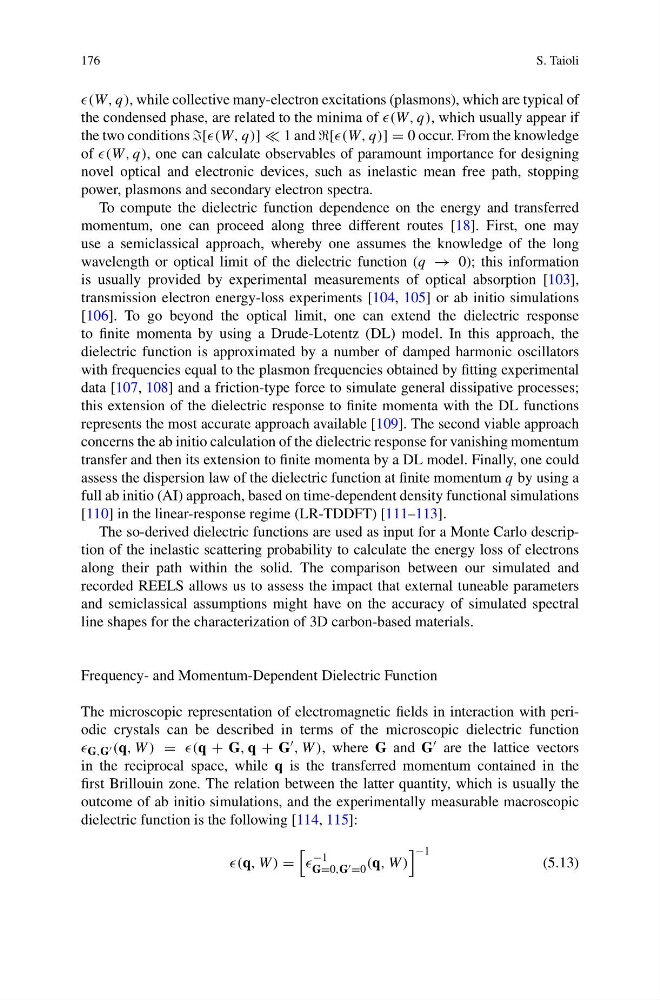
dielectric function is the following [114, 115]:
(q, W ) =
−1
G=0,G =0 (q, W )
−1
(5.13)
S. Taioli
q), while collective many-electron excitations (plasmons), which are typical of
the condensed phase, are related to the minima of (W, q), which usually appear if
the two conditions [ q)] ] 1 and [(W, q)] = 0 occur. From the knowledge
of (W, q), one can calculate observables of paramount importance for designing
novel optical and electronic devices, such as inelastic mean free path, stopping
power, plasmons and secondary electron spectra.
To compute the dielectric function dependence on the energy and transferred
momentum, one can proceed along three different routes [18]. First, one may
use a semiclassical approach, whereby one assumes the knowledge of the long
wavelength or optical limit of the dielectric function (q → 0); this information
is usually provided by experimental measurements of optical absorption [103],
transmission electron energy-loss experiments [104, 105] or ab initio simulations
[106]. To go beyond the optical limit, one can extend the dielectric response
to finite momenta by using a Drude-Lotentz (DL) model. In this approach, the
dielectric function is approximated by a number of damped harmonic oscillators
with frequencies equal to the plasmon frequencies obtained by fitting experimental
data [107, 108] and a friction-type force to simulate general dissipative processes;
this extension of the dielectric response to finite momenta with the DL functions
represents the most accurate approach available [109]. The second viable approach
concerns the ab initio calculation of the dielectric response for vanishing momentum
transfer and then its extension to finite momenta by a DL model. Finally, one could
assess the dispersion law of the dielectric function at finite momentum q by using a
full ab initio (AI) approach, based on time-dependent density functional simulations
[110] in the linear-response regime (LR-TDDFT) [111–113].
The so-derived dielectric functions are used as input for a Monte Carlo description of the inelastic scattering probability to calculate the energy loss of electrons
along their path within the solid. The comparison between our simulated and
recorded REELS allows us to assess the impact that external tuneable parameters
and semiclassical assumptions might have on the accuracy of simulated spectral
line shapes for the characterization of 3D carbon-based materials.
Frequency- and Momentum-Dependent Dielectric Function
The microscopic representation of electromagnetic fields in interaction with periodic crystals can be described in terms of the microscopic dielectric function
G,G (q, W ) = (q + G, q + G , W ), where G and G are the lattice vectors
in the reciprocal space, while q is the transferred momentum contained in the
first Brillouin zone. The relation between the latter quantity, which is usually the
outcome of ab initio simulations, and the experimentally measurable macroscopic
dielectric function is the following [114, 115]:
(q, W ) =
−1
G=0,G =0 (q, W )
−1
(5.13)