

5 Enabling Materials By Dimensionality: From 0D to 3D Carbon-Based. . .
171
of the self-energy operator, respectively. In this approach, c is found from the
convolution of the one-body Green’s function G 0 , obtained from DFT calculations,
with the correlation part of the screened Coulomb potential W c
0 , obtained at randomphase approximation level (RPA [84]):
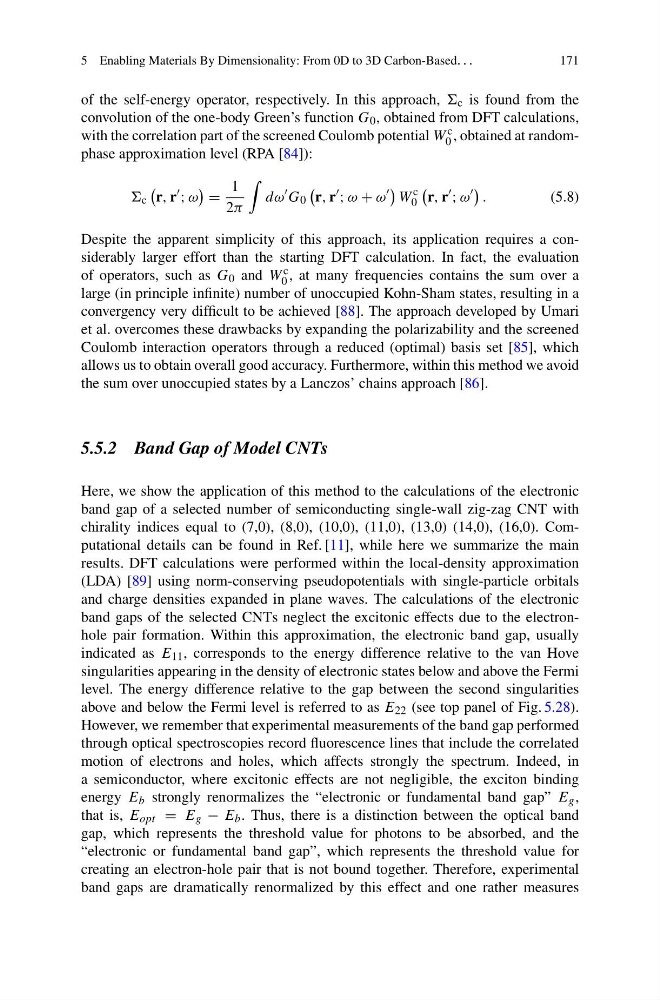
c
r, r
; ω
=
1
2π
dω
G 0
r, r
; ω + ω
W
c
0
r, r
; ω
.
(5.8)
Despite the apparent simplicity of this approach, its application requires a considerably larger effort than the starting DFT calculation. In fact, the evaluation
of operators, such as G 0 and W c
0 , at many frequencies contains the sum over a
large (in principle infinite) number of unoccupied Kohn-Sham states, resulting in a
convergency very difficult to be achieved [88]. The approach developed by Umari
et al. overcomes these drawbacks by expanding the polarizability and the screened
Coulomb interaction operators through a reduced (optimal) basis set [85], which
allows us to obtain overall good accuracy. Furthermore, within this method we avoid
the sum over unoccupied states by a Lanczos’ chains approach [86].
5.5.2 Band Gap of Model CNTs
Here, we show the application of this method to the calculations of the electronic
band gap of a selected number of semiconducting single-wall zig-zag CNT with
chirality indices equal to (7,0), (8,0), (10,0), (11,0), (13,0) (14,0), (16,0). Computational details can be found in Ref. [11], while here we summarize the main
results. DFT calculations were performed within the local-density approximation
(LDA) [89] using norm-conserving pseudopotentials with single-particle orbitals
and charge densities expanded in plane waves. The calculations of the electronic
band gaps of the selected CNTs neglect the excitonic effects due to the electronhole pair formation. Within this approximation, the electronic band gap, usually
indicated as E 11 , corresponds to the energy difference relative to the van Hove
singularities appearing in the density of electronic states below and above the Fermi
level. The energy difference relative to the gap between the second singularities
above and below the Fermi level is referred to as E 22 (see top panel of Fig. 5.28).
However, we remember that experimental measurements of the band gap performed
through optical spectroscopies record fluorescence lines that include the correlated
motion of electrons and holes, which affects strongly the spectrum. Indeed, in
a semiconductor, where excitonic effects are not negligible, the exciton binding
energy E b strongly renormalizes the “electronic or fundamental band gap” E g ,
that is, E opt = E g − E b . Thus, there is a distinction between the optical band
gap, which represents the threshold value for photons to be absorbed, and the
“electronic or fundamental band gap”, which represents the threshold value for
creating an electron-hole pair that is not bound together. Therefore, experimental
band gaps are dramatically renormalized by this effect and one rather measures
171
of the self-energy operator, respectively. In this approach, c is found from the
convolution of the one-body Green’s function G 0 , obtained from DFT calculations,
with the correlation part of the screened Coulomb potential W c
0 , obtained at randomphase approximation level (RPA [84]):
c
r, r
; ω
=
1
2π
dω
G 0
r, r
; ω + ω
W
c
0
r, r
; ω
.
(5.8)
Despite the apparent simplicity of this approach, its application requires a considerably larger effort than the starting DFT calculation. In fact, the evaluation
of operators, such as G 0 and W c
0 , at many frequencies contains the sum over a
large (in principle infinite) number of unoccupied Kohn-Sham states, resulting in a
convergency very difficult to be achieved [88]. The approach developed by Umari
et al. overcomes these drawbacks by expanding the polarizability and the screened
Coulomb interaction operators through a reduced (optimal) basis set [85], which
allows us to obtain overall good accuracy. Furthermore, within this method we avoid
the sum over unoccupied states by a Lanczos’ chains approach [86].
5.5.2 Band Gap of Model CNTs
Here, we show the application of this method to the calculations of the electronic
band gap of a selected number of semiconducting single-wall zig-zag CNT with
chirality indices equal to (7,0), (8,0), (10,0), (11,0), (13,0) (14,0), (16,0). Computational details can be found in Ref. [11], while here we summarize the main
results. DFT calculations were performed within the local-density approximation
(LDA) [89] using norm-conserving pseudopotentials with single-particle orbitals
and charge densities expanded in plane waves. The calculations of the electronic
band gaps of the selected CNTs neglect the excitonic effects due to the electronhole pair formation. Within this approximation, the electronic band gap, usually
indicated as E 11 , corresponds to the energy difference relative to the van Hove
singularities appearing in the density of electronic states below and above the Fermi
level. The energy difference relative to the gap between the second singularities
above and below the Fermi level is referred to as E 22 (see top panel of Fig. 5.28).
However, we remember that experimental measurements of the band gap performed
through optical spectroscopies record fluorescence lines that include the correlated
motion of electrons and holes, which affects strongly the spectrum. Indeed, in
a semiconductor, where excitonic effects are not negligible, the exciton binding
energy E b strongly renormalizes the “electronic or fundamental band gap” E g ,
that is, E opt = E g − E b . Thus, there is a distinction between the optical band
gap, which represents the threshold value for photons to be absorbed, and the
“electronic or fundamental band gap”, which represents the threshold value for
creating an electron-hole pair that is not bound together. Therefore, experimental
band gaps are dramatically renormalized by this effect and one rather measures