

5 Enabling Materials By Dimensionality: From 0D to 3D Carbon-Based. . .
169
a quantum fields in a space-time with a horizon should exhibit a thermal character.
This effect is closely related to the local density of states (LDOS) of the graphene
pseudosphere, which could be possibly considered as a black hole analogue. Indeed,
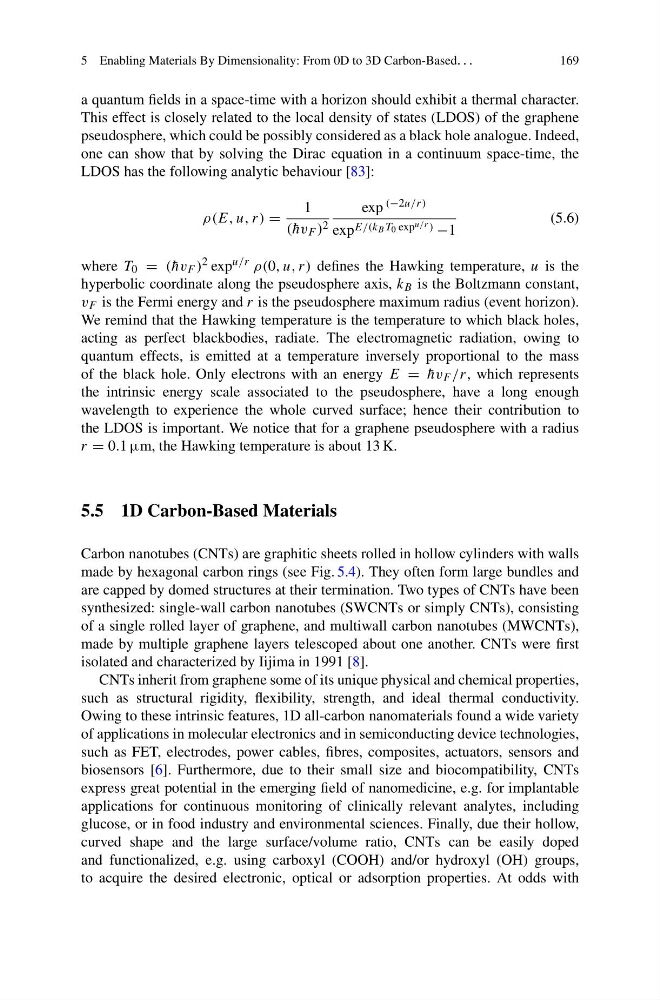
one can show that by solving the Dirac equation in a continuum space-time, the
LDOS has the following analytic behaviour [83]:
ρ(E, u, r) =
1
( ¯
hv F ) 2
exp (−2u/r)
exp E/(k B T 0 exp u/r ) −1
(5.6)
where T 0 = ( ¯
hv F ) 2 exp u/r ρ(0, u, r) defines the Hawking temperature, u is the
hyperbolic coordinate along the pseudosphere axis, k B is the Boltzmann constant,
v F is the Fermi energy and r is the pseudosphere maximum radius (event horizon).
We remind that the Hawking temperature is the temperature to which black holes,
acting as perfect blackbodies, radiate. The electromagnetic radiation, owing to
quantum effects, is emitted at a temperature inversely proportional to the mass
of the black hole. Only electrons with an energy E = ¯
hv F /r, which represents
the intrinsic energy scale associated to the pseudosphere, have a long enough
wavelength to experience the whole curved surface; hence their contribution to
the LDOS is important. We notice that for a graphene pseudosphere with a radius
r = 0.1 μm, the Hawking temperature is about 13 K.
5.5 1D Carbon-Based Materials
Carbon nanotubes (CNTs) are graphitic sheets rolled in hollow cylinders with walls
made by hexagonal carbon rings (see Fig. 5.4). They often form large bundles and
are capped by domed structures at their termination. Two types of CNTs have been
synthesized: single-wall carbon nanotubes (SWCNTs or simply CNTs), consisting
of a single rolled layer of graphene, and multiwall carbon nanotubes (MWCNTs),
made by multiple graphene layers telescoped about one another. CNTs were first
isolated and characterized by Iijima in 1991 [8].
CNTs inherit from graphene some of its unique physical and chemical properties,
such as structural rigidity, flexibility, strength, and ideal thermal conductivity.
Owing to these intrinsic features, 1D all-carbon nanomaterials found a wide variety
of applications in molecular electronics and in semiconducting device technologies,
such as FET, electrodes, power cables, fibres, composites, actuators, sensors and
biosensors [6]. Furthermore, due to their small size and biocompatibility, CNTs
express great potential in the emerging field of nanomedicine, e.g. for implantable
applications for continuous monitoring of clinically relevant analytes, including
glucose, or in food industry and environmental sciences. Finally, due their hollow,
curved shape and the large surface/volume ratio, CNTs can be easily doped
and functionalized, e.g. using carboxyl (COOH) and/or hydroxyl (OH) groups,
to acquire the desired electronic, optical or adsorption properties. At odds with
169
a quantum fields in a space-time with a horizon should exhibit a thermal character.
This effect is closely related to the local density of states (LDOS) of the graphene
pseudosphere, which could be possibly considered as a black hole analogue. Indeed,
one can show that by solving the Dirac equation in a continuum space-time, the
LDOS has the following analytic behaviour [83]:
ρ(E, u, r) =
1
( ¯
hv F ) 2
exp (−2u/r)
exp E/(k B T 0 exp u/r ) −1
(5.6)
where T 0 = ( ¯
hv F ) 2 exp u/r ρ(0, u, r) defines the Hawking temperature, u is the
hyperbolic coordinate along the pseudosphere axis, k B is the Boltzmann constant,
v F is the Fermi energy and r is the pseudosphere maximum radius (event horizon).
We remind that the Hawking temperature is the temperature to which black holes,
acting as perfect blackbodies, radiate. The electromagnetic radiation, owing to
quantum effects, is emitted at a temperature inversely proportional to the mass
of the black hole. Only electrons with an energy E = ¯
hv F /r, which represents
the intrinsic energy scale associated to the pseudosphere, have a long enough
wavelength to experience the whole curved surface; hence their contribution to
the LDOS is important. We notice that for a graphene pseudosphere with a radius
r = 0.1 μm, the Hawking temperature is about 13 K.
5.5 1D Carbon-Based Materials
Carbon nanotubes (CNTs) are graphitic sheets rolled in hollow cylinders with walls
made by hexagonal carbon rings (see Fig. 5.4). They often form large bundles and
are capped by domed structures at their termination. Two types of CNTs have been
synthesized: single-wall carbon nanotubes (SWCNTs or simply CNTs), consisting
of a single rolled layer of graphene, and multiwall carbon nanotubes (MWCNTs),
made by multiple graphene layers telescoped about one another. CNTs were first
isolated and characterized by Iijima in 1991 [8].
CNTs inherit from graphene some of its unique physical and chemical properties,
such as structural rigidity, flexibility, strength, and ideal thermal conductivity.
Owing to these intrinsic features, 1D all-carbon nanomaterials found a wide variety
of applications in molecular electronics and in semiconducting device technologies,
such as FET, electrodes, power cables, fibres, composites, actuators, sensors and
biosensors [6]. Furthermore, due to their small size and biocompatibility, CNTs
express great potential in the emerging field of nanomedicine, e.g. for implantable
applications for continuous monitoring of clinically relevant analytes, including
glucose, or in food industry and environmental sciences. Finally, due their hollow,
curved shape and the large surface/volume ratio, CNTs can be easily doped
and functionalized, e.g. using carboxyl (COOH) and/or hydroxyl (OH) groups,
to acquire the desired electronic, optical or adsorption properties. At odds with