

168
S. Taioli
5.4 Graphene Pseudospheres
Graphene is a versatile material, which can be arranged in the shape of stripes
(nanoribbons), rolled nanotubes or piled up in the direction orthogonal to its plane
(graphite). So, it is a legitimate thinking to search for other shapes.
In this respect, Beltrami’s pseudosphere, named after the Italian mathematician
Eugenio Beltrami who first devised this hyperbolic shape, is a surface of revolution
characterized by constant negative Gaussian curvature. Thus, it represents the
negative counterpart of the sphere which, at odds, is characterized by constant
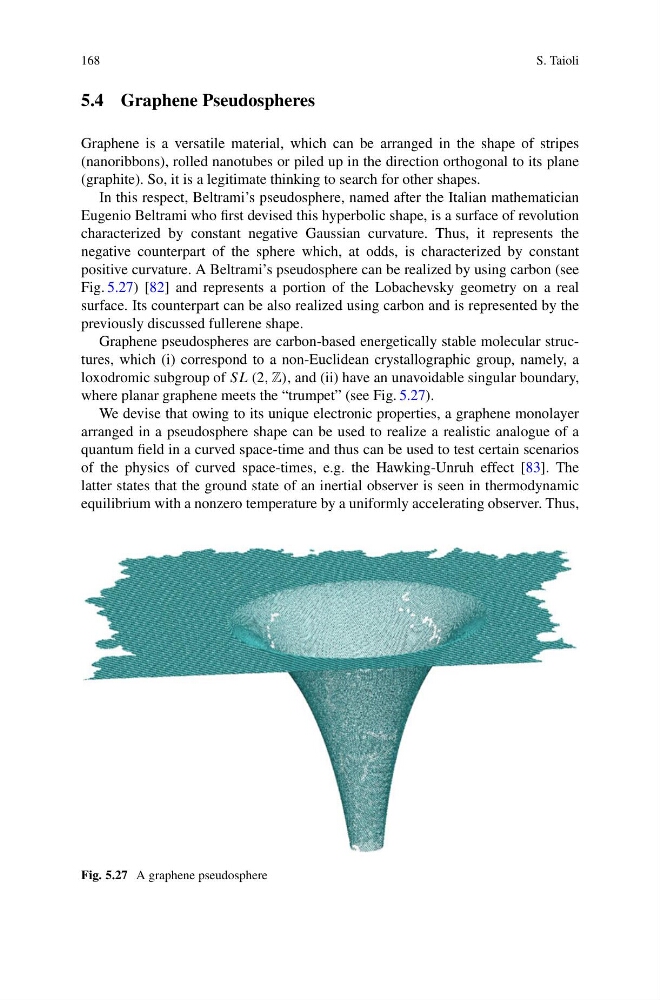
positive curvature. A Beltrami’s pseudosphere can be realized by using carbon (see
Fig. 5.27) [82] and represents a portion of the Lobachevsky geometry on a real
surface. Its counterpart can be also realized using carbon and is represented by the
previously discussed fullerene shape.
Graphene pseudospheres are carbon-based energetically stable molecular structures, which (i) correspond to a non-Euclidean crystallographic group, namely, a
loxodromic subgroup of SL (2, Z), and (ii) have an unavoidable singular boundary,
where planar graphene meets the “trumpet” (see Fig. 5.27).
We devise that owing to its unique electronic properties, a graphene monolayer
arranged in a pseudosphere shape can be used to realize a realistic analogue of a
quantum field in a curved space-time and thus can be used to test certain scenarios
of the physics of curved space-times, e.g. the Hawking-Unruh effect [83]. The
latter states that the ground state of an inertial observer is seen in thermodynamic
equilibrium with a nonzero temperature by a uniformly accelerating observer. Thus,
Fig. 5.27 A graphene pseudosphere
S. Taioli
5.4 Graphene Pseudospheres
Graphene is a versatile material, which can be arranged in the shape of stripes
(nanoribbons), rolled nanotubes or piled up in the direction orthogonal to its plane
(graphite). So, it is a legitimate thinking to search for other shapes.
In this respect, Beltrami’s pseudosphere, named after the Italian mathematician
Eugenio Beltrami who first devised this hyperbolic shape, is a surface of revolution
characterized by constant negative Gaussian curvature. Thus, it represents the
negative counterpart of the sphere which, at odds, is characterized by constant
positive curvature. A Beltrami’s pseudosphere can be realized by using carbon (see
Fig. 5.27) [82] and represents a portion of the Lobachevsky geometry on a real
surface. Its counterpart can be also realized using carbon and is represented by the
previously discussed fullerene shape.
Graphene pseudospheres are carbon-based energetically stable molecular structures, which (i) correspond to a non-Euclidean crystallographic group, namely, a
loxodromic subgroup of SL (2, Z), and (ii) have an unavoidable singular boundary,
where planar graphene meets the “trumpet” (see Fig. 5.27).
We devise that owing to its unique electronic properties, a graphene monolayer
arranged in a pseudosphere shape can be used to realize a realistic analogue of a
quantum field in a curved space-time and thus can be used to test certain scenarios
of the physics of curved space-times, e.g. the Hawking-Unruh effect [83]. The
latter states that the ground state of an inertial observer is seen in thermodynamic
equilibrium with a nonzero temperature by a uniformly accelerating observer. Thus,
Fig. 5.27 A graphene pseudosphere