

120
S. Yanagisawa and I. Hamada
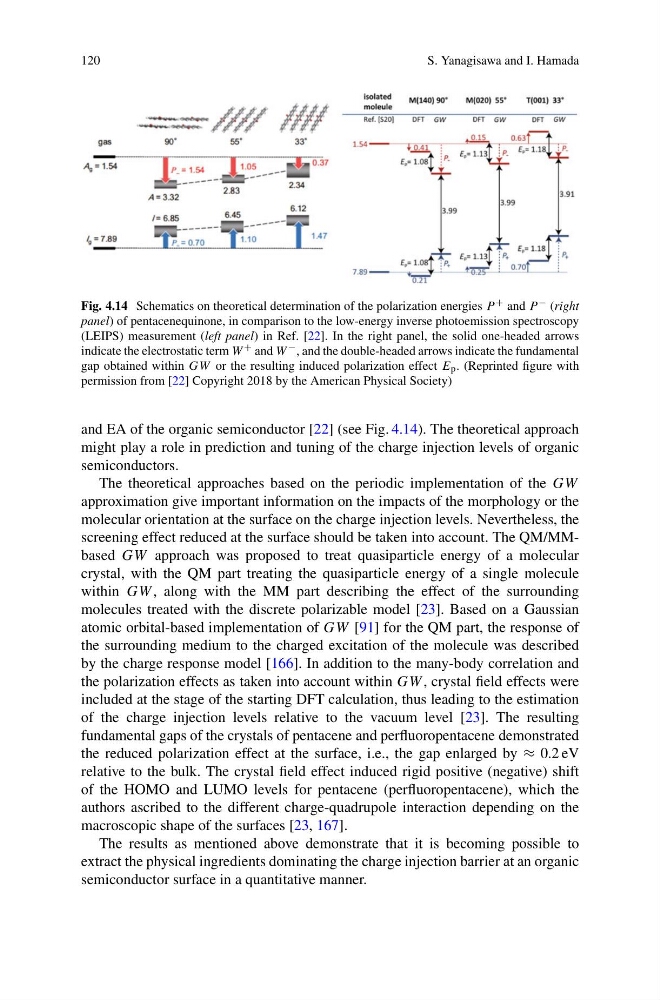
Fig. 4.14 Schematics on theoretical determination of the polarization energies P + and P − (right
panel) of pentacenequinone, in comparison to the low-energy inverse photoemission spectroscopy
(LEIPS) measurement (left panel) in Ref. [22]. In the right panel, the solid one-headed arrows
indicate the electrostatic term W + and W − , and the double-headed arrows indicate the fundamental
gap obtained within GW or the resulting induced polarization effect E p . (Reprinted figure with
permission from [22] Copyright 2018 by the American Physical Society)
and EA of the organic semiconductor [22] (see Fig. 4.14). The theoretical approach
might play a role in prediction and tuning of the charge injection levels of organic
semiconductors.
The theoretical approaches based on the periodic implementation of the GW
approximation give important information on the impacts of the morphology or the
molecular orientation at the surface on the charge injection levels. Nevertheless, the
screening effect reduced at the surface should be taken into account. The QM/MMbased GW approach was proposed to treat quasiparticle energy of a molecular
crystal, with the QM part treating the quasiparticle energy of a single molecule
within GW , along with the MM part describing the effect of the surrounding
molecules treated with the discrete polarizable model [23]. Based on a Gaussian
atomic orbital-based implementation of GW [91] for the QM part, the response of
the surrounding medium to the charged excitation of the molecule was described
by the charge response model [166]. In addition to the many-body correlation and
the polarization effects as taken into account within GW , crystal field effects were
included at the stage of the starting DFT calculation, thus leading to the estimation
of the charge injection levels relative to the vacuum level [23]. The resulting
fundamental gaps of the crystals of pentacene and perfluoropentacene demonstrated
the reduced polarization effect at the surface, i.e., the gap enlarged by ≈ 0.2 eV
relative to the bulk. The crystal field effect induced rigid positive (negative) shift
of the HOMO and LUMO levels for pentacene (perfluoropentacene), which the
authors ascribed to the different charge-quadrupole interaction depending on the
macroscopic shape of the surfaces [23, 167].
The results as mentioned above demonstrate that it is becoming possible to
extract the physical ingredients dominating the charge injection barrier at an organic
semiconductor surface in a quantitative manner.
S. Yanagisawa and I. Hamada
Fig. 4.14 Schematics on theoretical determination of the polarization energies P + and P − (right
panel) of pentacenequinone, in comparison to the low-energy inverse photoemission spectroscopy
(LEIPS) measurement (left panel) in Ref. [22]. In the right panel, the solid one-headed arrows
indicate the electrostatic term W + and W − , and the double-headed arrows indicate the fundamental
gap obtained within GW or the resulting induced polarization effect E p . (Reprinted figure with
permission from [22] Copyright 2018 by the American Physical Society)
and EA of the organic semiconductor [22] (see Fig. 4.14). The theoretical approach
might play a role in prediction and tuning of the charge injection levels of organic
semiconductors.
The theoretical approaches based on the periodic implementation of the GW
approximation give important information on the impacts of the morphology or the
molecular orientation at the surface on the charge injection levels. Nevertheless, the
screening effect reduced at the surface should be taken into account. The QM/MMbased GW approach was proposed to treat quasiparticle energy of a molecular
crystal, with the QM part treating the quasiparticle energy of a single molecule
within GW , along with the MM part describing the effect of the surrounding
molecules treated with the discrete polarizable model [23]. Based on a Gaussian
atomic orbital-based implementation of GW [91] for the QM part, the response of
the surrounding medium to the charged excitation of the molecule was described
by the charge response model [166]. In addition to the many-body correlation and
the polarization effects as taken into account within GW , crystal field effects were
included at the stage of the starting DFT calculation, thus leading to the estimation
of the charge injection levels relative to the vacuum level [23]. The resulting
fundamental gaps of the crystals of pentacene and perfluoropentacene demonstrated
the reduced polarization effect at the surface, i.e., the gap enlarged by ≈ 0.2 eV
relative to the bulk. The crystal field effect induced rigid positive (negative) shift
of the HOMO and LUMO levels for pentacene (perfluoropentacene), which the
authors ascribed to the different charge-quadrupole interaction depending on the
macroscopic shape of the surfaces [23, 167].
The results as mentioned above demonstrate that it is becoming possible to
extract the physical ingredients dominating the charge injection barrier at an organic
semiconductor surface in a quantitative manner.