

4 Nanoscale First-Principles Electronic Structure Simulations of Materials. . .
119
orientation at the surface. As mentioned in the previous subsection, a rigorous theoretical method describing quasiparticle energy, for instance, GW approximation,
requires fairly large computational resources, thus rendering difficult the application
of the methodologies to a surface or an interface represented by a periodic slab
model with a sufficiently thick vacuum layer.
To circumvent the computational difficulty, it was proposed recently that the
electrostatic potential represented by a slab model within DFT-GGA approximation
could be aligned to the electrostatic potential determined for a bulk system within
the GW approximation [21]. The valence and conduction band edge energies (or
HOMO- and LUMO-derived energies) of the bulk determined at the GW level of
theory could be shifted according to the electrostatic potential of the surface slab
model, for which a well-defined vacuum level could be determined. Overall, the
resulting IE and EA are in fair agreement with experiments. The slightly smaller
band gap than the experimental values may be ascribed to the different polarization
effects in bulk and surface.
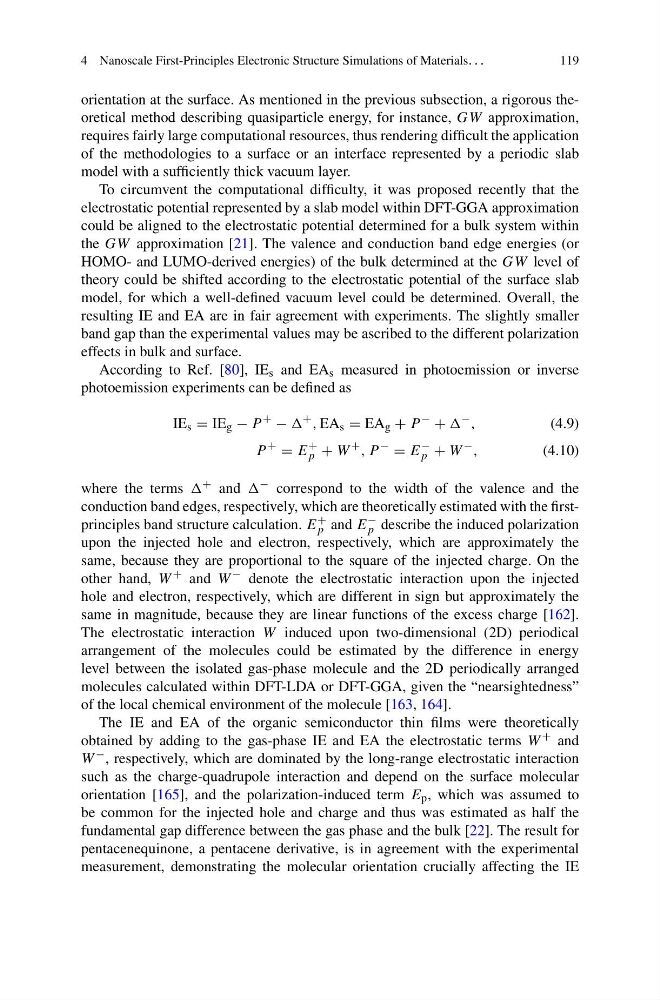
According to Ref. [80], IE s and EA s measured in photoemission or inverse
photoemission experiments can be defined as
IE s = IE g − P
+
−
+ , EA s = EA g + P
−
+
− ,
(4.9)
P
+
= E
+
p + W
+ , P
−
= E
−
p + W
− ,
(4.10)
where the terms + and − correspond to the width of the valence and the
conduction band edges, respectively, which are theoretically estimated with the firstprinciples band structure calculation. E +
p and E −
p describe the induced polarization
upon the injected hole and electron, respectively, which are approximately the
same, because they are proportional to the square of the injected charge. On the
other hand, W + and W − denote the electrostatic interaction upon the injected
hole and electron, respectively, which are different in sign but approximately the
same in magnitude, because they are linear functions of the excess charge [162].
The electrostatic interaction W induced upon two-dimensional (2D) periodical
arrangement of the molecules could be estimated by the difference in energy
level between the isolated gas-phase molecule and the 2D periodically arranged
molecules calculated within DFT-LDA or DFT-GGA, given the “nearsightedness”
of the local chemical environment of the molecule [163, 164].
The IE and EA of the organic semiconductor thin films were theoretically
obtained by adding to the gas-phase IE and EA the electrostatic terms W + and
W − , respectively, which are dominated by the long-range electrostatic interaction
such as the charge-quadrupole interaction and depend on the surface molecular
orientation [165], and the polarization-induced term E p , which was assumed to
be common for the injected hole and charge and thus was estimated as half the
fundamental gap difference between the gas phase and the bulk [22]. The result for
pentacenequinone, a pentacene derivative, is in agreement with the experimental
measurement, demonstrating the molecular orientation crucially affecting the IE
119
orientation at the surface. As mentioned in the previous subsection, a rigorous theoretical method describing quasiparticle energy, for instance, GW approximation,
requires fairly large computational resources, thus rendering difficult the application
of the methodologies to a surface or an interface represented by a periodic slab
model with a sufficiently thick vacuum layer.
To circumvent the computational difficulty, it was proposed recently that the
electrostatic potential represented by a slab model within DFT-GGA approximation
could be aligned to the electrostatic potential determined for a bulk system within
the GW approximation [21]. The valence and conduction band edge energies (or
HOMO- and LUMO-derived energies) of the bulk determined at the GW level of
theory could be shifted according to the electrostatic potential of the surface slab
model, for which a well-defined vacuum level could be determined. Overall, the
resulting IE and EA are in fair agreement with experiments. The slightly smaller
band gap than the experimental values may be ascribed to the different polarization
effects in bulk and surface.
According to Ref. [80], IE s and EA s measured in photoemission or inverse
photoemission experiments can be defined as
IE s = IE g − P
+
−
+ , EA s = EA g + P
−
+
− ,
(4.9)
P
+
= E
+
p + W
+ , P
−
= E
−
p + W
− ,
(4.10)
where the terms + and − correspond to the width of the valence and the
conduction band edges, respectively, which are theoretically estimated with the firstprinciples band structure calculation. E +
p and E −
p describe the induced polarization
upon the injected hole and electron, respectively, which are approximately the
same, because they are proportional to the square of the injected charge. On the
other hand, W + and W − denote the electrostatic interaction upon the injected
hole and electron, respectively, which are different in sign but approximately the
same in magnitude, because they are linear functions of the excess charge [162].
The electrostatic interaction W induced upon two-dimensional (2D) periodical
arrangement of the molecules could be estimated by the difference in energy
level between the isolated gas-phase molecule and the 2D periodically arranged
molecules calculated within DFT-LDA or DFT-GGA, given the “nearsightedness”
of the local chemical environment of the molecule [163, 164].
The IE and EA of the organic semiconductor thin films were theoretically
obtained by adding to the gas-phase IE and EA the electrostatic terms W + and
W − , respectively, which are dominated by the long-range electrostatic interaction
such as the charge-quadrupole interaction and depend on the surface molecular
orientation [165], and the polarization-induced term E p , which was assumed to
be common for the injected hole and charge and thus was estimated as half the
fundamental gap difference between the gas phase and the bulk [22]. The result for
pentacenequinone, a pentacene derivative, is in agreement with the experimental
measurement, demonstrating the molecular orientation crucially affecting the IE