

104
S. Yanagisawa and I. Hamada
(a)
(b)
H−2
H−1
H
H−4
H−3
L
L+1
Exp.
DOS (states·eV
−1
)
Energy (eV)
0.0
4.0
8.0
12.0
16.0
-6.0 -5.0 -4.0 -3.0 -2.0 -1.0 0.0 1.0 2.0 3.0
DOS (arb. unit)
X
Y L
Z N
-2.0
0.0
2.0
4.0
Energy (eV)
H−2
H−1
H
H−4
H−3
L
L+1
W H
W L
E g
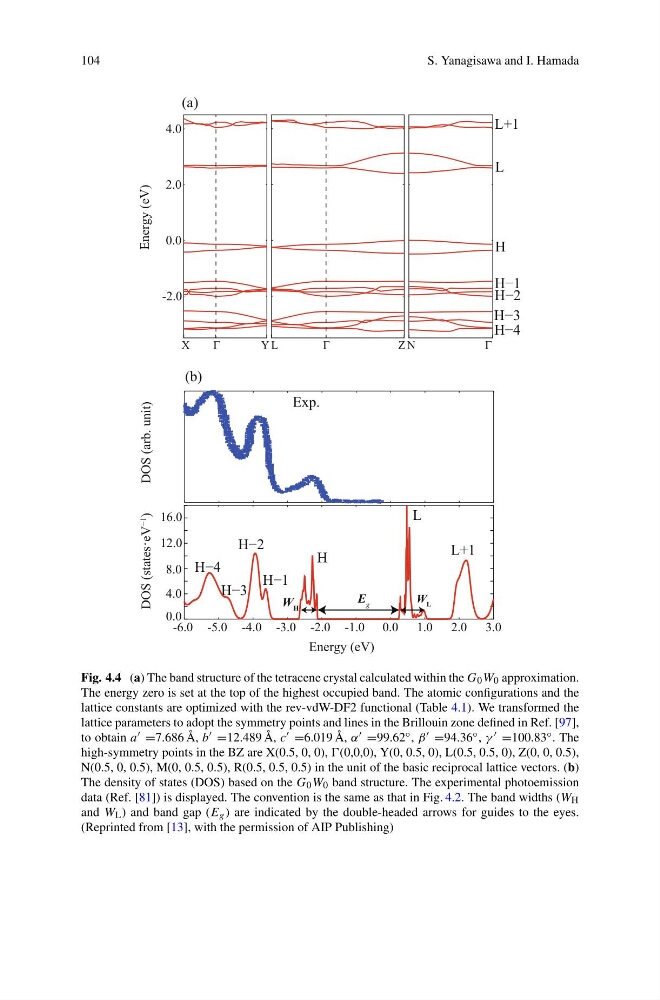
Fig. 4.4 (a) The band structure of the tetracene crystal calculated within the G 0 W 0 approximation.
The energy zero is set at the top of the highest occupied band. The atomic configurations and the
lattice constants are optimized with the rev-vdW-DF2 functional (Table 4.1). We transformed the
lattice parameters to adopt the symmetry points and lines in the Brillouin zone defined in Ref. [97],
to obtain a =7.686 Å, b =12.489 Å, c =6.019 Å, α =99.62 ◦ , β =94.36 ◦ , γ =100.83 ◦ . The
high-symmetry points in the BZ are X(0.5, 0, 0), (0,0,0), Y(0, 0.5, 0), L(0.5, 0.5, 0), Z(0, 0, 0.5),
N(0.5, 0, 0.5), M(0, 0.5, 0.5), R(0.5, 0.5, 0.5) in the unit of the basic reciprocal lattice vectors. (b)
The density of states (DOS) based on the G 0 W 0 band structure. The experimental photoemission
data (Ref. [81]) is displayed. The convention is the same as that in Fig. 4.2. The band widths (W H
and W L ) and band gap (E g ) are indicated by the double-headed arrows for guides to the eyes.
(Reprinted from [13], with the permission of AIP Publishing)
S. Yanagisawa and I. Hamada
(a)
(b)
H−2
H−1
H
H−4
H−3
L
L+1
Exp.
DOS (states·eV
−1
)
Energy (eV)
0.0
4.0
8.0
12.0
16.0
-6.0 -5.0 -4.0 -3.0 -2.0 -1.0 0.0 1.0 2.0 3.0
DOS (arb. unit)
X
Y L
Z N
-2.0
0.0
2.0
4.0
Energy (eV)
H−2
H−1
H
H−4
H−3
L
L+1
W H
W L
E g
Fig. 4.4 (a) The band structure of the tetracene crystal calculated within the G 0 W 0 approximation.
The energy zero is set at the top of the highest occupied band. The atomic configurations and the
lattice constants are optimized with the rev-vdW-DF2 functional (Table 4.1). We transformed the
lattice parameters to adopt the symmetry points and lines in the Brillouin zone defined in Ref. [97],
to obtain a =7.686 Å, b =12.489 Å, c =6.019 Å, α =99.62 ◦ , β =94.36 ◦ , γ =100.83 ◦ . The
high-symmetry points in the BZ are X(0.5, 0, 0), (0,0,0), Y(0, 0.5, 0), L(0.5, 0.5, 0), Z(0, 0, 0.5),
N(0.5, 0, 0.5), M(0, 0.5, 0.5), R(0.5, 0.5, 0.5) in the unit of the basic reciprocal lattice vectors. (b)
The density of states (DOS) based on the G 0 W 0 band structure. The experimental photoemission
data (Ref. [81]) is displayed. The convention is the same as that in Fig. 4.2. The band widths (W H
and W L ) and band gap (E g ) are indicated by the double-headed arrows for guides to the eyes.
(Reprinted from [13], with the permission of AIP Publishing)