

4 Nanoscale First-Principles Electronic Structure Simulations of Materials. . .
99
4.2.1.2 Electronic Structures with the GW Approximation
To confirm reliability of the theoretical crystal geometries of the oligoacenes
predicted with the vdW-DF method, we investigated the electronic structures for the
optimized crystal geometries using the many-body perturbation theory within the
GW approximation [13]. Here, we considered naphthalene, anthracene, tetracene,
and pentacene crystals, of which the experimental fundamental gap or the density
of states (DOS) were reported [71–81].
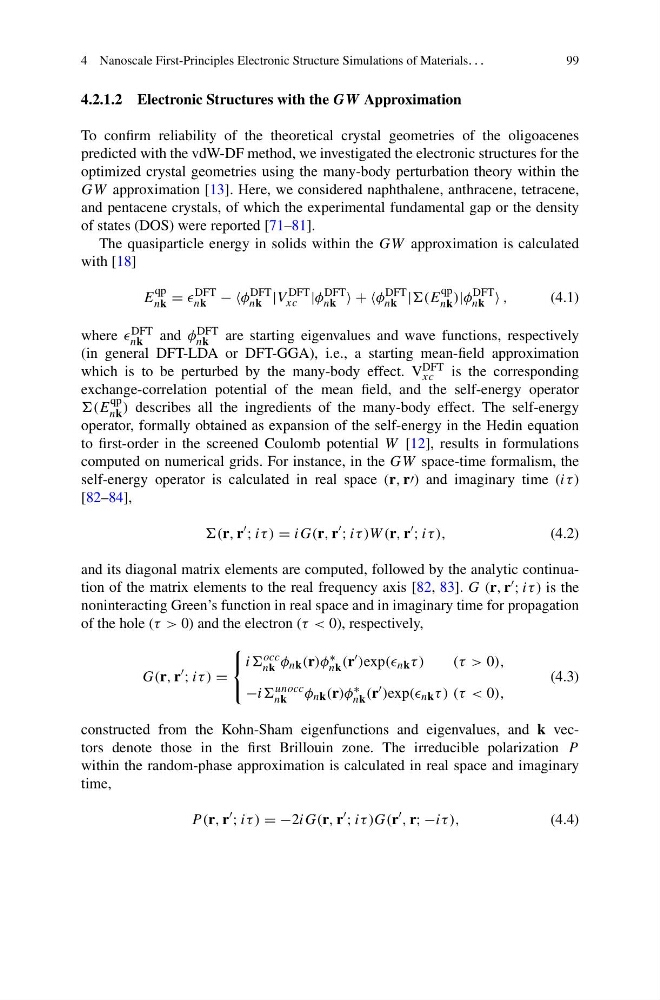
The quasiparticle energy in solids within the GW approximation is calculated
with [18]
E
qp
nk =
DFT
nk − −φ
DFT
nk |V
DFT
xc |φ
DFT
nk + +φ
DFT
nk |
qp
nk )|φ
DFT
nk ,
(4.1)
where DFT
nk and φ DFT
nk are starting eigenvalues and wave functions, respectively
(in general DFT-LDA or DFT-GGA), i.e., a starting mean-field approximation
which is to be perturbed by the many-body effect. V DFT
xc
is the corresponding
exchange-correlation potential of the mean field, and the self-energy operator
qp
nk ) describes all the ingredients of the many-body effect. The self-energy
operator, formally obtained as expansion of the self-energy in the Hedin equation
to first-order in the screened Coulomb potential W [12], results in formulations
computed on numerical grids. For instance, in the GW space-time formalism, the
self-energy operator is calculated in real space (r, r) and imaginary time (iτ )
[82–84],
(r, r
; iτ ) = iG(r, r
; iτ )W (r, r
; iτ ),
(4.2)
and its diagonal matrix elements are computed, followed by the analytic continuation of the matrix elements to the real frequency axis [82, 83]. G (r, r ; iτ ) is the
noninteracting Green’s function in real space and in imaginary time for propagation
of the hole (τ > 0) and the electron (τ < 0), respectively,
G(r, r
; iτ ) =
⎧
⎨
⎩
ii occ
nk φ nk (r)φ ∗
nk (r )exp(( nk τ )
(τ > 0),
−ii unocc
nk
φ nk (r)φ ∗
nk (r )exp(( nk τ ) (τ < 0),
(4.3)
constructed from the Kohn-Sham eigenfunctions and eigenvalues, and k vectors denote those in the first Brillouin zone. The irreducible polarization P
within the random-phase approximation is calculated in real space and imaginary
time,
P (r, r
; iτ ) = −2iG(r, r
; iτ )G(r
, r; −iτ ),
(4.4)
99
4.2.1.2 Electronic Structures with the GW Approximation
To confirm reliability of the theoretical crystal geometries of the oligoacenes
predicted with the vdW-DF method, we investigated the electronic structures for the
optimized crystal geometries using the many-body perturbation theory within the
GW approximation [13]. Here, we considered naphthalene, anthracene, tetracene,
and pentacene crystals, of which the experimental fundamental gap or the density
of states (DOS) were reported [71–81].
The quasiparticle energy in solids within the GW approximation is calculated
with [18]
E
qp
nk =
DFT
nk − −φ
DFT
nk |V
DFT
xc |φ
DFT
nk + +φ
DFT
nk |
qp
nk )|φ
DFT
nk ,
(4.1)
where DFT
nk and φ DFT
nk are starting eigenvalues and wave functions, respectively
(in general DFT-LDA or DFT-GGA), i.e., a starting mean-field approximation
which is to be perturbed by the many-body effect. V DFT
xc
is the corresponding
exchange-correlation potential of the mean field, and the self-energy operator
qp
nk ) describes all the ingredients of the many-body effect. The self-energy
operator, formally obtained as expansion of the self-energy in the Hedin equation
to first-order in the screened Coulomb potential W [12], results in formulations
computed on numerical grids. For instance, in the GW space-time formalism, the
self-energy operator is calculated in real space (r, r) and imaginary time (iτ )
[82–84],
(r, r
; iτ ) = iG(r, r
; iτ )W (r, r
; iτ ),
(4.2)
and its diagonal matrix elements are computed, followed by the analytic continuation of the matrix elements to the real frequency axis [82, 83]. G (r, r ; iτ ) is the
noninteracting Green’s function in real space and in imaginary time for propagation
of the hole (τ > 0) and the electron (τ < 0), respectively,
G(r, r
; iτ ) =
⎧
⎨
⎩
ii occ
nk φ nk (r)φ ∗
nk (r )exp(( nk τ )
(τ > 0),
−ii unocc
nk
φ nk (r)φ ∗
nk (r )exp(( nk τ ) (τ < 0),
(4.3)
constructed from the Kohn-Sham eigenfunctions and eigenvalues, and k vectors denote those in the first Brillouin zone. The irreducible polarization P
within the random-phase approximation is calculated in real space and imaginary
time,
P (r, r
; iτ ) = −2iG(r, r
; iτ )G(r
, r; −iτ ),
(4.4)