

of target expression is valuable for diagnosis, as well as the selection of treatment
regimen and pre-evaluation. There are often overexpressed specific receptors on the
surface of tumor cells. For example, abnormal overexpression of estrogen receptor
(ER) [34–36] and fructose transporter (GLUT5) [37] has been found in breast
cancer; prostate-specific membrane antigen (PSMA) is overexpressed in prostate
cancer [38–41]. FMI can be used to determine the expression level of related
hormone receptors in tumor biopsy specimens, which can help select the best
treatment plan. Using these receptors as targets to develop new, potential drugs
with high specificity and affinity is the main direction of development of antitumor
drugs. Currently, many active targeted fluorescence probes have been developed.
2.2.1 Estrogen Receptor-Targeted Fluorescent Probes
Estrogen receptor (ER) is a ligand-regulated transcription factor that regulates many
physiological and pathological processes and also plays a predominant role in breast
cancer growth. Therefore, ER is regarded as an important pharmaceutical target for
the treatment of breast cancer, and the development of ER-targeted fluorescence
probes has emerged as an active research field for breast cancer detection, and many
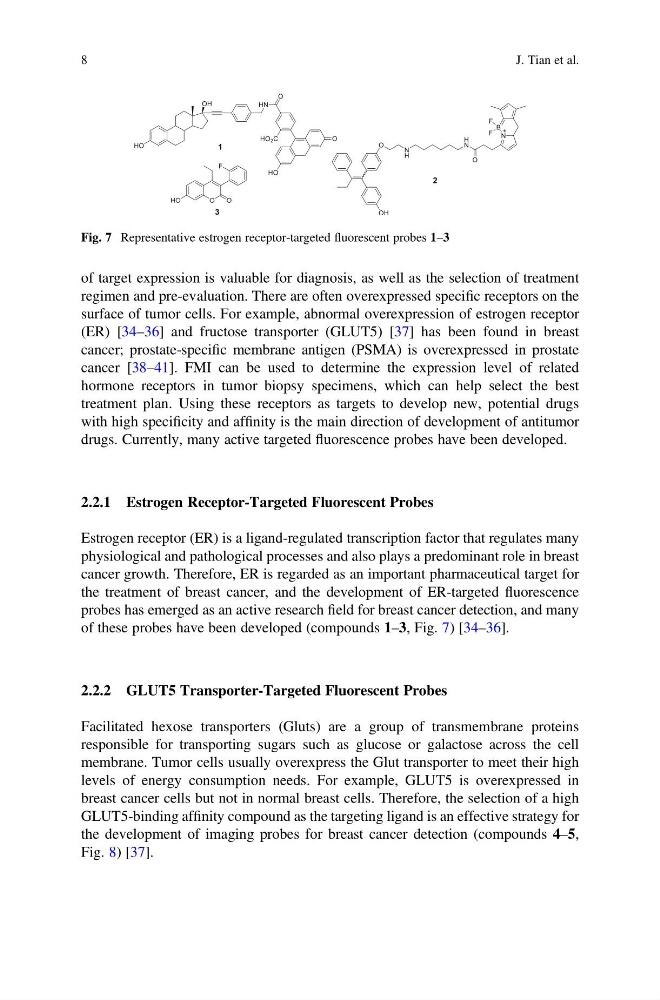
of these probes have been developed (compounds 1–3, Fig. 7) [34–36].
2.2.2 GLUT5 Transporter-Targeted Fluorescent Probes
Facilitated hexose transporters (Gluts) are a group of transmembrane proteins
responsible for transporting sugars such as glucose or galactose across the cell
membrane. Tumor cells usually overexpress the Glut transporter to meet their high
levels of energy consumption needs. For example, GLUT5 is overexpressed in
breast cancer cells but not in normal breast cells. Therefore, the selection of a high
GLUT5-binding affinity compound as the targeting ligand is an effective strategy for
the development of imaging probes for breast cancer detection (compounds 4–5,
Fig. 8) [37].
Fig. 7 Representative estrogen receptor-targeted fluorescent probes 1–3
8
J. Tian et al.
regimen and pre-evaluation. There are often overexpressed specific receptors on the
surface of tumor cells. For example, abnormal overexpression of estrogen receptor
(ER) [34–36] and fructose transporter (GLUT5) [37] has been found in breast
cancer; prostate-specific membrane antigen (PSMA) is overexpressed in prostate
cancer [38–41]. FMI can be used to determine the expression level of related
hormone receptors in tumor biopsy specimens, which can help select the best
treatment plan. Using these receptors as targets to develop new, potential drugs
with high specificity and affinity is the main direction of development of antitumor
drugs. Currently, many active targeted fluorescence probes have been developed.
2.2.1 Estrogen Receptor-Targeted Fluorescent Probes
Estrogen receptor (ER) is a ligand-regulated transcription factor that regulates many
physiological and pathological processes and also plays a predominant role in breast
cancer growth. Therefore, ER is regarded as an important pharmaceutical target for
the treatment of breast cancer, and the development of ER-targeted fluorescence
probes has emerged as an active research field for breast cancer detection, and many
of these probes have been developed (compounds 1–3, Fig. 7) [34–36].
2.2.2 GLUT5 Transporter-Targeted Fluorescent Probes
Facilitated hexose transporters (Gluts) are a group of transmembrane proteins
responsible for transporting sugars such as glucose or galactose across the cell
membrane. Tumor cells usually overexpress the Glut transporter to meet their high
levels of energy consumption needs. For example, GLUT5 is overexpressed in
breast cancer cells but not in normal breast cells. Therefore, the selection of a high
GLUT5-binding affinity compound as the targeting ligand is an effective strategy for
the development of imaging probes for breast cancer detection (compounds 4–5,
Fig. 8) [37].
Fig. 7 Representative estrogen receptor-targeted fluorescent probes 1–3
8
J. Tian et al.