

2.1 Fluorophores
The fluorophore can convert molecular recognition information into a fluorescence
signal, which has the advantages of high sensitivity, rapid reaction time, and the
ability to realize in situ detection. An ideal fluorophore has a large value of Stokes
shift [difference between the absorption maximum (λ max ) and the emission maximum (λ em )] to minimize the reabsorption of emitted photons. According to the
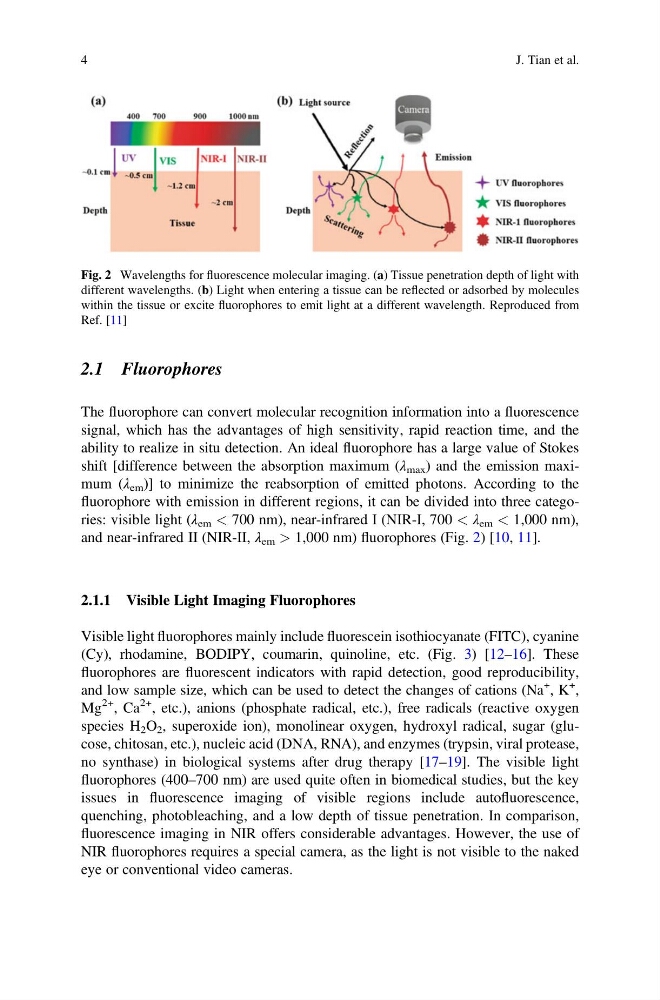
fluorophore with emission in different regions, it can be divided into three categories: visible light (λ em < 700 nm), near-infrared I (NIR-I, 700 < λ em < 1,000 nm),
and near-infrared II (NIR-II, λ em > 1,000 nm) fluorophores (Fig. 2) [10, 11].
2.1.1 Visible Light Imaging Fluorophores
Visible light fluorophores mainly include fluorescein isothiocyanate (FITC), cyanine
(Cy), rhodamine, BODIPY, coumarin, quinoline, etc. (Fig. 3) [12–16]. These
fluorophores are fluorescent indicators with rapid detection, good reproducibility,
and low sample size, which can be used to detect the changes of cations (Na
+
, K
+
,
Mg
2+ , Ca
2+ , etc.), anions (phosphate radical, etc.), free radicals (reactive oxygen
species H 2 O 2 , superoxide ion), monolinear oxygen, hydroxyl radical, sugar (glucose, chitosan, etc.), nucleic acid (DNA, RNA), and enzymes (trypsin, viral protease,
no synthase) in biological systems after drug therapy [17–19]. The visible light
fluorophores (400–700 nm) are used quite often in biomedical studies, but the key
issues in fluorescence imaging of visible regions include autofluorescence,
quenching, photobleaching, and a low depth of tissue penetration. In comparison,
fluorescence imaging in NIR offers considerable advantages. However, the use of
NIR fluorophores requires a special camera, as the light is not visible to the naked
eye or conventional video cameras.
Fig. 2 Wavelengths for fluorescence molecular imaging. (a) Tissue penetration depth of light with
different wavelengths. (b) Light when entering a tissue can be reflected or adsorbed by molecules
within the tissue or excite fluorophores to emit light at a different wavelength. Reproduced from
Ref. [11]
4
J. Tian et al.
The fluorophore can convert molecular recognition information into a fluorescence
signal, which has the advantages of high sensitivity, rapid reaction time, and the
ability to realize in situ detection. An ideal fluorophore has a large value of Stokes
shift [difference between the absorption maximum (λ max ) and the emission maximum (λ em )] to minimize the reabsorption of emitted photons. According to the
fluorophore with emission in different regions, it can be divided into three categories: visible light (λ em < 700 nm), near-infrared I (NIR-I, 700 < λ em < 1,000 nm),
and near-infrared II (NIR-II, λ em > 1,000 nm) fluorophores (Fig. 2) [10, 11].
2.1.1 Visible Light Imaging Fluorophores
Visible light fluorophores mainly include fluorescein isothiocyanate (FITC), cyanine
(Cy), rhodamine, BODIPY, coumarin, quinoline, etc. (Fig. 3) [12–16]. These
fluorophores are fluorescent indicators with rapid detection, good reproducibility,
and low sample size, which can be used to detect the changes of cations (Na
+
, K
+
,
Mg
2+ , Ca
2+ , etc.), anions (phosphate radical, etc.), free radicals (reactive oxygen
species H 2 O 2 , superoxide ion), monolinear oxygen, hydroxyl radical, sugar (glucose, chitosan, etc.), nucleic acid (DNA, RNA), and enzymes (trypsin, viral protease,
no synthase) in biological systems after drug therapy [17–19]. The visible light
fluorophores (400–700 nm) are used quite often in biomedical studies, but the key
issues in fluorescence imaging of visible regions include autofluorescence,
quenching, photobleaching, and a low depth of tissue penetration. In comparison,
fluorescence imaging in NIR offers considerable advantages. However, the use of
NIR fluorophores requires a special camera, as the light is not visible to the naked
eye or conventional video cameras.
Fig. 2 Wavelengths for fluorescence molecular imaging. (a) Tissue penetration depth of light with
different wavelengths. (b) Light when entering a tissue can be reflected or adsorbed by molecules
within the tissue or excite fluorophores to emit light at a different wavelength. Reproduced from
Ref. [11]
4
J. Tian et al.