

concept of using zerovalent metals, such as iron, as remediation is based on
reduction–oxidation or “redox” reactions, in which a neutral electron donor
(a metal) chemically reduces an electron acceptor (a contaminant). It is in nanoscale
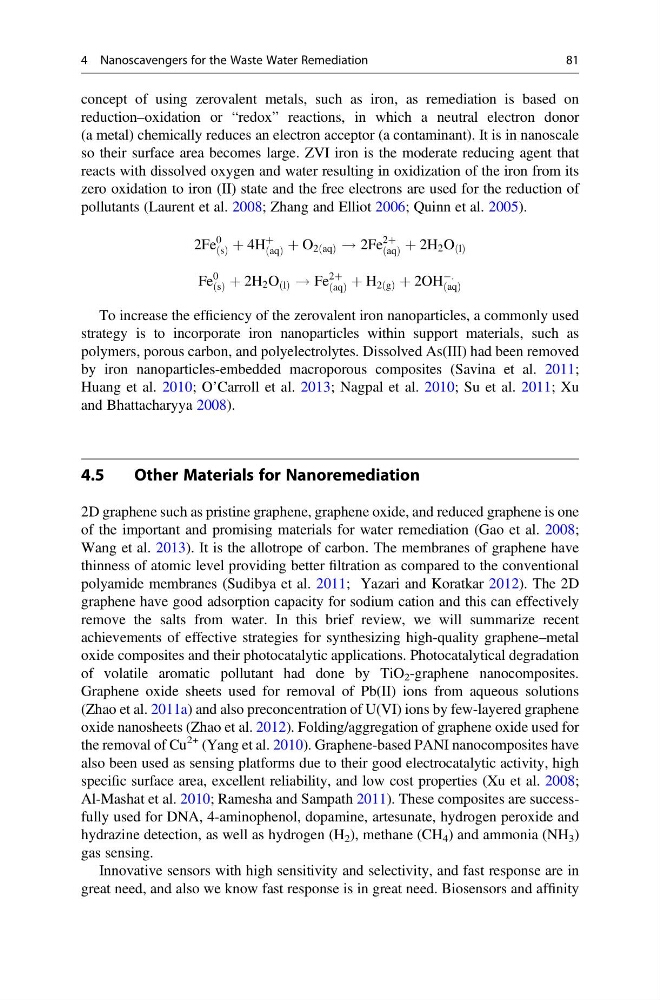
so their surface area becomes large. ZVI iron is the moderate reducing agent that
reacts with dissolved oxygen and water resulting in oxidization of the iron from its
zero oxidation to iron (II) state and the free electrons are used for the reduction of
pollutants (Laurent et al. 2008; Zhang and Elliot 2006; Quinn et al. 2005).
2Fe
0
s
ð Þ þ 4H
þ
aq
ð Þ þ O 2 aq
ð Þ ! 2Fe
2þ
aq
ð Þ þ 2H 2 O l
ð Þ
Fe
0
s
ð Þ þ 2H 2 O l
ð Þ ! Fe
2þ
aq
ð Þ þ H 2 g
ð Þ þ 2OH
À:
aq
ð Þ
To increase the efficiency of the zerovalent iron nanoparticles, a commonly used
strategy is to incorporate iron nanoparticles within support materials, such as
polymers, porous carbon, and polyelectrolytes. Dissolved As(III) had been removed
by iron nanoparticles-embedded macroporous composites (Savina et al. 2011;
Huang et al. 2010; O’Carroll et al. 2013; Nagpal et al. 2010; Su et al. 2011; Xu
and Bhattacharyya 2008).
4.5
Other Materials for Nanoremediation
2D graphene such as pristine graphene, graphene oxide, and reduced graphene is one
of the important and promising materials for water remediation (Gao et al. 2008;
Wang et al. 2013). It is the allotrope of carbon. The membranes of graphene have
thinness of atomic level providing better filtration as compared to the conventional
polyamide membranes (Sudibya et al. 2011; Yazari and Koratkar 2012). The 2D
graphene have good adsorption capacity for sodium cation and this can effectively
remove the salts from water. In this brief review, we will summarize recent
achievements of effective strategies for synthesizing high-quality graphene–metal
oxide composites and their photocatalytic applications. Photocatalytical degradation
of volatile aromatic pollutant had done by TiO 2 -graphene nanocomposites.
Graphene oxide sheets used for removal of Pb(II) ions from aqueous solutions
(Zhao et al. 2011a) and also preconcentration of U(VI) ions by few-layered graphene
oxide nanosheets (Zhao et al. 2012). Folding/aggregation of graphene oxide used for
the removal of Cu
2+ (Yang et al. 2010). Graphene-based PANI nanocomposites have
also been used as sensing platforms due to their good electrocatalytic activity, high
specific surface area, excellent reliability, and low cost properties (Xu et al. 2008;
Al-Mashat et al. 2010; Ramesha and Sampath 2011). These composites are successfully used for DNA, 4-aminophenol, dopamine, artesunate, hydrogen peroxide and
hydrazine detection, as well as hydrogen (H 2 ), methane (CH 4 ) and ammonia (NH 3 )
gas sensing.
Innovative sensors with high sensitivity and selectivity, and fast response are in
great need, and also we know fast response is in great need. Biosensors and affinity
4 Nanoscavengers for the Waste Water Remediation
81
reduction–oxidation or “redox” reactions, in which a neutral electron donor
(a metal) chemically reduces an electron acceptor (a contaminant). It is in nanoscale
so their surface area becomes large. ZVI iron is the moderate reducing agent that
reacts with dissolved oxygen and water resulting in oxidization of the iron from its
zero oxidation to iron (II) state and the free electrons are used for the reduction of
pollutants (Laurent et al. 2008; Zhang and Elliot 2006; Quinn et al. 2005).
2Fe
0
s
ð Þ þ 4H
þ
aq
ð Þ þ O 2 aq
ð Þ ! 2Fe
2þ
aq
ð Þ þ 2H 2 O l
ð Þ
Fe
0
s
ð Þ þ 2H 2 O l
ð Þ ! Fe
2þ
aq
ð Þ þ H 2 g
ð Þ þ 2OH
À:
aq
ð Þ
To increase the efficiency of the zerovalent iron nanoparticles, a commonly used
strategy is to incorporate iron nanoparticles within support materials, such as
polymers, porous carbon, and polyelectrolytes. Dissolved As(III) had been removed
by iron nanoparticles-embedded macroporous composites (Savina et al. 2011;
Huang et al. 2010; O’Carroll et al. 2013; Nagpal et al. 2010; Su et al. 2011; Xu
and Bhattacharyya 2008).
4.5
Other Materials for Nanoremediation
2D graphene such as pristine graphene, graphene oxide, and reduced graphene is one
of the important and promising materials for water remediation (Gao et al. 2008;
Wang et al. 2013). It is the allotrope of carbon. The membranes of graphene have
thinness of atomic level providing better filtration as compared to the conventional
polyamide membranes (Sudibya et al. 2011; Yazari and Koratkar 2012). The 2D
graphene have good adsorption capacity for sodium cation and this can effectively
remove the salts from water. In this brief review, we will summarize recent
achievements of effective strategies for synthesizing high-quality graphene–metal
oxide composites and their photocatalytic applications. Photocatalytical degradation
of volatile aromatic pollutant had done by TiO 2 -graphene nanocomposites.
Graphene oxide sheets used for removal of Pb(II) ions from aqueous solutions
(Zhao et al. 2011a) and also preconcentration of U(VI) ions by few-layered graphene
oxide nanosheets (Zhao et al. 2012). Folding/aggregation of graphene oxide used for
the removal of Cu
2+ (Yang et al. 2010). Graphene-based PANI nanocomposites have
also been used as sensing platforms due to their good electrocatalytic activity, high
specific surface area, excellent reliability, and low cost properties (Xu et al. 2008;
Al-Mashat et al. 2010; Ramesha and Sampath 2011). These composites are successfully used for DNA, 4-aminophenol, dopamine, artesunate, hydrogen peroxide and
hydrazine detection, as well as hydrogen (H 2 ), methane (CH 4 ) and ammonia (NH 3 )
gas sensing.
Innovative sensors with high sensitivity and selectivity, and fast response are in
great need, and also we know fast response is in great need. Biosensors and affinity
4 Nanoscavengers for the Waste Water Remediation
81