

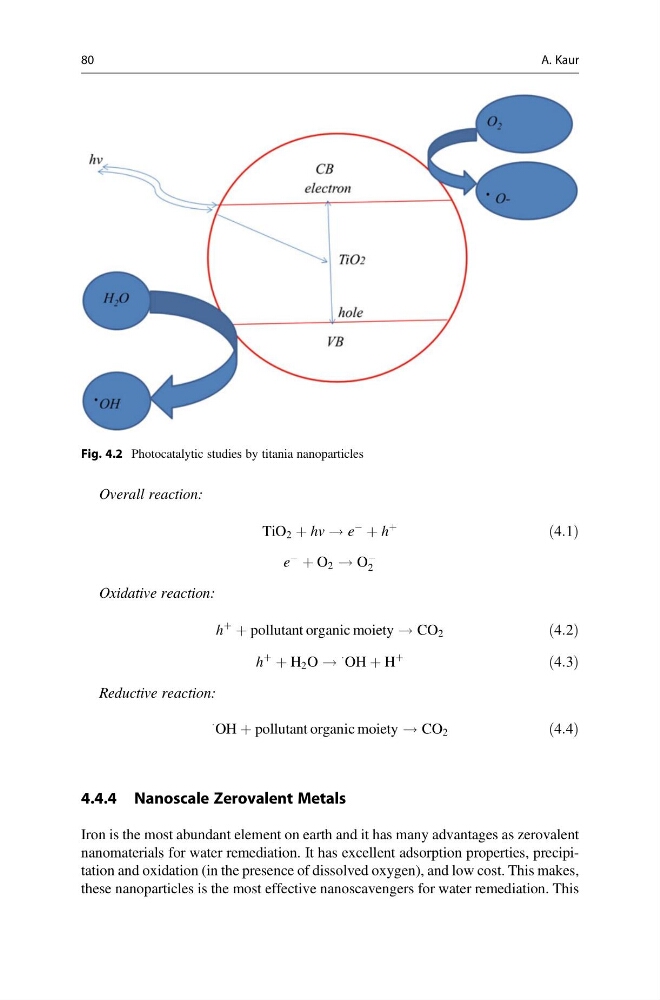
Overall reaction:
TiO 2 þ hv ! e
À
þ h
þ
ð4:1Þ
e
À
þ O 2 ! O
À
2
Oxidative reaction:
h
þ
þ pollutant organic moiety ! CO 2
ð4:2Þ
h
þ
þ H 2 O !
Á OH þ H
þ
ð4:3Þ
Reductive reaction:
Á OH þ pollutant organic moiety ! CO 2
ð4:4Þ
4.4.4 Nanoscale Zerovalent Metals
Iron is the most abundant element on earth and it has many advantages as zerovalent
nanomaterials for water remediation. It has excellent adsorption properties, precipitation and oxidation (in the presence of dissolved oxygen), and low cost. This makes,
these nanoparticles is the most effective nanoscavengers for water remediation. This
Fig. 4.2 Photocatalytic studies by titania nanoparticles
80
A. Kaur
TiO 2 þ hv ! e
À
þ h
þ
ð4:1Þ
e
À
þ O 2 ! O
À
2
Oxidative reaction:
h
þ
þ pollutant organic moiety ! CO 2
ð4:2Þ
h
þ
þ H 2 O !
Á OH þ H
þ
ð4:3Þ
Reductive reaction:
Á OH þ pollutant organic moiety ! CO 2
ð4:4Þ
4.4.4 Nanoscale Zerovalent Metals
Iron is the most abundant element on earth and it has many advantages as zerovalent
nanomaterials for water remediation. It has excellent adsorption properties, precipitation and oxidation (in the presence of dissolved oxygen), and low cost. This makes,
these nanoparticles is the most effective nanoscavengers for water remediation. This
Fig. 4.2 Photocatalytic studies by titania nanoparticles
80
A. Kaur