

4.4.3 Titania Nanoparticles for Water Remediation
Titanium dioxide is mainly found as a key ingredient in wall paints, sunscreens, and
toothpaste; and it acts as reflectors of light or as abrasives. TiO 2 has been widely
used as photocatalyst because of its high stability, wide source, acid–base resistance,
low cost, their high chemical stability, good photoactivity, relatively low cost, and
nontoxicity. This is mostly widely as photocatalyst used for environmental
applications because of its high oxidative power, nontoxicity, photostability, and
water insolubility properties under most conditions. Superoxide anions are produced
when electrons will react with oxygen and holes will react with water to produce the
hydroxyl radicals to degrade and mineralize the pollutant. In the photocatalyst
mechanism, a photocatalyst is irradiated with UV light with energy greater than
the bandgap energy, electron (e
À ) in the valence band will move to conduction band,
leaving a hole in the valence band and these holes and electrons have strong energy
potentials and migrate to the semiconductor surface generating highly reactive free
radicals.
TiO 2 nanoparticles have emerged as promising photocatalysts for water purification. The removal of total organic carbon from waters contaminated with organic
wastes was greatly enhanced by the addition of TiO 2 nanoparticles in the presence of
ultraviolet light. It was successfully used to degrade organic compounds (e.g.,
chlorinated alkanes and benzenes, dioxins, furans) pentacholorophenol and aromatic
chlorinated compounds had been photocatalytically studied using titania
nanoparticles (Kaur 2016; Mills and Hoffmann 1993; Jardim et al. 1997; Shunxin
et al. 1999). TiO 2 nanoparticles were used for preconcentration and separation of
rare earth metals and their determination in geological samples (Liang et al.
2001a, b; Hang et al. 2003; Choi et al. 2007).
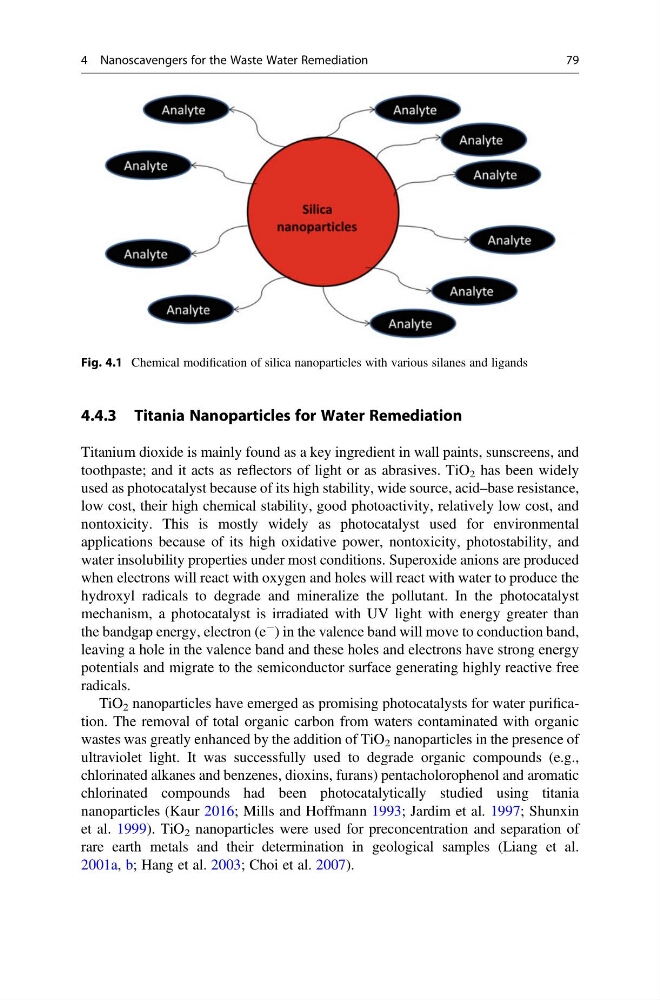
Fig. 4.1 Chemical modification of silica nanoparticles with various silanes and ligands
4 Nanoscavengers for the Waste Water Remediation
79
Titanium dioxide is mainly found as a key ingredient in wall paints, sunscreens, and
toothpaste; and it acts as reflectors of light or as abrasives. TiO 2 has been widely
used as photocatalyst because of its high stability, wide source, acid–base resistance,
low cost, their high chemical stability, good photoactivity, relatively low cost, and
nontoxicity. This is mostly widely as photocatalyst used for environmental
applications because of its high oxidative power, nontoxicity, photostability, and
water insolubility properties under most conditions. Superoxide anions are produced
when electrons will react with oxygen and holes will react with water to produce the
hydroxyl radicals to degrade and mineralize the pollutant. In the photocatalyst
mechanism, a photocatalyst is irradiated with UV light with energy greater than
the bandgap energy, electron (e
À ) in the valence band will move to conduction band,
leaving a hole in the valence band and these holes and electrons have strong energy
potentials and migrate to the semiconductor surface generating highly reactive free
radicals.
TiO 2 nanoparticles have emerged as promising photocatalysts for water purification. The removal of total organic carbon from waters contaminated with organic
wastes was greatly enhanced by the addition of TiO 2 nanoparticles in the presence of
ultraviolet light. It was successfully used to degrade organic compounds (e.g.,
chlorinated alkanes and benzenes, dioxins, furans) pentacholorophenol and aromatic
chlorinated compounds had been photocatalytically studied using titania
nanoparticles (Kaur 2016; Mills and Hoffmann 1993; Jardim et al. 1997; Shunxin
et al. 1999). TiO 2 nanoparticles were used for preconcentration and separation of
rare earth metals and their determination in geological samples (Liang et al.
2001a, b; Hang et al. 2003; Choi et al. 2007).
Fig. 4.1 Chemical modification of silica nanoparticles with various silanes and ligands
4 Nanoscavengers for the Waste Water Remediation
79