

O Al
Cl
O
O
CH 2
CH 3
H 2 C
CH 3
CH 2
C
H 3
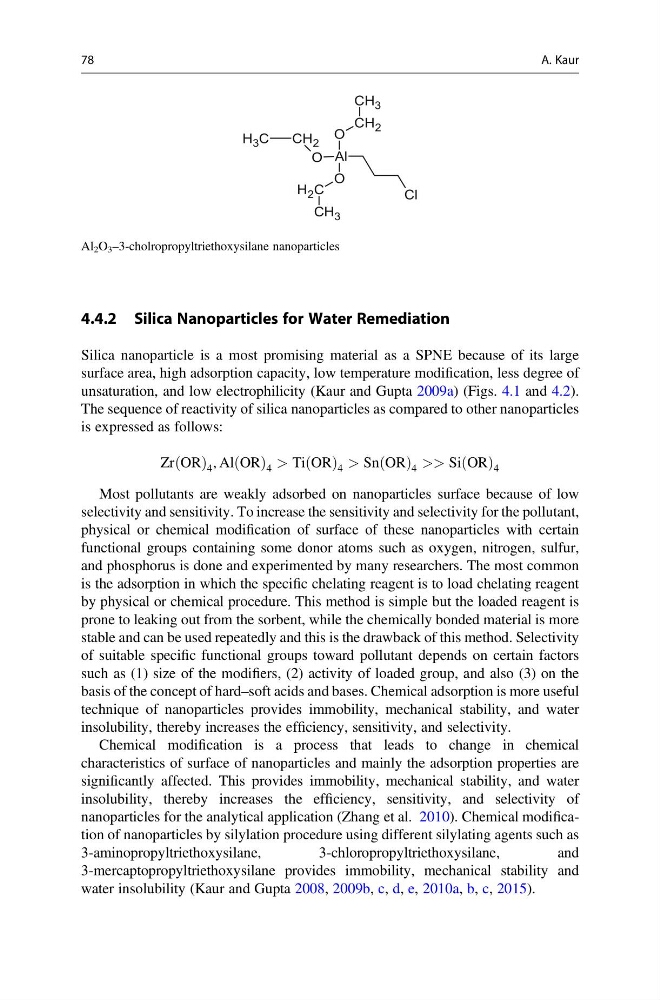
Al 2 O 3 –3-cholropropyltriethoxysilane nanoparticles
4.4.2 Silica Nanoparticles for Water Remediation
Silica nanoparticle is a most promising material as a SPNE because of its large
surface area, high adsorption capacity, low temperature modification, less degree of
unsaturation, and low electrophilicity (Kaur and Gupta 2009a) (Figs. 4.1 and 4.2).
The sequence of reactivity of silica nanoparticles as compared to other nanoparticles
is expressed as follows:
Zr OR
ð Þ 4 , Al OR
ð Þ 4 > Ti OR
ð Þ 4 > Sn OR
ð Þ 4 >> Si OR
ð Þ 4
Most pollutants are weakly adsorbed on nanoparticles surface because of low
selectivity and sensitivity. To increase the sensitivity and selectivity for the pollutant,
physical or chemical modification of surface of these nanoparticles with certain
functional groups containing some donor atoms such as oxygen, nitrogen, sulfur,
and phosphorus is done and experimented by many researchers. The most common
is the adsorption in which the specific chelating reagent is to load chelating reagent
by physical or chemical procedure. This method is simple but the loaded reagent is
prone to leaking out from the sorbent, while the chemically bonded material is more
stable and can be used repeatedly and this is the drawback of this method. Selectivity
of suitable specific functional groups toward pollutant depends on certain factors
such as (1) size of the modifiers, (2) activity of loaded group, and also (3) on the
basis of the concept of hard–soft acids and bases. Chemical adsorption is more useful
technique of nanoparticles provides immobility, mechanical stability, and water
insolubility, thereby increases the efficiency, sensitivity, and selectivity.
Chemical modification is a process that leads to change in chemical
characteristics of surface of nanoparticles and mainly the adsorption properties are
significantly affected. This provides immobility, mechanical stability, and water
insolubility, thereby increases the efficiency, sensitivity, and selectivity of
nanoparticles for the analytical application (Zhang et al. 2010). Chemical modification of nanoparticles by silylation procedure using different silylating agents such as
3-aminopropyltriethoxysilane,
3-chloropropyltriethoxysilane,
and
3-mercaptopropyltriethoxysilane provides immobility, mechanical stability and
water insolubility (Kaur and Gupta 2008, 2009b, c, d, e, 2010a, b, c, 2015).
78
A. Kaur
Cl
O
O
CH 2
CH 3
H 2 C
CH 3
CH 2
C
H 3
Al 2 O 3 –3-cholropropyltriethoxysilane nanoparticles
4.4.2 Silica Nanoparticles for Water Remediation
Silica nanoparticle is a most promising material as a SPNE because of its large
surface area, high adsorption capacity, low temperature modification, less degree of
unsaturation, and low electrophilicity (Kaur and Gupta 2009a) (Figs. 4.1 and 4.2).
The sequence of reactivity of silica nanoparticles as compared to other nanoparticles
is expressed as follows:
Zr OR
ð Þ 4 , Al OR
ð Þ 4 > Ti OR
ð Þ 4 > Sn OR
ð Þ 4 >> Si OR
ð Þ 4
Most pollutants are weakly adsorbed on nanoparticles surface because of low
selectivity and sensitivity. To increase the sensitivity and selectivity for the pollutant,
physical or chemical modification of surface of these nanoparticles with certain
functional groups containing some donor atoms such as oxygen, nitrogen, sulfur,
and phosphorus is done and experimented by many researchers. The most common
is the adsorption in which the specific chelating reagent is to load chelating reagent
by physical or chemical procedure. This method is simple but the loaded reagent is
prone to leaking out from the sorbent, while the chemically bonded material is more
stable and can be used repeatedly and this is the drawback of this method. Selectivity
of suitable specific functional groups toward pollutant depends on certain factors
such as (1) size of the modifiers, (2) activity of loaded group, and also (3) on the
basis of the concept of hard–soft acids and bases. Chemical adsorption is more useful
technique of nanoparticles provides immobility, mechanical stability, and water
insolubility, thereby increases the efficiency, sensitivity, and selectivity.
Chemical modification is a process that leads to change in chemical
characteristics of surface of nanoparticles and mainly the adsorption properties are
significantly affected. This provides immobility, mechanical stability, and water
insolubility, thereby increases the efficiency, sensitivity, and selectivity of
nanoparticles for the analytical application (Zhang et al. 2010). Chemical modification of nanoparticles by silylation procedure using different silylating agents such as
3-aminopropyltriethoxysilane,
3-chloropropyltriethoxysilane,
and
3-mercaptopropyltriethoxysilane provides immobility, mechanical stability and
water insolubility (Kaur and Gupta 2008, 2009b, c, d, e, 2010a, b, c, 2015).
78
A. Kaur