

• Zerovalent metal nanoparticles.
• Metal oxides nanoparticles.
• Carbon nanotubes (CNTs).
• Nanocomposites.
12.5.1.1 Zerovalent Metal Nanoparticles
They are the ones which are commonly used for the waste water treatment as they
have high reactivity. The examples of the zerovalent metal nanoparticles are iron
(Fe), zinc (Zn), aluminum (Al), and nickel (Ni) (Dermatas et al. 2018).
Silver Nanoparticles (Ag NPs)
Silver nanoparticles are most efficiently used in the wastewater treatment. They have
antibacterial effect which makes it toxic for the microorganisms such as the viruses,
bacteria, fungi, etc. and thus the use of the silver nanoparticles also gets increased
(Lu et al. 2016). These nanoparticles act on the microorganisms in a number of steps.
Firstly it gets attached to the cell wall and then slowly get penetrate inside the
microorganism and reach to the cell membrane. The penetration of the silver
nanoparticles will result in the change in the structure of the cell. After this, the
permeability of the silver nanoparticles inside the cell get increases and it will start
releasing the free radicals in the cell membrane. Because of these radicals the cell
will become weak and will ultimately die (Dakal et al. 2016). Along with that the
silver nanoparticles have the property of releasing the antimicrobial Ag
+ which
shows its reactivity with the thiol group present in many vital enzymes and results
in decreased functionality of the cell. For example—The sheets having the silver
nanoparticles have the antimicrobial properties toward the Escherichia coli and
Enterococcus faecalis. During the filtration of the contaminated water through the
sheets, the bacteria gets attached to the sheets and become inactive. This process of
disinfectioning of the water is called as the emergency water treatment. These Ag
NPs can be formed by the chemical reduction method by putting it into the polyether
sulfone (PES) microfiltration membrane. These membranes have the high antimicrobial properties due to which the microorganisms get attached near the membrane
and later can be removed easily (Lu et al. 2016).
Iron Nanoparticles
Iron nanoparticles (Fe NPs) helps in reducing the environmental pollution by its
reactivity. The iron nanoparticles are used either in metallic form or in its oxide form.
They are produced by some eco-friendly methods. They have large surface-tovolume ratio with excellent adsorption, precipitation, and oxidation properties.
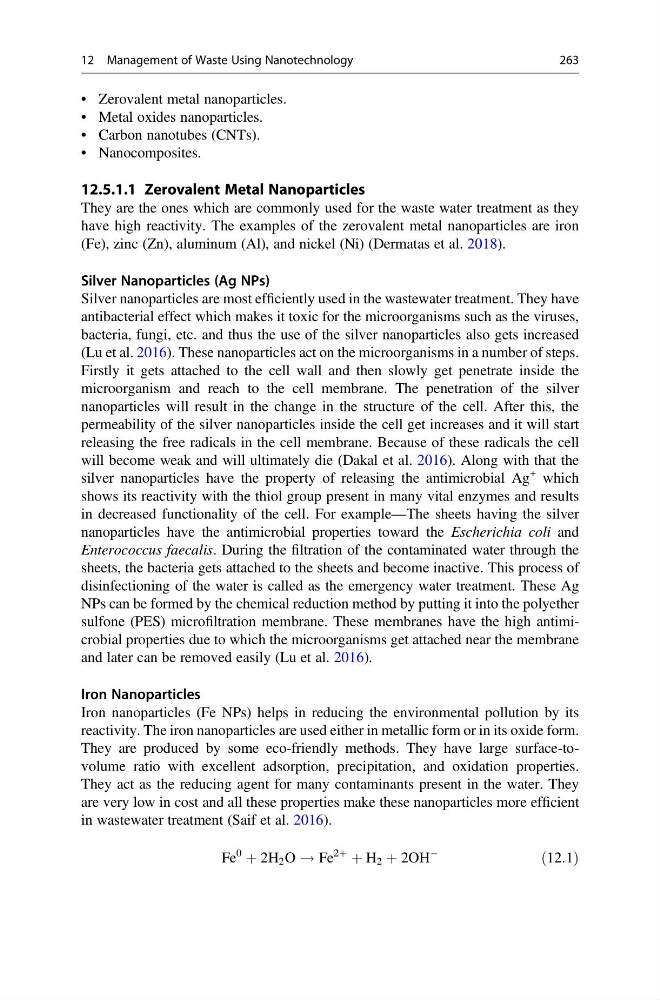
They act as the reducing agent for many contaminants present in the water. They
are very low in cost and all these properties make these nanoparticles more efficient
in wastewater treatment (Saif et al. 2016).
Fe
0
þ 2H 2 O ! Fe
2þ
þ H 2 þ 2OH
À
ð12:1Þ
12 Management of Waste Using Nanotechnology
263
• Metal oxides nanoparticles.
• Carbon nanotubes (CNTs).
• Nanocomposites.
12.5.1.1 Zerovalent Metal Nanoparticles
They are the ones which are commonly used for the waste water treatment as they
have high reactivity. The examples of the zerovalent metal nanoparticles are iron
(Fe), zinc (Zn), aluminum (Al), and nickel (Ni) (Dermatas et al. 2018).
Silver Nanoparticles (Ag NPs)
Silver nanoparticles are most efficiently used in the wastewater treatment. They have
antibacterial effect which makes it toxic for the microorganisms such as the viruses,
bacteria, fungi, etc. and thus the use of the silver nanoparticles also gets increased
(Lu et al. 2016). These nanoparticles act on the microorganisms in a number of steps.
Firstly it gets attached to the cell wall and then slowly get penetrate inside the
microorganism and reach to the cell membrane. The penetration of the silver
nanoparticles will result in the change in the structure of the cell. After this, the
permeability of the silver nanoparticles inside the cell get increases and it will start
releasing the free radicals in the cell membrane. Because of these radicals the cell
will become weak and will ultimately die (Dakal et al. 2016). Along with that the
silver nanoparticles have the property of releasing the antimicrobial Ag
+ which
shows its reactivity with the thiol group present in many vital enzymes and results
in decreased functionality of the cell. For example—The sheets having the silver
nanoparticles have the antimicrobial properties toward the Escherichia coli and
Enterococcus faecalis. During the filtration of the contaminated water through the
sheets, the bacteria gets attached to the sheets and become inactive. This process of
disinfectioning of the water is called as the emergency water treatment. These Ag
NPs can be formed by the chemical reduction method by putting it into the polyether
sulfone (PES) microfiltration membrane. These membranes have the high antimicrobial properties due to which the microorganisms get attached near the membrane
and later can be removed easily (Lu et al. 2016).
Iron Nanoparticles
Iron nanoparticles (Fe NPs) helps in reducing the environmental pollution by its
reactivity. The iron nanoparticles are used either in metallic form or in its oxide form.
They are produced by some eco-friendly methods. They have large surface-tovolume ratio with excellent adsorption, precipitation, and oxidation properties.
They act as the reducing agent for many contaminants present in the water. They
are very low in cost and all these properties make these nanoparticles more efficient
in wastewater treatment (Saif et al. 2016).
Fe
0
þ 2H 2 O ! Fe
2þ
þ H 2 þ 2OH
À
ð12:1Þ
12 Management of Waste Using Nanotechnology
263