

Fe
0
þ 2H
þ
! Fe
2þ
þ H 2
ð12:2Þ
Fe
0
þ O 2 þ 2H
þ
! Fe
2þ
þ H 2 O 2
ð12:3Þ
Fe
0
þ H 2 O 2 þ 2H
þ
! Fe
2þ
þ 2H 2 O
ð12:4Þ
Fe
2þ
þ H 2 O 2 ! Fe
3þ
þ OH
:
þ OH
À
ð12:5Þ
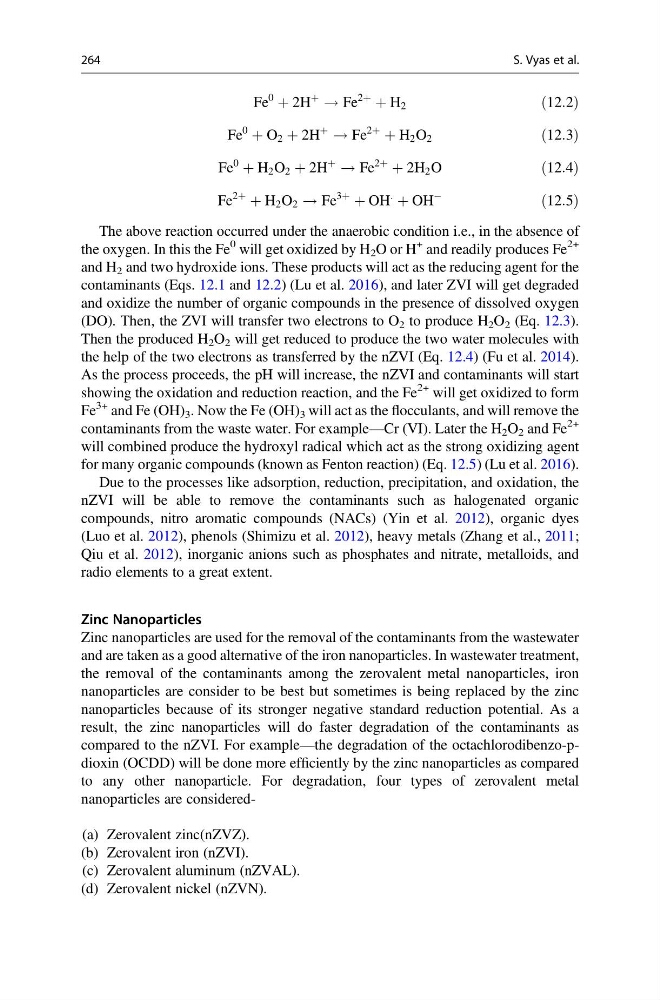
The above reaction occurred under the anaerobic condition i.e., in the absence of
the oxygen. In this the Fe
0 will get oxidized by H 2 O or H
+ and readily produces Fe
2+
and H 2 and two hydroxide ions. These products will act as the reducing agent for the
contaminants (Eqs. 12.1 and 12.2) (Lu et al. 2016), and later ZVI will get degraded
and oxidize the number of organic compounds in the presence of dissolved oxygen
(DO). Then, the ZVI will transfer two electrons to O 2 to produce H 2 O 2 (Eq. 12.3).
Then the produced H 2 O 2 will get reduced to produce the two water molecules with
the help of the two electrons as transferred by the nZVI (Eq. 12.4) (Fu et al. 2014).
As the process proceeds, the pH will increase, the nZVI and contaminants will start
showing the oxidation and reduction reaction, and the Fe
2+ will get oxidized to form
Fe
3+ and Fe (OH) 3 . Now the Fe (OH) 3 will act as the flocculants, and will remove the
contaminants from the waste water. For example—Cr (VI). Later the H 2 O 2 and Fe
2+
will combined produce the hydroxyl radical which act as the strong oxidizing agent
for many organic compounds (known as Fenton reaction) (Eq. 12.5) (Lu et al. 2016).
Due to the processes like adsorption, reduction, precipitation, and oxidation, the
nZVI will be able to remove the contaminants such as halogenated organic
compounds, nitro aromatic compounds (NACs) (Yin et al. 2012), organic dyes
(Luo et al. 2012), phenols (Shimizu et al. 2012), heavy metals (Zhang et al., 2011;
Qiu et al. 2012), inorganic anions such as phosphates and nitrate, metalloids, and
radio elements to a great extent.
Zinc Nanoparticles
Zinc nanoparticles are used for the removal of the contaminants from the wastewater
and are taken as a good alternative of the iron nanoparticles. In wastewater treatment,
the removal of the contaminants among the zerovalent metal nanoparticles, iron
nanoparticles are consider to be best but sometimes is being replaced by the zinc
nanoparticles because of its stronger negative standard reduction potential. As a
result, the zinc nanoparticles will do faster degradation of the contaminants as
compared to the nZVI. For example—the degradation of the octachlorodibenzo-pdioxin (OCDD) will be done more efficiently by the zinc nanoparticles as compared
to any other nanoparticle. For degradation, four types of zerovalent metal
nanoparticles are considered(a) Zerovalent zinc(nZVZ).
(b) Zerovalent iron (nZVI).
(c) Zerovalent aluminum (nZVAL).
(d) Zerovalent nickel (nZVN).
264
S. Vyas et al.
0
þ 2H
þ
! Fe
2þ
þ H 2
ð12:2Þ
Fe
0
þ O 2 þ 2H
þ
! Fe
2þ
þ H 2 O 2
ð12:3Þ
Fe
0
þ H 2 O 2 þ 2H
þ
! Fe
2þ
þ 2H 2 O
ð12:4Þ
Fe
2þ
þ H 2 O 2 ! Fe
3þ
þ OH
:
þ OH
À
ð12:5Þ
The above reaction occurred under the anaerobic condition i.e., in the absence of
the oxygen. In this the Fe
0 will get oxidized by H 2 O or H
+ and readily produces Fe
2+
and H 2 and two hydroxide ions. These products will act as the reducing agent for the
contaminants (Eqs. 12.1 and 12.2) (Lu et al. 2016), and later ZVI will get degraded
and oxidize the number of organic compounds in the presence of dissolved oxygen
(DO). Then, the ZVI will transfer two electrons to O 2 to produce H 2 O 2 (Eq. 12.3).
Then the produced H 2 O 2 will get reduced to produce the two water molecules with
the help of the two electrons as transferred by the nZVI (Eq. 12.4) (Fu et al. 2014).
As the process proceeds, the pH will increase, the nZVI and contaminants will start
showing the oxidation and reduction reaction, and the Fe
2+ will get oxidized to form
Fe
3+ and Fe (OH) 3 . Now the Fe (OH) 3 will act as the flocculants, and will remove the
contaminants from the waste water. For example—Cr (VI). Later the H 2 O 2 and Fe
2+
will combined produce the hydroxyl radical which act as the strong oxidizing agent
for many organic compounds (known as Fenton reaction) (Eq. 12.5) (Lu et al. 2016).
Due to the processes like adsorption, reduction, precipitation, and oxidation, the
nZVI will be able to remove the contaminants such as halogenated organic
compounds, nitro aromatic compounds (NACs) (Yin et al. 2012), organic dyes
(Luo et al. 2012), phenols (Shimizu et al. 2012), heavy metals (Zhang et al., 2011;
Qiu et al. 2012), inorganic anions such as phosphates and nitrate, metalloids, and
radio elements to a great extent.
Zinc Nanoparticles
Zinc nanoparticles are used for the removal of the contaminants from the wastewater
and are taken as a good alternative of the iron nanoparticles. In wastewater treatment,
the removal of the contaminants among the zerovalent metal nanoparticles, iron
nanoparticles are consider to be best but sometimes is being replaced by the zinc
nanoparticles because of its stronger negative standard reduction potential. As a
result, the zinc nanoparticles will do faster degradation of the contaminants as
compared to the nZVI. For example—the degradation of the octachlorodibenzo-pdioxin (OCDD) will be done more efficiently by the zinc nanoparticles as compared
to any other nanoparticle. For degradation, four types of zerovalent metal
nanoparticles are considered(a) Zerovalent zinc(nZVZ).
(b) Zerovalent iron (nZVI).
(c) Zerovalent aluminum (nZVAL).
(d) Zerovalent nickel (nZVN).
264
S. Vyas et al.