

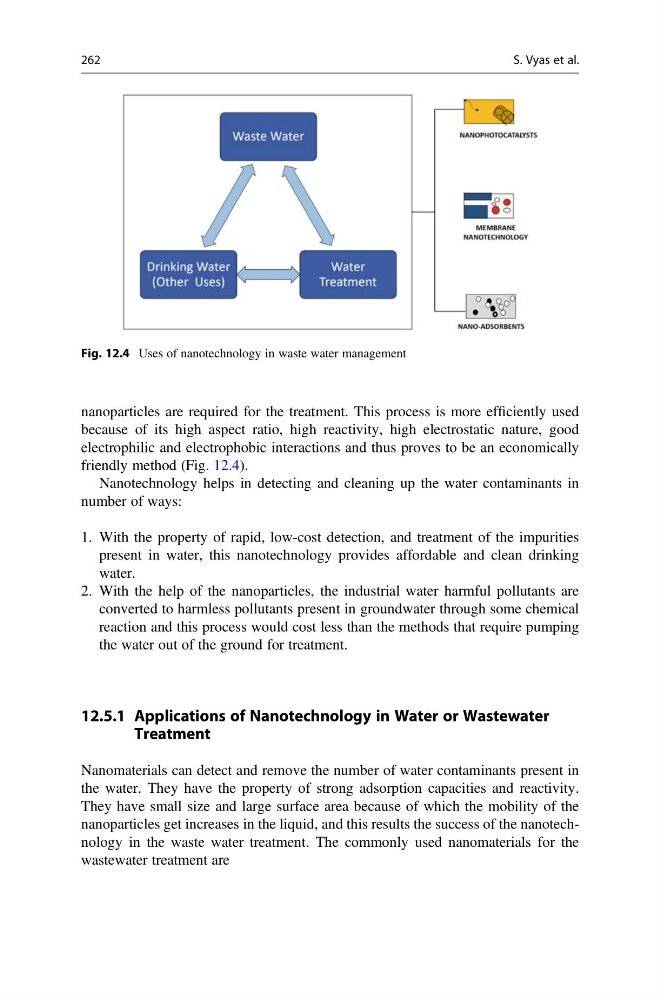
nanoparticles are required for the treatment. This process is more efficiently used
because of its high aspect ratio, high reactivity, high electrostatic nature, good
electrophilic and electrophobic interactions and thus proves to be an economically
friendly method (Fig. 12.4).
Nanotechnology helps in detecting and cleaning up the water contaminants in
number of ways:
1. With the property of rapid, low-cost detection, and treatment of the impurities
present in water, this nanotechnology provides affordable and clean drinking
water.
2. With the help of the nanoparticles, the industrial water harmful pollutants are
converted to harmless pollutants present in groundwater through some chemical
reaction and this process would cost less than the methods that require pumping
the water out of the ground for treatment.
12.5.1 Applications of Nanotechnology in Water or Wastewater
Treatment
Nanomaterials can detect and remove the number of water contaminants present in
the water. They have the property of strong adsorption capacities and reactivity.
They have small size and large surface area because of which the mobility of the
nanoparticles get increases in the liquid, and this results the success of the nanotechnology in the waste water treatment. The commonly used nanomaterials for the
wastewater treatment are
Fig. 12.4 Uses of nanotechnology in waste water management
262
S. Vyas et al.
because of its high aspect ratio, high reactivity, high electrostatic nature, good
electrophilic and electrophobic interactions and thus proves to be an economically
friendly method (Fig. 12.4).
Nanotechnology helps in detecting and cleaning up the water contaminants in
number of ways:
1. With the property of rapid, low-cost detection, and treatment of the impurities
present in water, this nanotechnology provides affordable and clean drinking
water.
2. With the help of the nanoparticles, the industrial water harmful pollutants are
converted to harmless pollutants present in groundwater through some chemical
reaction and this process would cost less than the methods that require pumping
the water out of the ground for treatment.
12.5.1 Applications of Nanotechnology in Water or Wastewater
Treatment
Nanomaterials can detect and remove the number of water contaminants present in
the water. They have the property of strong adsorption capacities and reactivity.
They have small size and large surface area because of which the mobility of the
nanoparticles get increases in the liquid, and this results the success of the nanotechnology in the waste water treatment. The commonly used nanomaterials for the
wastewater treatment are
Fig. 12.4 Uses of nanotechnology in waste water management
262
S. Vyas et al.