

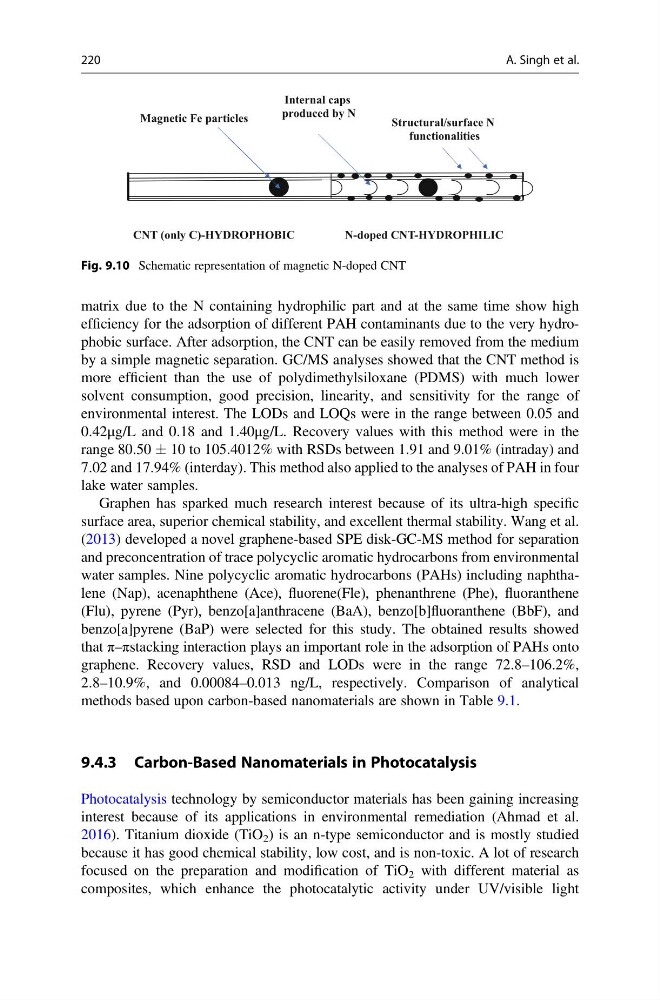
matrix due to the N containing hydrophilic part and at the same time show high
efficiency for the adsorption of different PAH contaminants due to the very hydrophobic surface. After adsorption, the CNT can be easily removed from the medium
by a simple magnetic separation. GC/MS analyses showed that the CNT method is
more efficient than the use of polydimethylsiloxane (PDMS) with much lower
solvent consumption, good precision, linearity, and sensitivity for the range of
environmental interest. The LODs and LOQs were in the range between 0.05 and
0.42μg/L and 0.18 and 1.40μg/L. Recovery values with this method were in the
range 80.50 Æ 10 to 105.4012% with RSDs between 1.91 and 9.01% (intraday) and
7.02 and 17.94% (interday). This method also applied to the analyses of PAH in four
lake water samples.
Graphen has sparked much research interest because of its ultra-high specific
surface area, superior chemical stability, and excellent thermal stability. Wang et al.
(2013) developed a novel graphene-based SPE disk-GC-MS method for separation
and preconcentration of trace polycyclic aromatic hydrocarbons from environmental
water samples. Nine polycyclic aromatic hydrocarbons (PAHs) including naphthalene (Nap), acenaphthene (Ace), fluorene(Fle), phenanthrene (Phe), fluoranthene
(Flu), pyrene (Pyr), benzo[a]anthracene (BaA), benzo[b]fluoranthene (BbF), and
benzo[a]pyrene (BaP) were selected for this study. The obtained results showed
that π–πstacking interaction plays an important role in the adsorption of PAHs onto
graphene. Recovery values, RSD and LODs were in the range 72.8–106.2%,
2.8–10.9%, and 0.00084–0.013 ng/L, respectively. Comparison of analytical
methods based upon carbon-based nanomaterials are shown in Table 9.1.
9.4.3 Carbon-Based Nanomaterials in Photocatalysis
Photocatalysis technology by semiconductor materials has been gaining increasing
interest because of its applications in environmental remediation (Ahmad et al.
2016). Titanium dioxide (TiO 2 ) is an n-type semiconductor and is mostly studied
because it has good chemical stability, low cost, and is non-toxic. A lot of research
focused on the preparation and modification of TiO 2 with different material as
composites, which enhance the photocatalytic activity under UV/visible light
CNT (only C)-HYDROPHOBIC
N-doped CNT-HYDROPHILIC
Magnetic Fe particles
Internal caps
produced by N
Structural/surface N
functionalities
Fig. 9.10 Schematic representation of magnetic N-doped CNT
220
A. Singh et al.
efficiency for the adsorption of different PAH contaminants due to the very hydrophobic surface. After adsorption, the CNT can be easily removed from the medium
by a simple magnetic separation. GC/MS analyses showed that the CNT method is
more efficient than the use of polydimethylsiloxane (PDMS) with much lower
solvent consumption, good precision, linearity, and sensitivity for the range of
environmental interest. The LODs and LOQs were in the range between 0.05 and
0.42μg/L and 0.18 and 1.40μg/L. Recovery values with this method were in the
range 80.50 Æ 10 to 105.4012% with RSDs between 1.91 and 9.01% (intraday) and
7.02 and 17.94% (interday). This method also applied to the analyses of PAH in four
lake water samples.
Graphen has sparked much research interest because of its ultra-high specific
surface area, superior chemical stability, and excellent thermal stability. Wang et al.
(2013) developed a novel graphene-based SPE disk-GC-MS method for separation
and preconcentration of trace polycyclic aromatic hydrocarbons from environmental
water samples. Nine polycyclic aromatic hydrocarbons (PAHs) including naphthalene (Nap), acenaphthene (Ace), fluorene(Fle), phenanthrene (Phe), fluoranthene
(Flu), pyrene (Pyr), benzo[a]anthracene (BaA), benzo[b]fluoranthene (BbF), and
benzo[a]pyrene (BaP) were selected for this study. The obtained results showed
that π–πstacking interaction plays an important role in the adsorption of PAHs onto
graphene. Recovery values, RSD and LODs were in the range 72.8–106.2%,
2.8–10.9%, and 0.00084–0.013 ng/L, respectively. Comparison of analytical
methods based upon carbon-based nanomaterials are shown in Table 9.1.
9.4.3 Carbon-Based Nanomaterials in Photocatalysis
Photocatalysis technology by semiconductor materials has been gaining increasing
interest because of its applications in environmental remediation (Ahmad et al.
2016). Titanium dioxide (TiO 2 ) is an n-type semiconductor and is mostly studied
because it has good chemical stability, low cost, and is non-toxic. A lot of research
focused on the preparation and modification of TiO 2 with different material as
composites, which enhance the photocatalytic activity under UV/visible light
CNT (only C)-HYDROPHOBIC
N-doped CNT-HYDROPHILIC
Magnetic Fe particles
Internal caps
produced by N
Structural/surface N
functionalities
Fig. 9.10 Schematic representation of magnetic N-doped CNT
220
A. Singh et al.