

30–40 SPME extractions before being discarded. The method showed good precision, wide linear range, low detection limits, and high recoveries.
Zhao et al. (2011) fabricated magnetic multi-walled carbon nanotubes and
applied to magnetic solid-phase extraction (MSPE) of eight heavy molecular weight
PAHs including chrysene, benzo[a]anthracene, benzo[b]fluoranthene, benzo[k]
fluoranthene, benzo[a]pyrene, indeno[1,2,3-cd]pyrene, dibenzo[a,h]-anthracene,
and benzo[g,h,i]perylene from edible oil samples. MSPE is a mode of extraction
technique based on the use of magnetic or magnetizable adsorbents, which can be
readily isolated from sample matrix with an external magnet. After the optimization
of main parameters that affects extraction efficiency, MSPE-GC-MS method is used
for the determination of PAHs in edible oils. The LODs and LOQs of the target
PAHs by this method ranged between 0.10–0.88 ng/g and 0.34–2.9 ng/g, respectively. Recovery values with this method were in the range 87.8–122.3% with RSDs
less than 6.8% (intraday) and 9.6% (interday).
Needle type extraction (NTE) has many advantages over SPME and needle trap
extraction where commercially available sorbents or chemically synthesized
polymers are packed inside needle (Bagheri et al. 2011).One of the advantages of
needle extraction technique over SPME is the robustness of the needle. Compared to
the fragile SPME fiber, the needle device is nearly impossible to break mechanically.
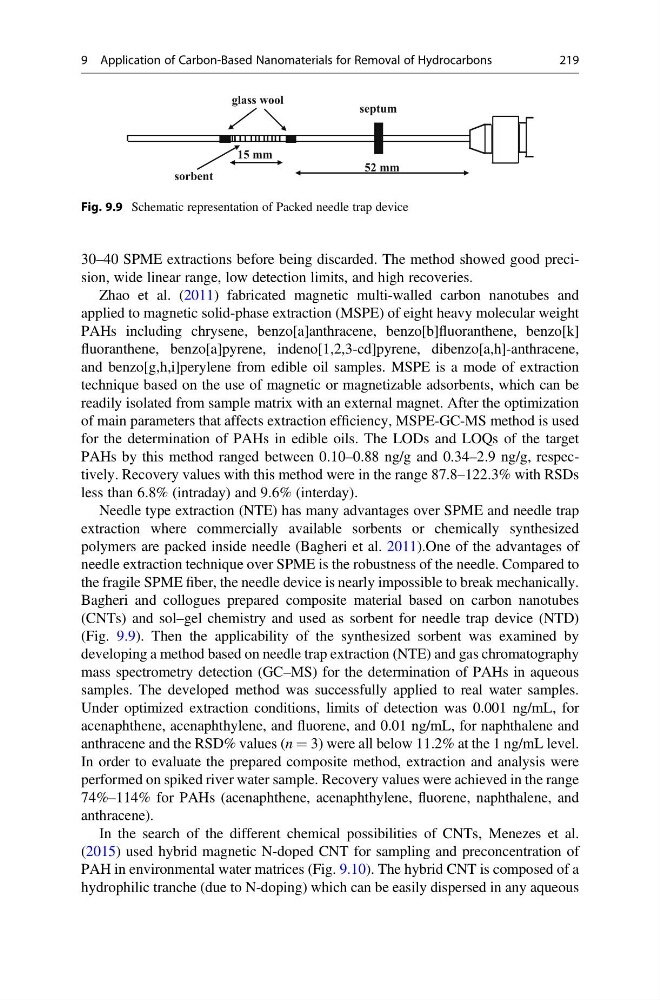
Bagheri and collogues prepared composite material based on carbon nanotubes
(CNTs) and sol–gel chemistry and used as sorbent for needle trap device (NTD)
(Fig. 9.9). Then the applicability of the synthesized sorbent was examined by
developing a method based on needle trap extraction (NTE) and gas chromatography
mass spectrometry detection (GC–MS) for the determination of PAHs in aqueous
samples. The developed method was successfully applied to real water samples.
Under optimized extraction conditions, limits of detection was 0.001 ng/mL, for
acenaphthene, acenaphthylene, and fluorene, and 0.01 ng/mL, for naphthalene and
anthracene and the RSD% values (n ¼ 3) were all below 11.2% at the 1 ng/mL level.
In order to evaluate the prepared composite method, extraction and analysis were
performed on spiked river water sample. Recovery values were achieved in the range
74%–114% for PAHs (acenaphthene, acenaphthylene, fluorene, naphthalene, and
anthracene).
In the search of the different chemical possibilities of CNTs, Menezes et al.
(2015) used hybrid magnetic N-doped CNT for sampling and preconcentration of
PAH in environmental water matrices (Fig. 9.10). The hybrid CNT is composed of a
hydrophilic tranche (due to N-doping) which can be easily dispersed in any aqueous
15 mm
52 mm
septum
sorbent
glass wool
Fig. 9.9 Schematic representation of Packed needle trap device
9 Application of Carbon-Based Nanomaterials for Removal of Hydrocarbons
219
Zhao et al. (2011) fabricated magnetic multi-walled carbon nanotubes and
applied to magnetic solid-phase extraction (MSPE) of eight heavy molecular weight
PAHs including chrysene, benzo[a]anthracene, benzo[b]fluoranthene, benzo[k]
fluoranthene, benzo[a]pyrene, indeno[1,2,3-cd]pyrene, dibenzo[a,h]-anthracene,
and benzo[g,h,i]perylene from edible oil samples. MSPE is a mode of extraction
technique based on the use of magnetic or magnetizable adsorbents, which can be
readily isolated from sample matrix with an external magnet. After the optimization
of main parameters that affects extraction efficiency, MSPE-GC-MS method is used
for the determination of PAHs in edible oils. The LODs and LOQs of the target
PAHs by this method ranged between 0.10–0.88 ng/g and 0.34–2.9 ng/g, respectively. Recovery values with this method were in the range 87.8–122.3% with RSDs
less than 6.8% (intraday) and 9.6% (interday).
Needle type extraction (NTE) has many advantages over SPME and needle trap
extraction where commercially available sorbents or chemically synthesized
polymers are packed inside needle (Bagheri et al. 2011).One of the advantages of
needle extraction technique over SPME is the robustness of the needle. Compared to
the fragile SPME fiber, the needle device is nearly impossible to break mechanically.
Bagheri and collogues prepared composite material based on carbon nanotubes
(CNTs) and sol–gel chemistry and used as sorbent for needle trap device (NTD)
(Fig. 9.9). Then the applicability of the synthesized sorbent was examined by
developing a method based on needle trap extraction (NTE) and gas chromatography
mass spectrometry detection (GC–MS) for the determination of PAHs in aqueous
samples. The developed method was successfully applied to real water samples.
Under optimized extraction conditions, limits of detection was 0.001 ng/mL, for
acenaphthene, acenaphthylene, and fluorene, and 0.01 ng/mL, for naphthalene and
anthracene and the RSD% values (n ¼ 3) were all below 11.2% at the 1 ng/mL level.
In order to evaluate the prepared composite method, extraction and analysis were
performed on spiked river water sample. Recovery values were achieved in the range
74%–114% for PAHs (acenaphthene, acenaphthylene, fluorene, naphthalene, and
anthracene).
In the search of the different chemical possibilities of CNTs, Menezes et al.
(2015) used hybrid magnetic N-doped CNT for sampling and preconcentration of
PAH in environmental water matrices (Fig. 9.10). The hybrid CNT is composed of a
hydrophilic tranche (due to N-doping) which can be easily dispersed in any aqueous
15 mm
52 mm
septum
sorbent
glass wool
Fig. 9.9 Schematic representation of Packed needle trap device
9 Application of Carbon-Based Nanomaterials for Removal of Hydrocarbons
219