

applications such as supercapacitors, sensors, solar cells, photovoltaic cells and
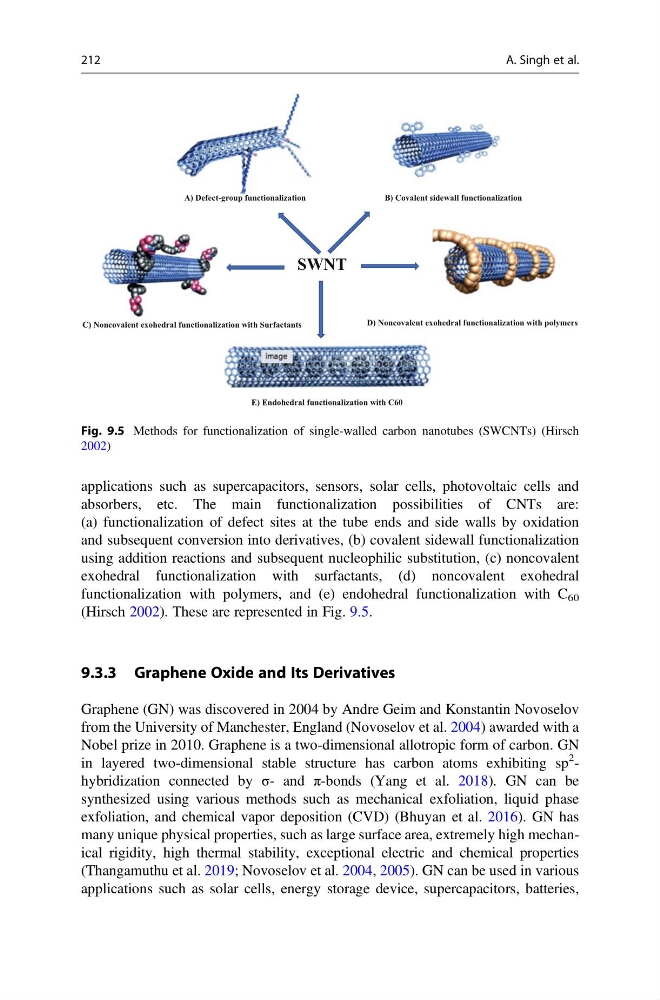
absorbers, etc. The main functionalization possibilities of CNTs are:
(a) functionalization of defect sites at the tube ends and side walls by oxidation
and subsequent conversion into derivatives, (b) covalent sidewall functionalization
using addition reactions and subsequent nucleophilic substitution, (c) noncovalent
exohedral functionalization with surfactants, (d) noncovalent exohedral
functionalization with polymers, and (e) endohedral functionalization with C 60
(Hirsch 2002). These are represented in Fig. 9.5.
9.3.3 Graphene Oxide and Its Derivatives
Graphene (GN) was discovered in 2004 by Andre Geim and Konstantin Novoselov
from the University of Manchester, England (Novoselov et al. 2004) awarded with a
Nobel prize in 2010. Graphene is a two-dimensional allotropic form of carbon. GN
in layered two-dimensional stable structure has carbon atoms exhibiting sp
2 -
hybridization connected by σ- and π-bonds (Yang et al. 2018). GN can be
synthesized using various methods such as mechanical exfoliation, liquid phase
exfoliation, and chemical vapor deposition (CVD) (Bhuyan et al. 2016). GN has
many unique physical properties, such as large surface area, extremely high mechanical rigidity, high thermal stability, exceptional electric and chemical properties
(Thangamuthu et al. 2019; Novoselov et al. 2004, 2005). GN can be used in various
applications such as solar cells, energy storage device, supercapacitors, batteries,
A) Defect-group functionalization
B) Covalent sidewall functionalization
C) Noncovalent exohedral functionalization with Surfactants
D) Noncovalent exohedral functionalization with polymers
E) Endohedral functionalization with C60
SWNT
Fig. 9.5 Methods for functionalization of single-walled carbon nanotubes (SWCNTs) (Hirsch
2002)
212
A. Singh et al.
absorbers, etc. The main functionalization possibilities of CNTs are:
(a) functionalization of defect sites at the tube ends and side walls by oxidation
and subsequent conversion into derivatives, (b) covalent sidewall functionalization
using addition reactions and subsequent nucleophilic substitution, (c) noncovalent
exohedral functionalization with surfactants, (d) noncovalent exohedral
functionalization with polymers, and (e) endohedral functionalization with C 60
(Hirsch 2002). These are represented in Fig. 9.5.
9.3.3 Graphene Oxide and Its Derivatives
Graphene (GN) was discovered in 2004 by Andre Geim and Konstantin Novoselov
from the University of Manchester, England (Novoselov et al. 2004) awarded with a
Nobel prize in 2010. Graphene is a two-dimensional allotropic form of carbon. GN
in layered two-dimensional stable structure has carbon atoms exhibiting sp
2 -
hybridization connected by σ- and π-bonds (Yang et al. 2018). GN can be
synthesized using various methods such as mechanical exfoliation, liquid phase
exfoliation, and chemical vapor deposition (CVD) (Bhuyan et al. 2016). GN has
many unique physical properties, such as large surface area, extremely high mechanical rigidity, high thermal stability, exceptional electric and chemical properties
(Thangamuthu et al. 2019; Novoselov et al. 2004, 2005). GN can be used in various
applications such as solar cells, energy storage device, supercapacitors, batteries,
A) Defect-group functionalization
B) Covalent sidewall functionalization
C) Noncovalent exohedral functionalization with Surfactants
D) Noncovalent exohedral functionalization with polymers
E) Endohedral functionalization with C60
SWNT
Fig. 9.5 Methods for functionalization of single-walled carbon nanotubes (SWCNTs) (Hirsch
2002)
212
A. Singh et al.