

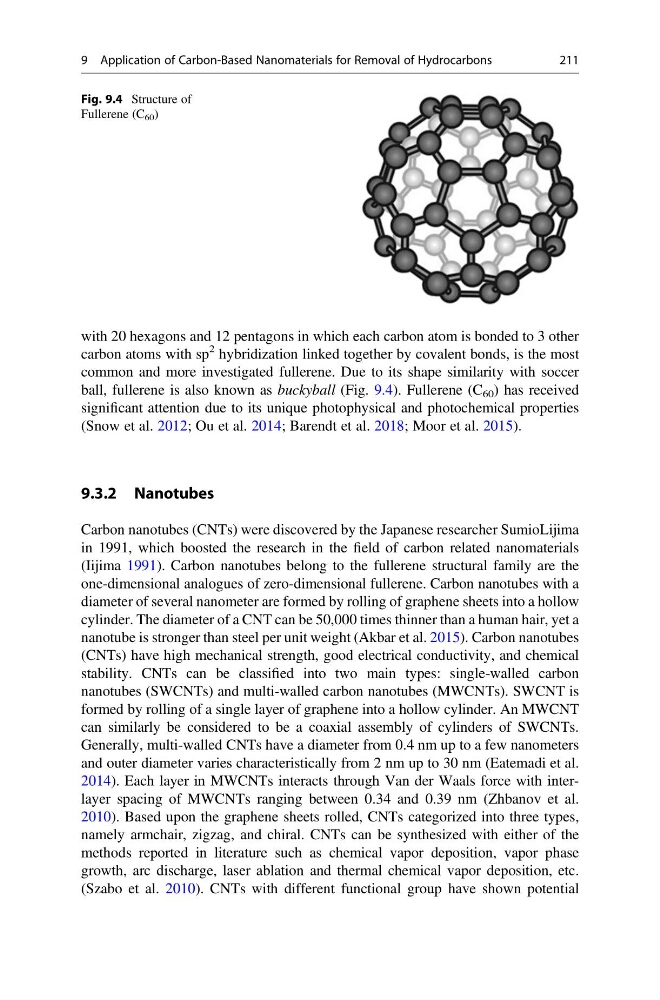
with 20 hexagons and 12 pentagons in which each carbon atom is bonded to 3 other
carbon atoms with sp
2 hybridization linked together by covalent bonds, is the most
common and more investigated fullerene. Due to its shape similarity with soccer
ball, fullerene is also known as buckyball (Fig. 9.4). Fullerene (C 60 ) has received
significant attention due to its unique photophysical and photochemical properties
(Snow et al. 2012; Ou et al. 2014; Barendt et al. 2018; Moor et al. 2015).
9.3.2 Nanotubes
Carbon nanotubes (CNTs) were discovered by the Japanese researcher SumioLijima
in 1991, which boosted the research in the field of carbon related nanomaterials
(Iijima 1991). Carbon nanotubes belong to the fullerene structural family are the
one-dimensional analogues of zero-dimensional fullerene. Carbon nanotubes with a
diameter of several nanometer are formed by rolling of graphene sheets into a hollow
cylinder. The diameter of a CNT can be 50,000 times thinner than a human hair, yet a
nanotube is stronger than steel per unit weight (Akbar et al. 2015). Carbon nanotubes
(CNTs) have high mechanical strength, good electrical conductivity, and chemical
stability. CNTs can be classified into two main types: single-walled carbon
nanotubes (SWCNTs) and multi-walled carbon nanotubes (MWCNTs). SWCNT is
formed by rolling of a single layer of graphene into a hollow cylinder. An MWCNT
can similarly be considered to be a coaxial assembly of cylinders of SWCNTs.
Generally, multi-walled CNTs have a diameter from 0.4 nm up to a few nanometers
and outer diameter varies characteristically from 2 nm up to 30 nm (Eatemadi et al.
2014). Each layer in MWCNTs interacts through Van der Waals force with interlayer spacing of MWCNTs ranging between 0.34 and 0.39 nm (Zhbanov et al.
2010). Based upon the graphene sheets rolled, CNTs categorized into three types,
namely armchair, zigzag, and chiral. CNTs can be synthesized with either of the
methods reported in literature such as chemical vapor deposition, vapor phase
growth, arc discharge, laser ablation and thermal chemical vapor deposition, etc.
(Szabo et al. 2010). CNTs with different functional group have shown potential
Fig. 9.4 Structure of
Fullerene (C 60 )
9 Application of Carbon-Based Nanomaterials for Removal of Hydrocarbons
211
carbon atoms with sp
2 hybridization linked together by covalent bonds, is the most
common and more investigated fullerene. Due to its shape similarity with soccer
ball, fullerene is also known as buckyball (Fig. 9.4). Fullerene (C 60 ) has received
significant attention due to its unique photophysical and photochemical properties
(Snow et al. 2012; Ou et al. 2014; Barendt et al. 2018; Moor et al. 2015).
9.3.2 Nanotubes
Carbon nanotubes (CNTs) were discovered by the Japanese researcher SumioLijima
in 1991, which boosted the research in the field of carbon related nanomaterials
(Iijima 1991). Carbon nanotubes belong to the fullerene structural family are the
one-dimensional analogues of zero-dimensional fullerene. Carbon nanotubes with a
diameter of several nanometer are formed by rolling of graphene sheets into a hollow
cylinder. The diameter of a CNT can be 50,000 times thinner than a human hair, yet a
nanotube is stronger than steel per unit weight (Akbar et al. 2015). Carbon nanotubes
(CNTs) have high mechanical strength, good electrical conductivity, and chemical
stability. CNTs can be classified into two main types: single-walled carbon
nanotubes (SWCNTs) and multi-walled carbon nanotubes (MWCNTs). SWCNT is
formed by rolling of a single layer of graphene into a hollow cylinder. An MWCNT
can similarly be considered to be a coaxial assembly of cylinders of SWCNTs.
Generally, multi-walled CNTs have a diameter from 0.4 nm up to a few nanometers
and outer diameter varies characteristically from 2 nm up to 30 nm (Eatemadi et al.
2014). Each layer in MWCNTs interacts through Van der Waals force with interlayer spacing of MWCNTs ranging between 0.34 and 0.39 nm (Zhbanov et al.
2010). Based upon the graphene sheets rolled, CNTs categorized into three types,
namely armchair, zigzag, and chiral. CNTs can be synthesized with either of the
methods reported in literature such as chemical vapor deposition, vapor phase
growth, arc discharge, laser ablation and thermal chemical vapor deposition, etc.
(Szabo et al. 2010). CNTs with different functional group have shown potential
Fig. 9.4 Structure of
Fullerene (C 60 )
9 Application of Carbon-Based Nanomaterials for Removal of Hydrocarbons
211