

potential to remove organophosphate pesticides. The surface of nanocrystalline
alumina possesses high surface area and high concentration of hydroxyl groups
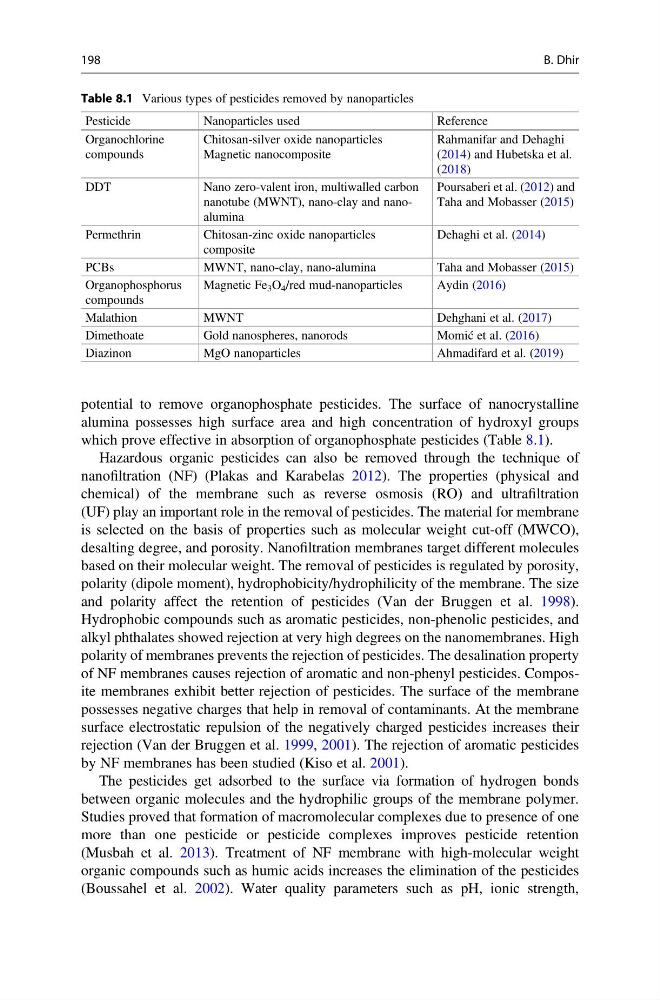
which prove effective in absorption of organophosphate pesticides (Table 8.1).
Hazardous organic pesticides can also be removed through the technique of
nanofiltration (NF) (Plakas and Karabelas 2012). The properties (physical and
chemical) of the membrane such as reverse osmosis (RO) and ultrafiltration
(UF) play an important role in the removal of pesticides. The material for membrane
is selected on the basis of properties such as molecular weight cut-off (MWCO),
desalting degree, and porosity. Nanofiltration membranes target different molecules
based on their molecular weight. The removal of pesticides is regulated by porosity,
polarity (dipole moment), hydrophobicity/hydrophilicity of the membrane. The size
and polarity affect the retention of pesticides (Van der Bruggen et al. 1998).
Hydrophobic compounds such as aromatic pesticides, non-phenolic pesticides, and
alkyl phthalates showed rejection at very high degrees on the nanomembranes. High
polarity of membranes prevents the rejection of pesticides. The desalination property
of NF membranes causes rejection of aromatic and non-phenyl pesticides. Composite membranes exhibit better rejection of pesticides. The surface of the membrane
possesses negative charges that help in removal of contaminants. At the membrane
surface electrostatic repulsion of the negatively charged pesticides increases their
rejection (Van der Bruggen et al. 1999, 2001). The rejection of aromatic pesticides
by NF membranes has been studied (Kiso et al. 2001).
The pesticides get adsorbed to the surface via formation of hydrogen bonds
between organic molecules and the hydrophilic groups of the membrane polymer.
Studies proved that formation of macromolecular complexes due to presence of one
more than one pesticide or pesticide complexes improves pesticide retention
(Musbah et al. 2013). Treatment of NF membrane with high-molecular weight
organic compounds such as humic acids increases the elimination of the pesticides
(Boussahel et al. 2002). Water quality parameters such as pH, ionic strength,
Table 8.1 Various types of pesticides removed by nanoparticles
Pesticide
Nanoparticles used
Reference
Organochlorine
compounds
Chitosan-silver oxide nanoparticles
Magnetic nanocomposite
Rahmanifar and Dehaghi
(2014) and Hubetska et al.
(2018)
DDT
Nano zero-valent iron, multiwalled carbon
nanotube (MWNT), nano-clay and nanoalumina
Poursaberi et al. (2012) and
Taha and Mobasser (2015)
Permethrin
Chitosan-zinc oxide nanoparticles
composite
Dehaghi et al. (2014)
PCBs
MWNT, nano-clay, nano-alumina
Taha and Mobasser (2015)
Organophosphorus
compounds
Magnetic Fe 3 O 4 /red mud-nanoparticles
Aydin (2016)
Malathion
MWNT
Dehghani et al. (2017)
Dimethoate
Gold nanospheres, nanorods
Momić et al. (2016)
Diazinon
MgO nanoparticles
Ahmadifard et al. (2019)
198
B. Dhir
alumina possesses high surface area and high concentration of hydroxyl groups
which prove effective in absorption of organophosphate pesticides (Table 8.1).
Hazardous organic pesticides can also be removed through the technique of
nanofiltration (NF) (Plakas and Karabelas 2012). The properties (physical and
chemical) of the membrane such as reverse osmosis (RO) and ultrafiltration
(UF) play an important role in the removal of pesticides. The material for membrane
is selected on the basis of properties such as molecular weight cut-off (MWCO),
desalting degree, and porosity. Nanofiltration membranes target different molecules
based on their molecular weight. The removal of pesticides is regulated by porosity,
polarity (dipole moment), hydrophobicity/hydrophilicity of the membrane. The size
and polarity affect the retention of pesticides (Van der Bruggen et al. 1998).
Hydrophobic compounds such as aromatic pesticides, non-phenolic pesticides, and
alkyl phthalates showed rejection at very high degrees on the nanomembranes. High
polarity of membranes prevents the rejection of pesticides. The desalination property
of NF membranes causes rejection of aromatic and non-phenyl pesticides. Composite membranes exhibit better rejection of pesticides. The surface of the membrane
possesses negative charges that help in removal of contaminants. At the membrane
surface electrostatic repulsion of the negatively charged pesticides increases their
rejection (Van der Bruggen et al. 1999, 2001). The rejection of aromatic pesticides
by NF membranes has been studied (Kiso et al. 2001).
The pesticides get adsorbed to the surface via formation of hydrogen bonds
between organic molecules and the hydrophilic groups of the membrane polymer.
Studies proved that formation of macromolecular complexes due to presence of one
more than one pesticide or pesticide complexes improves pesticide retention
(Musbah et al. 2013). Treatment of NF membrane with high-molecular weight
organic compounds such as humic acids increases the elimination of the pesticides
(Boussahel et al. 2002). Water quality parameters such as pH, ionic strength,
Table 8.1 Various types of pesticides removed by nanoparticles
Pesticide
Nanoparticles used
Reference
Organochlorine
compounds
Chitosan-silver oxide nanoparticles
Magnetic nanocomposite
Rahmanifar and Dehaghi
(2014) and Hubetska et al.
(2018)
DDT
Nano zero-valent iron, multiwalled carbon
nanotube (MWNT), nano-clay and nanoalumina
Poursaberi et al. (2012) and
Taha and Mobasser (2015)
Permethrin
Chitosan-zinc oxide nanoparticles
composite
Dehaghi et al. (2014)
PCBs
MWNT, nano-clay, nano-alumina
Taha and Mobasser (2015)
Organophosphorus
compounds
Magnetic Fe 3 O 4 /red mud-nanoparticles
Aydin (2016)
Malathion
MWNT
Dehghani et al. (2017)
Dimethoate
Gold nanospheres, nanorods
Momić et al. (2016)
Diazinon
MgO nanoparticles
Ahmadifard et al. (2019)
198
B. Dhir