

presence of organic matter also influence the rejection of pesticides. Increase in pH
decreases the rejection rate, while decrease in pH improves adsorption and ionic
strength. High ionic strength reduces membrane permeability resulting in a better
rejection. This happens because electrostatic forces and pore size inside the membrane decrease.
Two pesticides, namely hexaconazole and chlorpyrifos have been effectively
adsorbed from water samples using nanocomposite composed of magnetic Fe 3 O 4
nanoparticles (M), graphene oxide (GO), and N-methyl-D-glucamine functionalized
calixarene (NGC). Both chlorpyrifos and hexaconazole showed high adsorption
capacities of 78.74 and 93.46 mg g
À1 , respectively.
Though nanomaterials offer several advantages for removal of pesticides,
properties such as unstability, toxicity, and recovery costs need to be considered
while designing technologies using nanomaterials for remediation processes
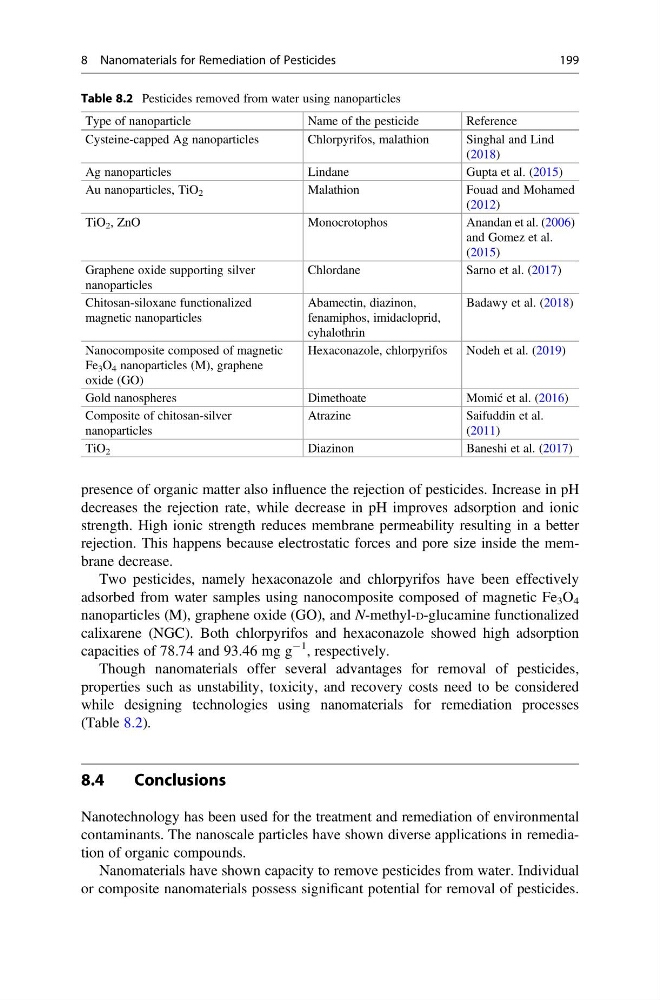
(Table 8.2).
8.4
Conclusions
Nanotechnology has been used for the treatment and remediation of environmental
contaminants. The nanoscale particles have shown diverse applications in remediation of organic compounds.
Nanomaterials have shown capacity to remove pesticides from water. Individual
or composite nanomaterials possess significant potential for removal of pesticides.
Table 8.2 Pesticides removed from water using nanoparticles
Type of nanoparticle
Name of the pesticide
Reference
Cysteine-capped Ag nanoparticles
Chlorpyrifos, malathion
Singhal and Lind
(2018)
Ag nanoparticles
Lindane
Gupta et al. (2015)
Au nanoparticles, TiO 2
Malathion
Fouad and Mohamed
(2012)
TiO 2 , ZnO
Monocrotophos
Anandan et al. (2006)
and Gomez et al.
(2015)
Graphene oxide supporting silver
nanoparticles
Chlordane
Sarno et al. (2017)
Chitosan-siloxane functionalized
magnetic nanoparticles
Abamectin, diazinon,
fenamiphos, imidacloprid,
cyhalothrin
Badawy et al. (2018)
Nanocomposite composed of magnetic
Fe 3 O 4 nanoparticles (M), graphene
oxide (GO)
Hexaconazole, chlorpyrifos Nodeh et al. (2019)
Gold nanospheres
Dimethoate
Momić et al. (2016)
Composite of chitosan-silver
nanoparticles
Atrazine
Saifuddin et al.
(2011)
TiO 2
Diazinon
Baneshi et al. (2017)
8 Nanomaterials for Remediation of Pesticides
199
decreases the rejection rate, while decrease in pH improves adsorption and ionic
strength. High ionic strength reduces membrane permeability resulting in a better
rejection. This happens because electrostatic forces and pore size inside the membrane decrease.
Two pesticides, namely hexaconazole and chlorpyrifos have been effectively
adsorbed from water samples using nanocomposite composed of magnetic Fe 3 O 4
nanoparticles (M), graphene oxide (GO), and N-methyl-D-glucamine functionalized
calixarene (NGC). Both chlorpyrifos and hexaconazole showed high adsorption
capacities of 78.74 and 93.46 mg g
À1 , respectively.
Though nanomaterials offer several advantages for removal of pesticides,
properties such as unstability, toxicity, and recovery costs need to be considered
while designing technologies using nanomaterials for remediation processes
(Table 8.2).
8.4
Conclusions
Nanotechnology has been used for the treatment and remediation of environmental
contaminants. The nanoscale particles have shown diverse applications in remediation of organic compounds.
Nanomaterials have shown capacity to remove pesticides from water. Individual
or composite nanomaterials possess significant potential for removal of pesticides.
Table 8.2 Pesticides removed from water using nanoparticles
Type of nanoparticle
Name of the pesticide
Reference
Cysteine-capped Ag nanoparticles
Chlorpyrifos, malathion
Singhal and Lind
(2018)
Ag nanoparticles
Lindane
Gupta et al. (2015)
Au nanoparticles, TiO 2
Malathion
Fouad and Mohamed
(2012)
TiO 2 , ZnO
Monocrotophos
Anandan et al. (2006)
and Gomez et al.
(2015)
Graphene oxide supporting silver
nanoparticles
Chlordane
Sarno et al. (2017)
Chitosan-siloxane functionalized
magnetic nanoparticles
Abamectin, diazinon,
fenamiphos, imidacloprid,
cyhalothrin
Badawy et al. (2018)
Nanocomposite composed of magnetic
Fe 3 O 4 nanoparticles (M), graphene
oxide (GO)
Hexaconazole, chlorpyrifos Nodeh et al. (2019)
Gold nanospheres
Dimethoate
Momić et al. (2016)
Composite of chitosan-silver
nanoparticles
Atrazine
Saifuddin et al.
(2011)
TiO 2
Diazinon
Baneshi et al. (2017)
8 Nanomaterials for Remediation of Pesticides
199