

nanocomposites have exhibited high magnetic response for removing the dyes
(Fig. 7.7).
The existence of high surface area with active functional groups has increased the
availability of the active binding sites for the adsorptive removal of MB. In addition,
the high pH of the reaction media has supported the electrostatic attraction of MB
with negatively charged nanoparticles. The resultant kinetic studies have shown the
presence of pseudo-second-order model with applicability of Freundlich adsorption
isotherm. In addition, the adsorption process was found to be endothermic and
spontaneous in nature. The reproducibility of the system was found to be higher
after four successive cycles. Therefore, the combination of C-dots for dye removal
has provided an excellent cost-effective means for waste water purification process.
Till date, wide research has been carried out on the synthesis, characterization and
application of C-dots due to their extraordinary applications in dye removal. Different parameters such as low cost, easy synthetic procedure and size controllable
approaches make C-dots an exceptional material of nano-field. The field of C-dots
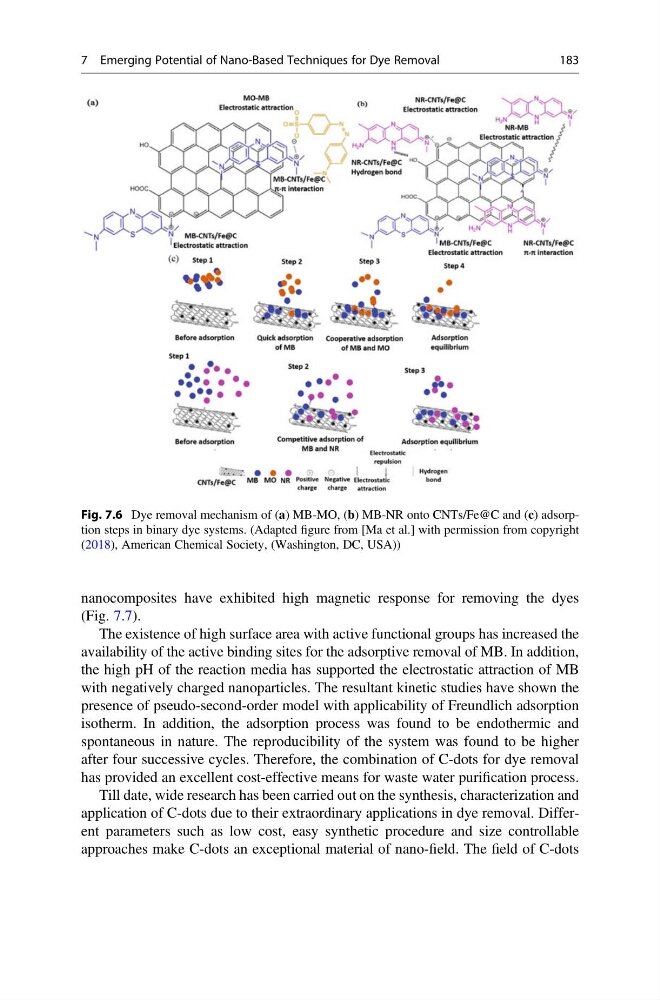
Fig. 7.6 Dye removal mechanism of (a) MB-MO, (b) MB-NR onto CNTs/Fe@C and (c) adsorption steps in binary dye systems. (Adapted figure from [Ma et al.] with permission from copyright
(2018), American Chemical Society, (Washington, DC, USA))
7 Emerging Potential of Nano-Based Techniques for Dye Removal
183
(Fig. 7.7).
The existence of high surface area with active functional groups has increased the
availability of the active binding sites for the adsorptive removal of MB. In addition,
the high pH of the reaction media has supported the electrostatic attraction of MB
with negatively charged nanoparticles. The resultant kinetic studies have shown the
presence of pseudo-second-order model with applicability of Freundlich adsorption
isotherm. In addition, the adsorption process was found to be endothermic and
spontaneous in nature. The reproducibility of the system was found to be higher
after four successive cycles. Therefore, the combination of C-dots for dye removal
has provided an excellent cost-effective means for waste water purification process.
Till date, wide research has been carried out on the synthesis, characterization and
application of C-dots due to their extraordinary applications in dye removal. Different parameters such as low cost, easy synthetic procedure and size controllable
approaches make C-dots an exceptional material of nano-field. The field of C-dots
Fig. 7.6 Dye removal mechanism of (a) MB-MO, (b) MB-NR onto CNTs/Fe@C and (c) adsorption steps in binary dye systems. (Adapted figure from [Ma et al.] with permission from copyright
(2018), American Chemical Society, (Washington, DC, USA))
7 Emerging Potential of Nano-Based Techniques for Dye Removal
183