

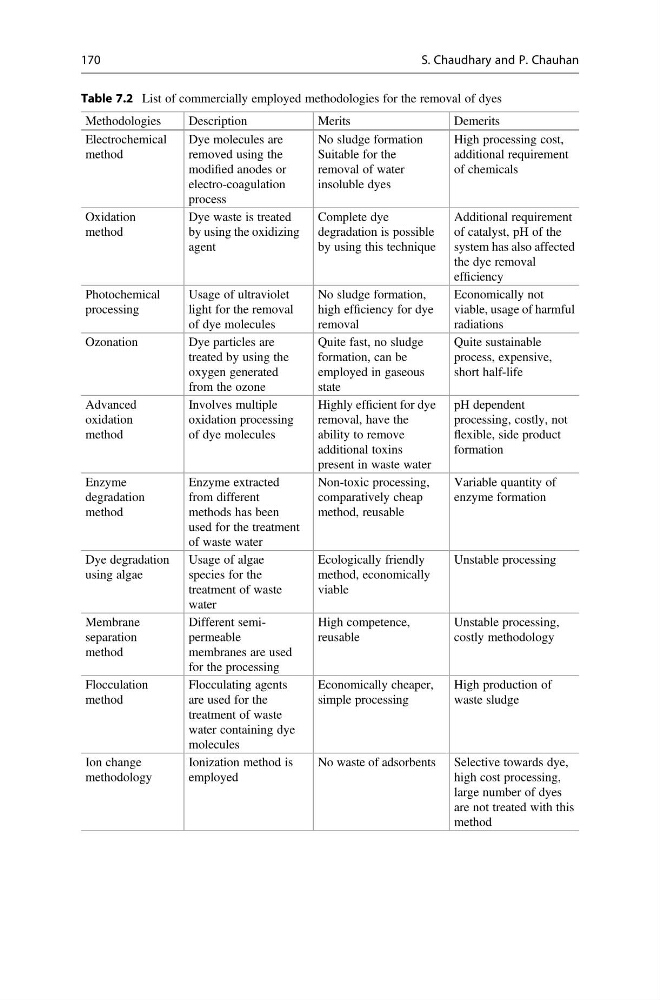
Table 7.2 List of commercially employed methodologies for the removal of dyes
Methodologies
Description
Merits
Demerits
Electrochemical
method
Dye molecules are
removed using the
modified anodes or
electro-coagulation
process
No sludge formation
Suitable for the
removal of water
insoluble dyes
High processing cost,
additional requirement
of chemicals
Oxidation
method
Dye waste is treated
by using the oxidizing
agent
Complete dye
degradation is possible
by using this technique
Additional requirement
of catalyst, pH of the
system has also affected
the dye removal
efficiency
Photochemical
processing
Usage of ultraviolet
light for the removal
of dye molecules
No sludge formation,
high efficiency for dye
removal
Economically not
viable, usage of harmful
radiations
Ozonation
Dye particles are
treated by using the
oxygen generated
from the ozone
Quite fast, no sludge
formation, can be
employed in gaseous
state
Quite sustainable
process, expensive,
short half-life
Advanced
oxidation
method
Involves multiple
oxidation processing
of dye molecules
Highly efficient for dye
removal, have the
ability to remove
additional toxins
present in waste water
pH dependent
processing, costly, not
flexible, side product
formation
Enzyme
degradation
method
Enzyme extracted
from different
methods has been
used for the treatment
of waste water
Non-toxic processing,
comparatively cheap
method, reusable
Variable quantity of
enzyme formation
Dye degradation
using algae
Usage of algae
species for the
treatment of waste
water
Ecologically friendly
method, economically
viable
Unstable processing
Membrane
separation
method
Different semipermeable
membranes are used
for the processing
High competence,
reusable
Unstable processing,
costly methodology
Flocculation
method
Flocculating agents
are used for the
treatment of waste
water containing dye
molecules
Economically cheaper,
simple processing
High production of
waste sludge
Ion change
methodology
Ionization method is
employed
No waste of adsorbents Selective towards dye,
high cost processing,
large number of dyes
are not treated with this
method
170
S. Chaudhary and P. Chauhan
Methodologies
Description
Merits
Demerits
Electrochemical
method
Dye molecules are
removed using the
modified anodes or
electro-coagulation
process
No sludge formation
Suitable for the
removal of water
insoluble dyes
High processing cost,
additional requirement
of chemicals
Oxidation
method
Dye waste is treated
by using the oxidizing
agent
Complete dye
degradation is possible
by using this technique
Additional requirement
of catalyst, pH of the
system has also affected
the dye removal
efficiency
Photochemical
processing
Usage of ultraviolet
light for the removal
of dye molecules
No sludge formation,
high efficiency for dye
removal
Economically not
viable, usage of harmful
radiations
Ozonation
Dye particles are
treated by using the
oxygen generated
from the ozone
Quite fast, no sludge
formation, can be
employed in gaseous
state
Quite sustainable
process, expensive,
short half-life
Advanced
oxidation
method
Involves multiple
oxidation processing
of dye molecules
Highly efficient for dye
removal, have the
ability to remove
additional toxins
present in waste water
pH dependent
processing, costly, not
flexible, side product
formation
Enzyme
degradation
method
Enzyme extracted
from different
methods has been
used for the treatment
of waste water
Non-toxic processing,
comparatively cheap
method, reusable
Variable quantity of
enzyme formation
Dye degradation
using algae
Usage of algae
species for the
treatment of waste
water
Ecologically friendly
method, economically
viable
Unstable processing
Membrane
separation
method
Different semipermeable
membranes are used
for the processing
High competence,
reusable
Unstable processing,
costly methodology
Flocculation
method
Flocculating agents
are used for the
treatment of waste
water containing dye
molecules
Economically cheaper,
simple processing
High production of
waste sludge
Ion change
methodology
Ionization method is
employed
No waste of adsorbents Selective towards dye,
high cost processing,
large number of dyes
are not treated with this
method
170
S. Chaudhary and P. Chauhan