

nanoparticles, especially quantum dots (QDs) present huge potential for fabrication
of FRET-based nanosensors.
QDs are semiconductor nanoparticles within the size range of 1–10 nm. These
nanomaterials display quantum confinement giving rise to distinctive electronic and
optical properties, depending on their size. QDs offer better optical properties and
FRET characteristics over organic fluorophores (OFs). The core size of QDs can be
controlled during synthesis, which results in quantum confinement and this gives
emission range tuning potential to the QDs, hence, providing advantage for FRET
than OFs. QDs show strong chemical degradation and/or photo bleaching resistance
due to inorganic core, brighter probes due to molar extinction coefficient 10–100
times greater than OFs, large Stokes shift, longer fluorescence lifetime (20–50 ns)
than OFs, excitation of multicoloured QDs from single source without overlap of
emission peaks due to narrow emission and broad absorption peaks, elimination of
background auto fluorescence in biological samples and simultaneous detection of
multiple targets. Table 5.1 (Stanisavljevic et al. 2015) represents benefits of QDs
over OFs based on desirable characteristics for FRET.
However, QDs also face shortcomings like insolubility and inorganic nature, but
such problems can be overcome by modification using capping agents and different
coatings. Luminescence intermittency is another drawback for applications of QDs,
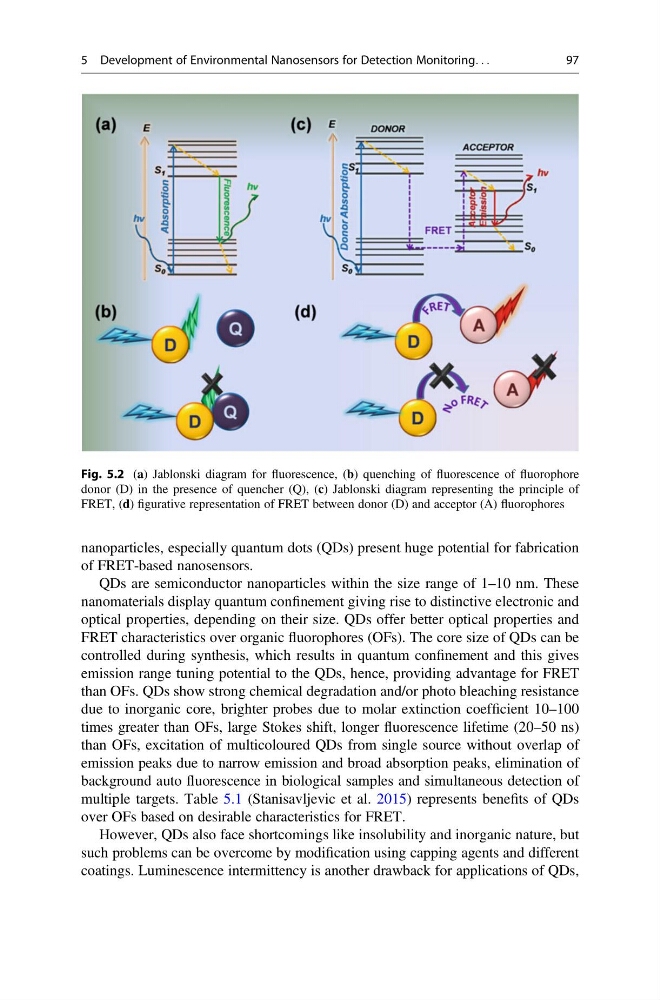
Fig. 5.2 (a) Jablonski diagram for fluorescence, (b) quenching of fluorescence of fluorophore
donor (D) in the presence of quencher (Q), (c) Jablonski diagram representing the principle of
FRET, (d) figurative representation of FRET between donor (D) and acceptor (A) fluorophores
5 Development of Environmental Nanosensors for Detection Monitoring. . .
97
of FRET-based nanosensors.
QDs are semiconductor nanoparticles within the size range of 1–10 nm. These
nanomaterials display quantum confinement giving rise to distinctive electronic and
optical properties, depending on their size. QDs offer better optical properties and
FRET characteristics over organic fluorophores (OFs). The core size of QDs can be
controlled during synthesis, which results in quantum confinement and this gives
emission range tuning potential to the QDs, hence, providing advantage for FRET
than OFs. QDs show strong chemical degradation and/or photo bleaching resistance
due to inorganic core, brighter probes due to molar extinction coefficient 10–100
times greater than OFs, large Stokes shift, longer fluorescence lifetime (20–50 ns)
than OFs, excitation of multicoloured QDs from single source without overlap of
emission peaks due to narrow emission and broad absorption peaks, elimination of
background auto fluorescence in biological samples and simultaneous detection of
multiple targets. Table 5.1 (Stanisavljevic et al. 2015) represents benefits of QDs
over OFs based on desirable characteristics for FRET.
However, QDs also face shortcomings like insolubility and inorganic nature, but
such problems can be overcome by modification using capping agents and different
coatings. Luminescence intermittency is another drawback for applications of QDs,
Fig. 5.2 (a) Jablonski diagram for fluorescence, (b) quenching of fluorescence of fluorophore
donor (D) in the presence of quencher (Q), (c) Jablonski diagram representing the principle of
FRET, (d) figurative representation of FRET between donor (D) and acceptor (A) fluorophores
5 Development of Environmental Nanosensors for Detection Monitoring. . .
97