

have been represented in Fig. 5.2a, b. For instance gold nanoparticles (AuNPs),
when brought to close proximity to fluorescein isothiocyanates (FITCs) result in the
quenching of fluorescence emitted by FITCs (Munawar et al. 2019).
Another types of fluorescence-based nanosensors are based on the phenomenon
of Föster resonance energy transfer (FRET), which involves energy transfer
between two fluorophores, one of which act as a donor and other as an acceptor.
This is the energy transfer that is non-radiative in nature and doesn’t include photon
emission but involves long range dipole–dipole interaction between the two
fluorophores. For the phenomenon of FRET to occur, the distance between the
FRET pair should be less than 10 nm and there must be more than 30% overlap
between the donor’s emission spectrum and acceptor’s absorbance spectrum
(Stanisavljevic et al. 2015; Elangovan et al. 2002). The basic principle of FRET is
shown in Fig. 5.2c, d.
The principle of FRET has been utilized for development of highly sensitive
analytical techniques in various research fields. But, the combination of nanotechnology with the principle of FRET has led to the development of FRET-based
nanosensors with improved sensor properties. Among various nanomaterials,
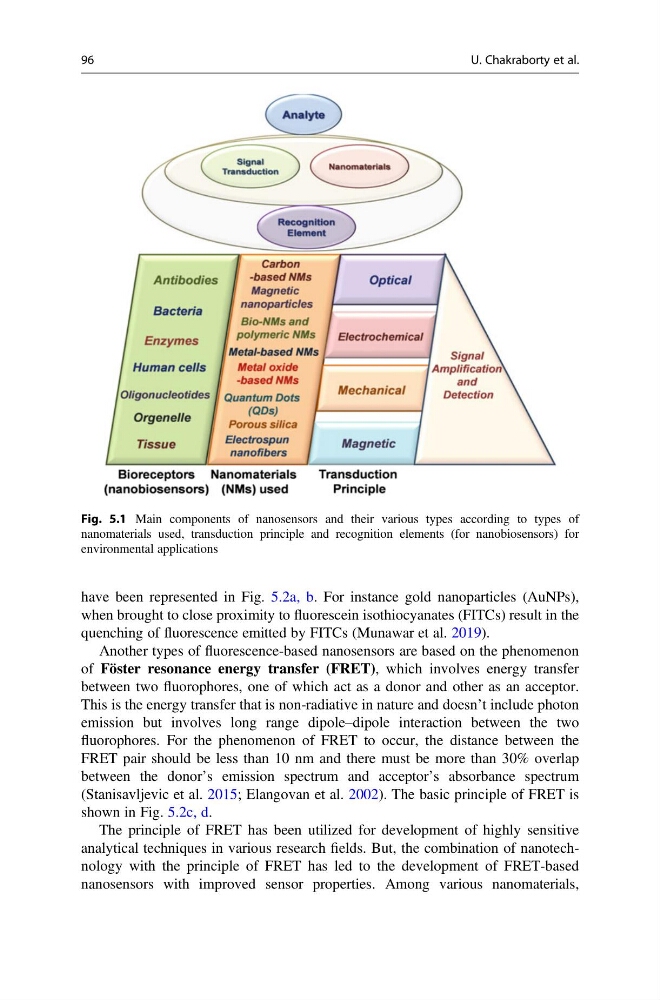
Fig. 5.1 Main components of nanosensors and their various types according to types of
nanomaterials used, transduction principle and recognition elements (for nanobiosensors) for
environmental applications
96
U. Chakraborty et al.
when brought to close proximity to fluorescein isothiocyanates (FITCs) result in the
quenching of fluorescence emitted by FITCs (Munawar et al. 2019).
Another types of fluorescence-based nanosensors are based on the phenomenon
of Föster resonance energy transfer (FRET), which involves energy transfer
between two fluorophores, one of which act as a donor and other as an acceptor.
This is the energy transfer that is non-radiative in nature and doesn’t include photon
emission but involves long range dipole–dipole interaction between the two
fluorophores. For the phenomenon of FRET to occur, the distance between the
FRET pair should be less than 10 nm and there must be more than 30% overlap
between the donor’s emission spectrum and acceptor’s absorbance spectrum
(Stanisavljevic et al. 2015; Elangovan et al. 2002). The basic principle of FRET is
shown in Fig. 5.2c, d.
The principle of FRET has been utilized for development of highly sensitive
analytical techniques in various research fields. But, the combination of nanotechnology with the principle of FRET has led to the development of FRET-based
nanosensors with improved sensor properties. Among various nanomaterials,
Fig. 5.1 Main components of nanosensors and their various types according to types of
nanomaterials used, transduction principle and recognition elements (for nanobiosensors) for
environmental applications
96
U. Chakraborty et al.