

3 Continuous Catalytic Processes with Supported Ionic Liquid …
61
110 120 130 140 150 160 170 180 190 200 210
0
10
20
30
40
50
60
70
80
90
100
CO conversion X
CO / %
Reaction temperature / ºC
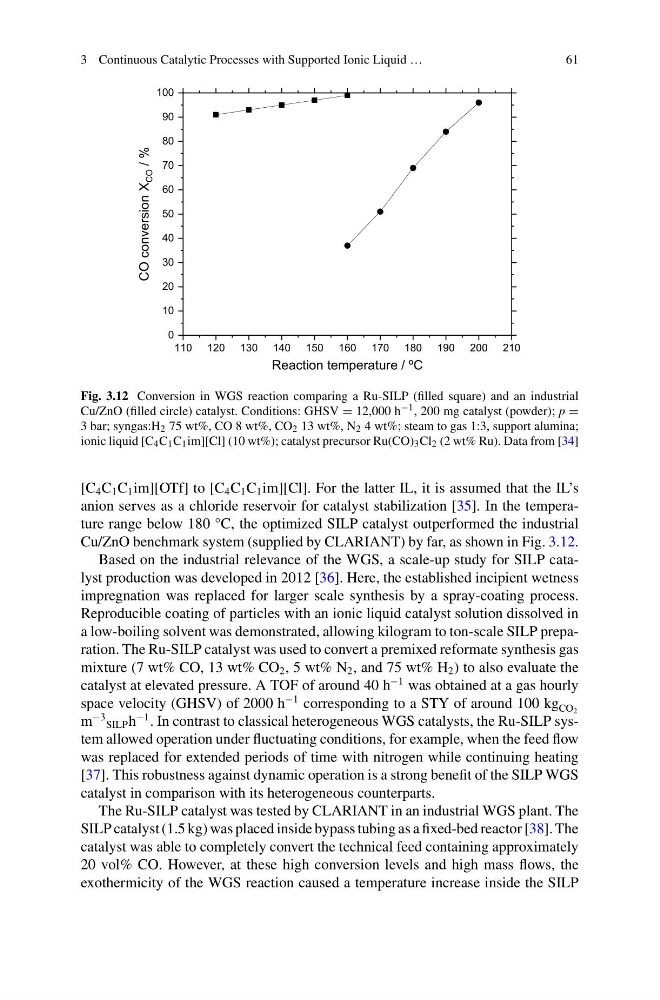
Fig. 3.12 Conversion in WGS reaction comparing a Ru-SILP (filled square) and an industrial
Cu/ZnO (filled circle) catalyst. Conditions: GHSV = 12,000 h −1 , 200 mg catalyst (powder); p =
3 bar; syngas:H 2 75 wt%, CO 8 wt%, CO 2 13 wt%, N 2 4 wt%; steam to gas 1:3, support alumina;
ionic liquid [C 4 C 1 C 1 im][Cl] (10 wt%); catalyst precursor Ru(CO) 3 Cl 2 (2 wt% Ru). Data from [34]
[C 4 C 1 C 1 im][OTf] to [C 4 C 1 C 1 im][Cl]. For the latter IL, it is assumed that the IL’s
anion serves as a chloride reservoir for catalyst stabilization [35]. In the temperature range below 180 °C, the optimized SILP catalyst outperformed the industrial
Cu/ZnO benchmark system (supplied by CLARIANT) by far, as shown in Fig. 3.12.
Based on the industrial relevance of the WGS, a scale-up study for SILP catalyst production was developed in 2012 [36]. Here, the established incipient wetness
impregnation was replaced for larger scale synthesis by a spray-coating process.
Reproducible coating of particles with an ionic liquid catalyst solution dissolved in
a low-boiling solvent was demonstrated, allowing kilogram to ton-scale SILP preparation. The Ru-SILP catalyst was used to convert a premixed reformate synthesis gas
mixture (7 wt% CO, 13 wt% CO 2 , 5 wt% N 2 , and 75 wt% H 2 ) to also evaluate the
catalyst at elevated pressure. A TOF of around 40 h
−1 was obtained at a gas hourly
space velocity (GHSV) of 2000 h
−1 corresponding to a STY of around 100 kg CO 2
m
−3
SILP h
−1 . In contrast to classical heterogeneous WGS catalysts, the Ru-SILP system allowed operation under fluctuating conditions, for example, when the feed flow
was replaced for extended periods of time with nitrogen while continuing heating
[37]. This robustness against dynamic operation is a strong benefit of the SILP WGS
catalyst in comparison with its heterogeneous counterparts.
The Ru-SILP catalyst was tested by CLARIANT in an industrial WGS plant. The
SILP catalyst (1.5 kg) was placed inside bypass tubing as a fixed-bed reactor [38]. The
catalyst was able to completely convert the technical feed containing approximately
20 vol% CO. However, at these high conversion levels and high mass flows, the
exothermicity of the WGS reaction caused a temperature increase inside the SILP
61
110 120 130 140 150 160 170 180 190 200 210
0
10
20
30
40
50
60
70
80
90
100
CO conversion X
CO / %
Reaction temperature / ºC
Fig. 3.12 Conversion in WGS reaction comparing a Ru-SILP (filled square) and an industrial
Cu/ZnO (filled circle) catalyst. Conditions: GHSV = 12,000 h −1 , 200 mg catalyst (powder); p =
3 bar; syngas:H 2 75 wt%, CO 8 wt%, CO 2 13 wt%, N 2 4 wt%; steam to gas 1:3, support alumina;
ionic liquid [C 4 C 1 C 1 im][Cl] (10 wt%); catalyst precursor Ru(CO) 3 Cl 2 (2 wt% Ru). Data from [34]
[C 4 C 1 C 1 im][OTf] to [C 4 C 1 C 1 im][Cl]. For the latter IL, it is assumed that the IL’s
anion serves as a chloride reservoir for catalyst stabilization [35]. In the temperature range below 180 °C, the optimized SILP catalyst outperformed the industrial
Cu/ZnO benchmark system (supplied by CLARIANT) by far, as shown in Fig. 3.12.
Based on the industrial relevance of the WGS, a scale-up study for SILP catalyst production was developed in 2012 [36]. Here, the established incipient wetness
impregnation was replaced for larger scale synthesis by a spray-coating process.
Reproducible coating of particles with an ionic liquid catalyst solution dissolved in
a low-boiling solvent was demonstrated, allowing kilogram to ton-scale SILP preparation. The Ru-SILP catalyst was used to convert a premixed reformate synthesis gas
mixture (7 wt% CO, 13 wt% CO 2 , 5 wt% N 2 , and 75 wt% H 2 ) to also evaluate the
catalyst at elevated pressure. A TOF of around 40 h
−1 was obtained at a gas hourly
space velocity (GHSV) of 2000 h
−1 corresponding to a STY of around 100 kg CO 2
m
−3
SILP h
−1 . In contrast to classical heterogeneous WGS catalysts, the Ru-SILP system allowed operation under fluctuating conditions, for example, when the feed flow
was replaced for extended periods of time with nitrogen while continuing heating
[37]. This robustness against dynamic operation is a strong benefit of the SILP WGS
catalyst in comparison with its heterogeneous counterparts.
The Ru-SILP catalyst was tested by CLARIANT in an industrial WGS plant. The
SILP catalyst (1.5 kg) was placed inside bypass tubing as a fixed-bed reactor [38]. The
catalyst was able to completely convert the technical feed containing approximately
20 vol% CO. However, at these high conversion levels and high mass flows, the
exothermicity of the WGS reaction caused a temperature increase inside the SILP