

60
M. Haumann
The Rh-qp complex (see Fig. 3.9), immobilized in [C 2 C 1 im][NTf 2 ] dispersed
on silica gel, was applied by the Leitner group for the asymmetric hydrogenation
of N-(1-phenylvinyl)acetamide [30]. The compound serves as model substrate for
active pharmaceutical ingredient (API) synthesis of the target molecule N-(1-(5fluoropyrimidin-2-yl)vinyl)acetamide from the portfolio of AstraZeneca. Due to the
poor miscibility of the enamides in scCO 2 , a helper solvent was added to facilitate
the dissolution in the feed. Of the investigated solvents dichloromethane, toluene,
and methanol, only toluene showed promising performance both with respect to
the formation of a homogeneous phase under scCO 2 reaction conditions as well as
preventing precipitation of the product. In a continuous scCO 2 reactor setup, the flow
and process conditions were optimized. Again, water content within the feed was
found to deactivate the SILP catalyst over time, leading to a decline of conversion
from a quantitative level to 68% after 120 h time on stream, while the selectivity
remained constant above 99%. The average STY of this process was calculated to be
21 kg m
−3 h
−1 with no Rh leaching being detected by means of ICP-OES (<1 ppm).
Similar to the previous study, careful drying of the feed resulted in improved catalyst
lifetime for more than 80 h time on stream and a cumulative turnover number (TON)
exceeding 10,000. One kilogram of the starting material N-(1-phenylvinyl)acetamide
could be converted by the scCO 2 -SILP process within 18 h time on stream. These
values would allow the scCO 2 -SILP continuous flow process to be operated in an
industrially viable scenario.
3.4 Gas-Phase Water-Gas Shift Reaction
The water-gas shift (WGS) reaction is the exothermic conversion of carbon monoxide and water to hydrogen and carbon dioxide. The reaction is of enormous industrial
importance in the conversion of carbon monoxide to additional hydrogen, for example, in the Haber–Bosch process for ammonia production or in methane reforming
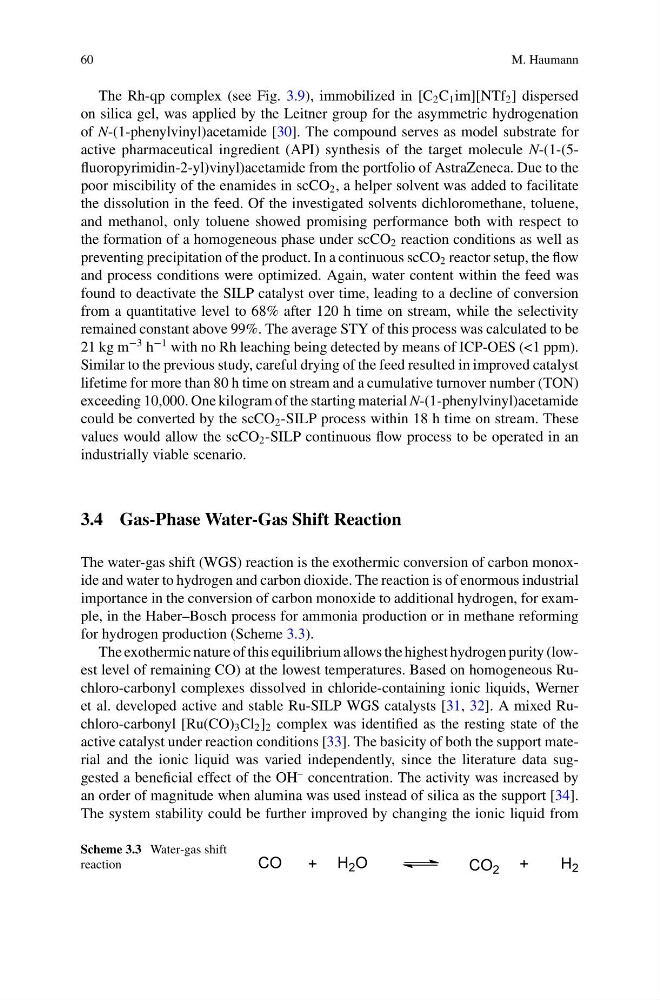
for hydrogen production (Scheme 3.3).
The exothermic nature of this equilibrium allows the highest hydrogen purity (lowest level of remaining CO) at the lowest temperatures. Based on homogeneous Ruchloro-carbonyl complexes dissolved in chloride-containing ionic liquids, Werner
et al. developed active and stable Ru-SILP WGS catalysts [31, 32]. A mixed Ruchloro-carbonyl [Ru(CO) 3 Cl 2 ] 2 complex was identified as the resting state of the
active catalyst under reaction conditions [33]. The basicity of both the support material and the ionic liquid was varied independently, since the literature data suggested a beneficial effect of the OH
– concentration. The activity was increased by
an order of magnitude when alumina was used instead of silica as the support [34].
The system stability could be further improved by changing the ionic liquid from
Scheme 3.3 Water-gas shift
reaction
M. Haumann
The Rh-qp complex (see Fig. 3.9), immobilized in [C 2 C 1 im][NTf 2 ] dispersed
on silica gel, was applied by the Leitner group for the asymmetric hydrogenation
of N-(1-phenylvinyl)acetamide [30]. The compound serves as model substrate for
active pharmaceutical ingredient (API) synthesis of the target molecule N-(1-(5fluoropyrimidin-2-yl)vinyl)acetamide from the portfolio of AstraZeneca. Due to the
poor miscibility of the enamides in scCO 2 , a helper solvent was added to facilitate
the dissolution in the feed. Of the investigated solvents dichloromethane, toluene,
and methanol, only toluene showed promising performance both with respect to
the formation of a homogeneous phase under scCO 2 reaction conditions as well as
preventing precipitation of the product. In a continuous scCO 2 reactor setup, the flow
and process conditions were optimized. Again, water content within the feed was
found to deactivate the SILP catalyst over time, leading to a decline of conversion
from a quantitative level to 68% after 120 h time on stream, while the selectivity
remained constant above 99%. The average STY of this process was calculated to be
21 kg m
−3 h
−1 with no Rh leaching being detected by means of ICP-OES (<1 ppm).
Similar to the previous study, careful drying of the feed resulted in improved catalyst
lifetime for more than 80 h time on stream and a cumulative turnover number (TON)
exceeding 10,000. One kilogram of the starting material N-(1-phenylvinyl)acetamide
could be converted by the scCO 2 -SILP process within 18 h time on stream. These
values would allow the scCO 2 -SILP continuous flow process to be operated in an
industrially viable scenario.
3.4 Gas-Phase Water-Gas Shift Reaction
The water-gas shift (WGS) reaction is the exothermic conversion of carbon monoxide and water to hydrogen and carbon dioxide. The reaction is of enormous industrial
importance in the conversion of carbon monoxide to additional hydrogen, for example, in the Haber–Bosch process for ammonia production or in methane reforming
for hydrogen production (Scheme 3.3).
The exothermic nature of this equilibrium allows the highest hydrogen purity (lowest level of remaining CO) at the lowest temperatures. Based on homogeneous Ruchloro-carbonyl complexes dissolved in chloride-containing ionic liquids, Werner
et al. developed active and stable Ru-SILP WGS catalysts [31, 32]. A mixed Ruchloro-carbonyl [Ru(CO) 3 Cl 2 ] 2 complex was identified as the resting state of the
active catalyst under reaction conditions [33]. The basicity of both the support material and the ionic liquid was varied independently, since the literature data suggested a beneficial effect of the OH
– concentration. The activity was increased by
an order of magnitude when alumina was used instead of silica as the support [34].
The system stability could be further improved by changing the ionic liquid from
Scheme 3.3 Water-gas shift
reaction