

62
M. Haumann
bed above 200 °C. This probably led to the thermal decomposition of the Ru complex
as well as the ionic liquid, resulting in irreversible catalyst deactivation. An industrial
application would have to solve this heat management issue by an appropriate reactor
design. As one possible option, LINDE, BIOENERGY2020, and academic partners
have reported the idea to use membrane reactors for SILP WGS catalysis [23].
3.5 Miscellaneous Gas-Phase Applications
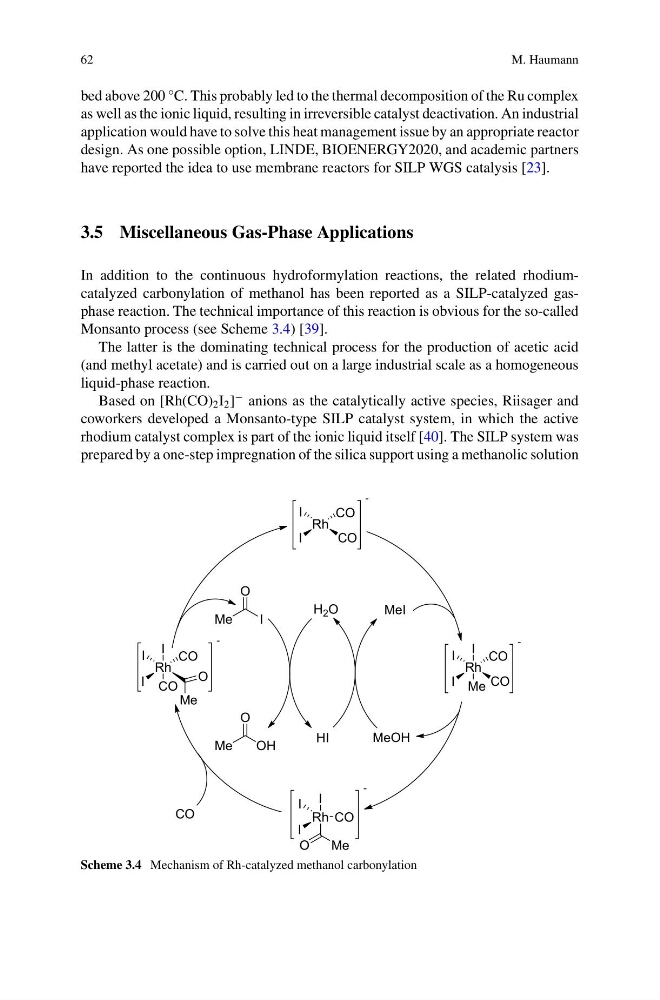
In addition to the continuous hydroformylation reactions, the related rhodiumcatalyzed carbonylation of methanol has been reported as a SILP-catalyzed gasphase reaction. The technical importance of this reaction is obvious for the so-called
Monsanto process (see Scheme 3.4) [39].
The latter is the dominating technical process for the production of acetic acid
(and methyl acetate) and is carried out on a large industrial scale as a homogeneous
liquid-phase reaction.
Based on [Rh(CO) 2 I 2 ]
− anions as the catalytically active species, Riisager and
coworkers developed a Monsanto-type SILP catalyst system, in which the active
rhodium catalyst complex is part of the ionic liquid itself [40]. The SILP system was
prepared by a one-step impregnation of the silica support using a methanolic solution
Rh
CO
I
CO
I
Rh
CO
I
CO
I
-
I
Me
Rh
I
CO
I
I
Me
O
Rh
I
CO
I
I
CO
O
Me
-
-
-
Me
I
O
Me
OH
O
MeOH
MeI
HI
H 2 O
CO
Scheme 3.4 Mechanism of Rh-catalyzed methanol carbonylation
M. Haumann
bed above 200 °C. This probably led to the thermal decomposition of the Ru complex
as well as the ionic liquid, resulting in irreversible catalyst deactivation. An industrial
application would have to solve this heat management issue by an appropriate reactor
design. As one possible option, LINDE, BIOENERGY2020, and academic partners
have reported the idea to use membrane reactors for SILP WGS catalysis [23].
3.5 Miscellaneous Gas-Phase Applications
In addition to the continuous hydroformylation reactions, the related rhodiumcatalyzed carbonylation of methanol has been reported as a SILP-catalyzed gasphase reaction. The technical importance of this reaction is obvious for the so-called
Monsanto process (see Scheme 3.4) [39].
The latter is the dominating technical process for the production of acetic acid
(and methyl acetate) and is carried out on a large industrial scale as a homogeneous
liquid-phase reaction.
Based on [Rh(CO) 2 I 2 ]
− anions as the catalytically active species, Riisager and
coworkers developed a Monsanto-type SILP catalyst system, in which the active
rhodium catalyst complex is part of the ionic liquid itself [40]. The SILP system was
prepared by a one-step impregnation of the silica support using a methanolic solution
Rh
CO
I
CO
I
Rh
CO
I
CO
I
-
I
Me
Rh
I
CO
I
I
Me
O
Rh
I
CO
I
I
CO
O
Me
-
-
-
Me
I
O
Me
OH
O
MeOH
MeI
HI
H 2 O
CO
Scheme 3.4 Mechanism of Rh-catalyzed methanol carbonylation