

54
M. Haumann
0
20
40
60
80
100
120
140
0
5
10
15
20
25
30
Time / h
Conversion of butenes / %
70
75
80
85
90
95
100
n-pentanal / %
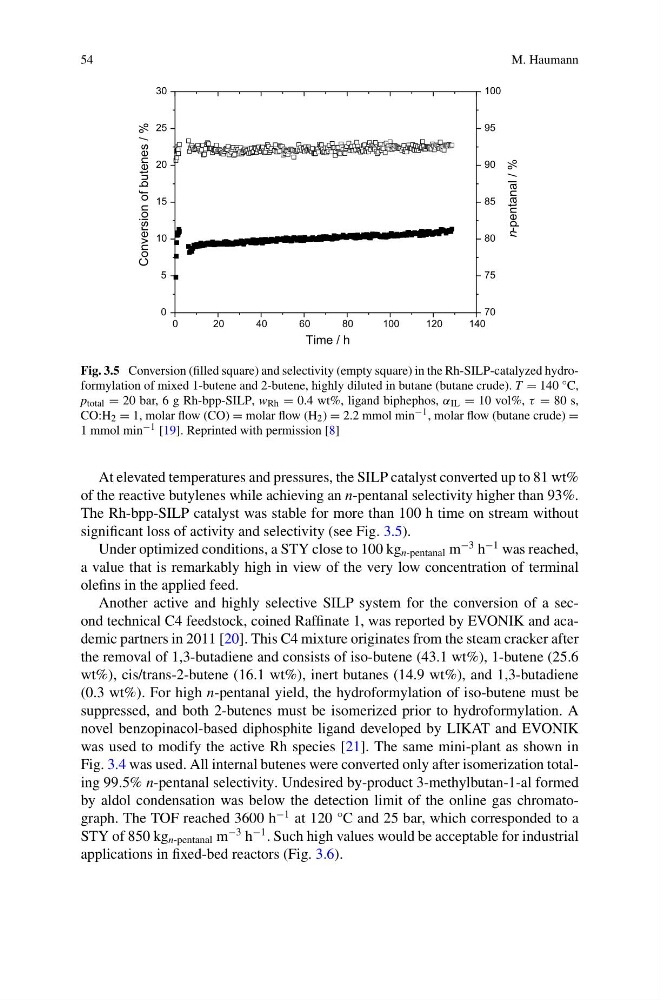
Fig. 3.5 Conversion (filled square) and selectivity (empty square) in the Rh-SILP-catalyzed hydroformylation of mixed 1-butene and 2-butene, highly diluted in butane (butane crude). T = 140 °C,
p total = 20 bar, 6 g Rh-bpp-SILP, w Rh = 0.4 wt%, ligand biphephos, α IL = 10 vol%, τ = 80 s,
CO:H 2 = 1, molar flow (CO) = molar flow (H 2 ) = 2.2 mmol min −1 , molar flow (butane crude) =
1 mmol min −1 [19]. Reprinted with permission [8]
At elevated temperatures and pressures, the SILP catalyst converted up to 81 wt%
of the reactive butylenes while achieving an n-pentanal selectivity higher than 93%.
The Rh-bpp-SILP catalyst was stable for more than 100 h time on stream without
significant loss of activity and selectivity (see Fig. 3.5).
Under optimized conditions, a STY close to 100 kg n-pentanal m
−3 h
−1 was reached,
a value that is remarkably high in view of the very low concentration of terminal
olefins in the applied feed.
Another active and highly selective SILP system for the conversion of a second technical C4 feedstock, coined Raffinate 1, was reported by EVONIK and academic partners in 2011 [20]. This C4 mixture originates from the steam cracker after
the removal of 1,3-butadiene and consists of iso-butene (43.1 wt%), 1-butene (25.6
wt%), cis/trans-2-butene (16.1 wt%), inert butanes (14.9 wt%), and 1,3-butadiene
(0.3 wt%). For high n-pentanal yield, the hydroformylation of iso-butene must be
suppressed, and both 2-butenes must be isomerized prior to hydroformylation. A
novel benzopinacol-based diphosphite ligand developed by LIKAT and EVONIK
was used to modify the active Rh species [21]. The same mini-plant as shown in
Fig. 3.4 was used. All internal butenes were converted only after isomerization totaling 99.5% n-pentanal selectivity. Undesired by-product 3-methylbutan-1-al formed
by aldol condensation was below the detection limit of the online gas chromatograph. The TOF reached 3600 h
−1 at 120 °C and 25 bar, which corresponded to a
STY of 850 kg n-pentanal m
−3 h
−1 . Such high values would be acceptable for industrial
applications in fixed-bed reactors (Fig. 3.6).
M. Haumann
0
20
40
60
80
100
120
140
0
5
10
15
20
25
30
Time / h
Conversion of butenes / %
70
75
80
85
90
95
100
n-pentanal / %
Fig. 3.5 Conversion (filled square) and selectivity (empty square) in the Rh-SILP-catalyzed hydroformylation of mixed 1-butene and 2-butene, highly diluted in butane (butane crude). T = 140 °C,
p total = 20 bar, 6 g Rh-bpp-SILP, w Rh = 0.4 wt%, ligand biphephos, α IL = 10 vol%, τ = 80 s,
CO:H 2 = 1, molar flow (CO) = molar flow (H 2 ) = 2.2 mmol min −1 , molar flow (butane crude) =
1 mmol min −1 [19]. Reprinted with permission [8]
At elevated temperatures and pressures, the SILP catalyst converted up to 81 wt%
of the reactive butylenes while achieving an n-pentanal selectivity higher than 93%.
The Rh-bpp-SILP catalyst was stable for more than 100 h time on stream without
significant loss of activity and selectivity (see Fig. 3.5).
Under optimized conditions, a STY close to 100 kg n-pentanal m
−3 h
−1 was reached,
a value that is remarkably high in view of the very low concentration of terminal
olefins in the applied feed.
Another active and highly selective SILP system for the conversion of a second technical C4 feedstock, coined Raffinate 1, was reported by EVONIK and academic partners in 2011 [20]. This C4 mixture originates from the steam cracker after
the removal of 1,3-butadiene and consists of iso-butene (43.1 wt%), 1-butene (25.6
wt%), cis/trans-2-butene (16.1 wt%), inert butanes (14.9 wt%), and 1,3-butadiene
(0.3 wt%). For high n-pentanal yield, the hydroformylation of iso-butene must be
suppressed, and both 2-butenes must be isomerized prior to hydroformylation. A
novel benzopinacol-based diphosphite ligand developed by LIKAT and EVONIK
was used to modify the active Rh species [21]. The same mini-plant as shown in
Fig. 3.4 was used. All internal butenes were converted only after isomerization totaling 99.5% n-pentanal selectivity. Undesired by-product 3-methylbutan-1-al formed
by aldol condensation was below the detection limit of the online gas chromatograph. The TOF reached 3600 h
−1 at 120 °C and 25 bar, which corresponded to a
STY of 850 kg n-pentanal m
−3 h
−1 . Such high values would be acceptable for industrial
applications in fixed-bed reactors (Fig. 3.6).